15 Minutes
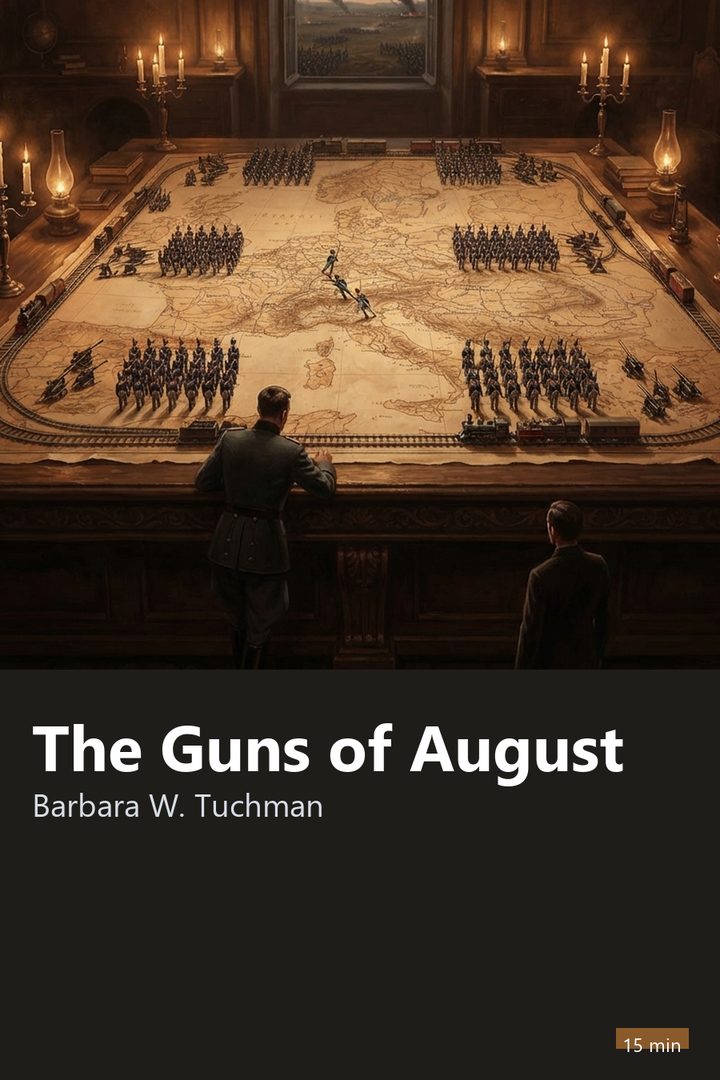
Cover of The Guns of August

History · 17 min

The Guns of August

Barbara W. Tuchman · 1962

Who it's for

For anyone who wants to understand how a whole continent of kings, generals, and diplomats walked, in just a few weeks, from a solemn funeral into a war nobody knew how to stop. It's also for those who like to see, up close, how perfect plans on paper fall apart when they meet reality.

Read it in the app

⚡ Free to download • 🎁 One full book free every day

🎧 Audio coming soon in the app

Narration for the English summaries is on its way. Meanwhile you can read the full summary in the app.

3 ideas to take with you

1

Training a generation of officers to believe that fighting spirit can replace artillery is dressing up a gamble as strategy.

2

For Tuchman, the Russian invasion in the east made Germany pull troops from the west right before the Marne, and a battle far from the spotlight weighed on the outcome of the other.

3

For historians like Christopher Clark, the right question about 1914 is not who was the one guilty party, but how several powers, together, walked toward a disaster that none of them controlled alone.

“
At Edward VII's funeral in 1910, nine kings rode together in London; four years later, their countries were at war.
An idea from The Guns of August, in the words of 15 Minutes

Preview

Start reading now

A funeral with nine kings and a world about to end

May 1910, London. King Edward VII dies, and his funeral brings together, in a single ceremony, nearly all the royalty of Europe: nine kings on horseback behind the coffin, among them Kaiser Wilhelm II, the late king's nephew. Barbara Tuchman opens the book with this scene because it sums up a world that didn't yet know its days were numbered, a Europe of royal cousins and a feeling that a major war between European powers was a thing of the past.

It's almost a screenwriter's trick: setting that procession full of certainties against the chaos that would come just four years later. Think of a family wedding, everyone in suits, smiling for the photo, with no idea that before long half of them will have a bitter fight and never speak properly again. This contrast between the pomp of 1910 and the destruction of 1914 prepares the reader for how far the fall would be behind the elegant ceremony, with old tensions of rivalry and colonies that no crown could solve alone.


Alliances that became chains: how a whole continent was dragged along

The Europe of 1914 was split into two big blocs of mutual commitment: on one side Germany and Austria-Hungary, on the other France, Russia, and Great Britain. It was like a group of friends who promise, half joking, to fight together if any one of them is disrespected at a party, except that here the promise involved entire armies, with no one agreeing on what to do if the fight got out of hand right from the start.

Add to that decades of arms racing and of general staffs planning, year after year, how each army would move on the first day of a future war, with train schedules calculated almost to the minute. The problem is that once the first country began to mobilize, stopping halfway became nearly impossible: it was a domino effect set up years earlier, just waiting for someone to touch the first piece.

The Schlieffen Plan: betting the whole war on a single move

Germany's perennial fear was fighting France in the west and Russia in the east at the same time. The solution cooked up by the general staff, named after the general who designed it, was to knock out France quickly, in about six weeks, with a wide sweep of troops through Belgium to encircle Paris, and only then turn the army against Russia, which would take longer to mobilize because of its huge territory and slower railroads.

It was a plan drawn up in the smallest detail, almost a timetable calculated to the minute, with no real margin for the unexpected. Helmuth von Moltke, chief of the German general staff in 1914, inherited the original design and tinkered with it, weakening precisely the right wing that was supposed to make the biggest encirclement, a change that would weigh heavily in the following weeks. Carrying out the plan also required moving troops through Belgium, a neutral country, a calculated risk that helped bring Great Britain into the war within the first few days.

13 more sections and the quiz

Continue in the app

Read the whole summary, finish with the The Guns of August quiz and follow the guided Journeys. No ads in the app.

About Barbara W. Tuchman

Barbara Tuchman was born in 1912 and died in 1989. She was an American historian and journalist. She had no doctorate in history and built her career as an independent author, writing works of narrative nonfiction history for a general audience, outside the traditional academic world. She won the Pulitzer Prize in 1963 for "The Guns of August," published in 1962, recognized for a narrative style that reads like a novel without giving up documentary research. She is also the author of "The Proud Tower" and "A Distant Mirror," among other books on European history.

Explore

Category:
History
Part of the Journeys:
World History