15 Minutes
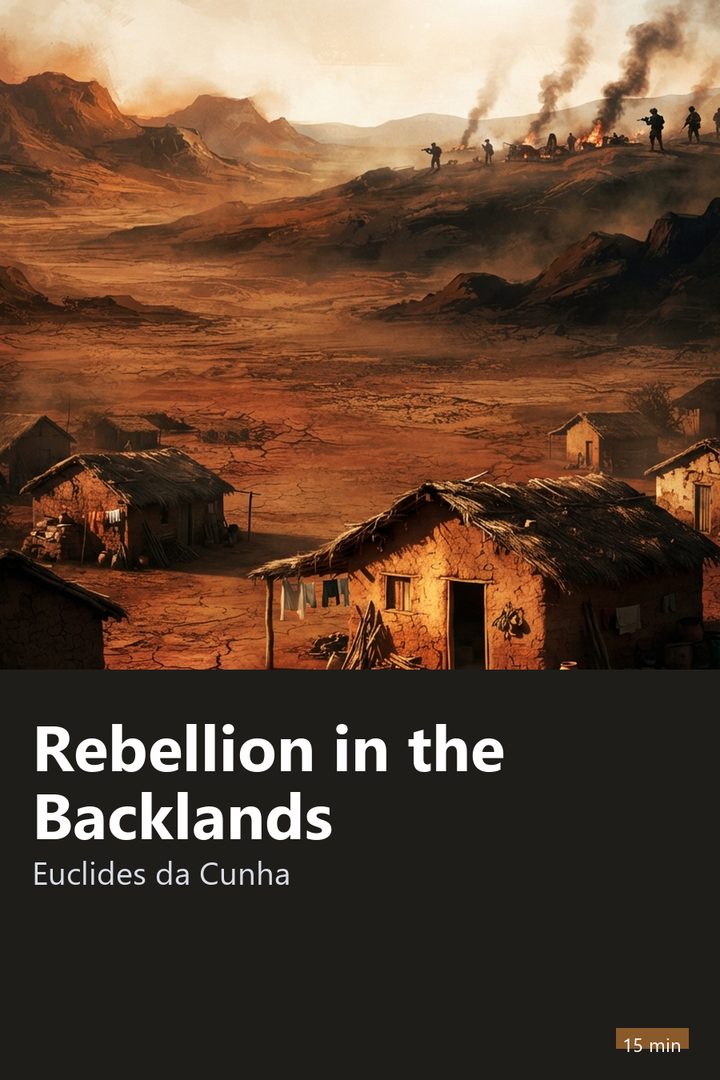
Cover of Rebellion in the Backlands

History · 17 min

Rebellion in the Backlands

Euclides da Cunha · 1902

Who it's for

Original title (Portuguese): Os Sertões: Campanha de Canudos. For readers who want to understand one of the greatest tragedies of an armed conflict fought inside a country's own borders, told by a narrator who went to the backlands of Bahia expecting to see a simple battle and came back with a book of denunciation. It also works for people who enjoy well-told history without having to memorize dates for a test.

Read it in the app

⚡ Free to download • 🎁 One full book free every day

🎧 Audio coming soon in the app

Narration for the English summaries is on its way. Meanwhile you can read the full summary in the app.

3 ideas to take with you

1

For Euclides, the geography of the Bahian backlands is not background scenery: it decides who can plant, who can move, and who can survive there.

2

According to the book, the newborn Republic saw a monarchist conspiracy in Canudos, and that fear helps explain the violence of its response.

3

The same correspondent who went to cover a military campaign considered necessary ended the book accusing the country's own Army of the scale of the damage it caused.

“
For Euclides, the same drought that nearly kills is what forges, over generations, the resilience of those who stay.
An idea from Rebellion in the Backlands, in the words of 15 Minutes

Preview

Start reading now

A correspondent who went to see a war inside his own country

In 1897 Brazil was a young republic, proclaimed less than ten years earlier and still unsure about its own form of government. In the interior of Bahia, an armed conflict between Army troops and the residents of a settlement called Canudos became national news. The newspaper O Estado de São Paulo sent Euclides da Cunha, an engineer by training, to cover the campaign as a correspondent.

Euclides arrived in the backlands expecting to describe a quick military operation against a group the press of the day treated as a threat to republican order. What he found was a long, costly, badly planned war, fought against a poor population that held out for months against a far better armed Army. That experience underpins the book he would publish five years later, in 1902.

Os Sertões is neither a novel nor an ordinary military report. It is divided into three parts, The Land, The Man, and The Struggle, which explain the war starting from the territory, then the people who lived there, and only after that the fighting: understanding the conflict meant first understanding where and with whom it was happening.
The land that decides who gets to survive there

The first part describes the Bahian backlands as a territory with its own rules: a semiarid region of low, thorny vegetation known as caatinga, crossed by rivers that dry up for much of the year. Euclides describes this territory in almost technical detail, consistent with his training as an engineer.

For anyone living far from there, it is easy to imagine the backlands as empty. The book shows the opposite: a demanding landscape, but one populated by people who learned over generations to plant at the right moment, store water, and move in search of pasture when the drought tightens. It is not empty nature, it is nature that charges a high price from anyone who doesn't know its rules, and that same idea is what the second part of the book develops, now looking at the people who live there.

The drought that turns into hunger and pushes people onto the road

The climate of the Bahian backlands has a pattern of droughts that keep coming back, sometimes for years in a row. When the drought really bites, crops weaken, cattle die, and whole families leave the land in search of food and work somewhere else. The book records this cycle as a normal part of backlands life, not as a rare accident.

In this context of recurring hunger lived much of the population that would later gather at Canudos. People who lost crops and cattle in a severe drought had few options: stay on the bad land, migrate with no sure offer of work, or follow someone who promised a new place to start over.

It's like losing your job in a small town with no other factory nearby and no new paycheck in sight, and having to choose between moving to the big city with no guarantees or accepting the first offer that comes along. The drought created that same kind of pressure, only on the scale of a crowd.

12 more sections and the quiz

Continue in the app

Read the whole summary, finish with the Rebellion in the Backlands quiz and follow the guided Journeys. No ads in the app.

About Euclides da Cunha

Euclides da Cunha was born in 1866 and died in 1909. He trained as a military engineer and worked on public works before becoming a journalist. He covered the War of Canudos in 1897 as a correspondent for the São Paulo newspaper O Estado de São Paulo, an experience that gave rise to Os Sertões, published in 1902, a book that earned him a seat in the Brazilian Academy of Letters.

Explore

Category:
History
Part of the Journeys:
Thinking Brazil