15 Minutes
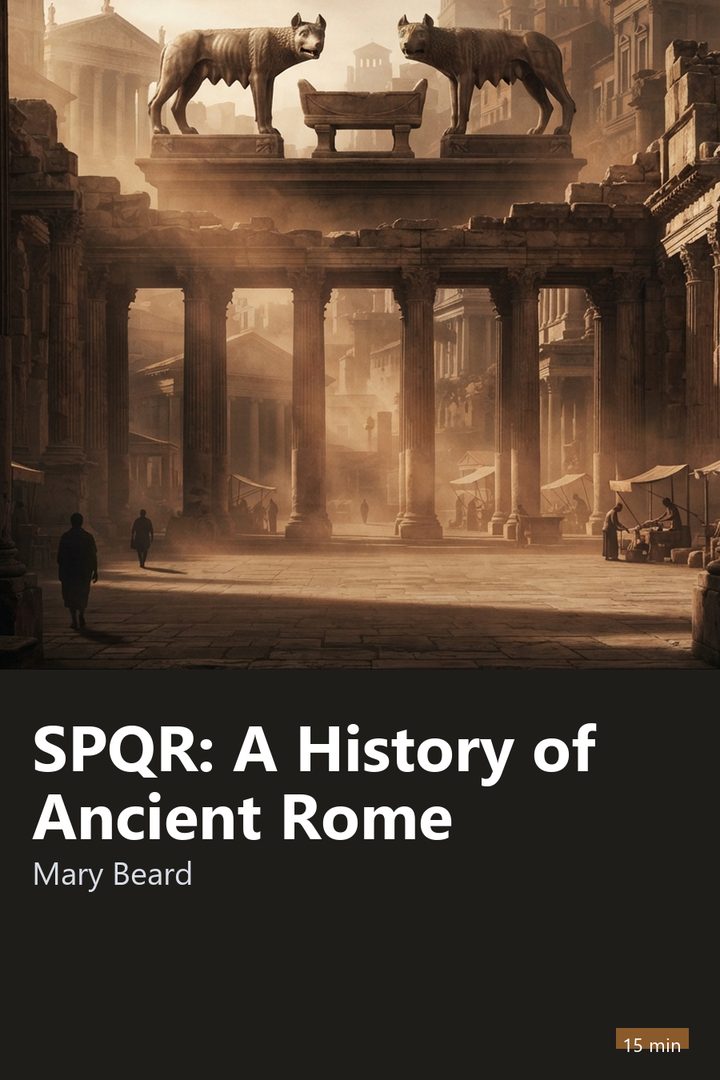
Cover of SPQR: A History of Ancient Rome

History · 17 min

SPQR: A History of Ancient Rome

Mary Beard · 2015

Who it's for

For people who love history but are tired of emperors told like movie superheroes, and who want to understand how Rome went from a village on a riverbank to the superpower that shaped even our idea of empire and citizenship.

Read it in the app

⚡ Free to download • 🎁 One full book free every day

🎧 Audio coming soon in the app

Narration for the English summaries is on its way. Meanwhile you can read the full summary in the app.

3 ideas to take with you

1

For Beard, telling its own founding story with a fratricide inside the legend was no shame for Rome: it was a way of admitting, from the very first myth, that power there would come at a high price, even between brothers.

2

Slavery held up a good part of the Roman economy, but the same system opened a door that was rare for the time: a freed slave became a citizen, and his son was born a full citizen.

3

According to the book, Roman rule over a gigantic territory depended less on soldiers in every city and more on local elites who benefited from Roman order and helped keep it going.

“
Whoever writes his own crisis in the first person usually comes out well in history, and that is exactly what Cicero did with the Catiline affair.
An idea from SPQR: A History of Ancient Rome, in the words of 15 Minutes

Preview

Start reading now

Cicero Against Catiline: The Day She Chose to Open the Book

Mary Beard does not start in 753 BC, with the founding of Rome. She opens the book in 63 BC, inside the Senate, with the consul Cicero on his feet, accusing the senator Catiline of plotting a coup against the republic. The scene shows Rome at the height of its own political machinery, with rules, rivalries, and a system of power that had already been running for five hundred years before that day.

The choice is almost a provocation: telling the story backward, starting from the moment when Rome was already the Rome we recognize, and only then going back to explain how it got there. It's like opening someone's biography on the day of their retirement, before their birth: the reader already knows the outcome, and every chapter that follows takes on a different weight.

Catiline loses, flees, dies in battle, and Cicero is hailed as father of the fatherland. But this conspiracy plants a doubt that runs through the entire book: almost everything we know about that crisis comes from the rhetoric of Cicero himself, the man who had every interest in looking like the hero of the story.

Romulus and Remus: A Founding Myth That Begins With Fratricide

Rome's best-known legend isn't pretty: twin brothers, raised by a she-wolf after being abandoned in a river, argue over where to build the city, and one kills the other. Romulus founds Rome over the body of his own brother Remus, and becomes its first king.

Beard doesn't treat this as historical fact, but as a founding myth that says a lot about how the Romans saw themselves. A people born out of a family fight who don't hide it is, in a way, warning that power there will always come at a high price, even among relatives.

It's like a family that tells, without embarrassment, the ugly story of the grandparents' split: it isn't pride in the violence, it's acknowledging that it's part of who they are. The Romans repeated this myth on coins, statues, and in school, never trying to soften the ending.

The Rape of the Sabine Women: An Uncomfortable Myth, Told Without a Filter

Another founding legend: without enough women to form families, the first Romans invite their Sabine neighbors to a festival and abduct their daughters. It's a story of violence against women, treated for centuries as an almost heroic episode in the founding of the city.

Beard calls attention to how this myth was used: less to celebrate the abduction itself, and more to show the Sabine women later throwing themselves between the two armies, begging for peace between fathers and husbands. In other words, the role of women in Rome's official story is born tied to reconciling men at war, not to deciding for themselves.

Telling this myth without cutting the uncomfortable part is an editorial choice: the book doesn't treat ancient legend as cute stuff for kids, but as a clue to how that society saw violence, gender, and power from the first chapter of its own history.

12 more sections and the quiz

Continue in the app

Read the whole summary, finish with the SPQR: A History of Ancient Rome quiz and follow the guided Journeys. No ads in the app.

About Mary Beard

Mary Beard is a British historian and classicist, a professor of Classics at the University of Cambridge and a fellow of Newnham College. A longtime columnist for the Times Literary Supplement, she has also presented documentaries about the ancient world for the BBC. In 2018 she was made a Dame Commander of the Order of the British Empire for services to classical scholarship.

Explore

Category:
History
Part of the Journeys:
World History