15 Minutes
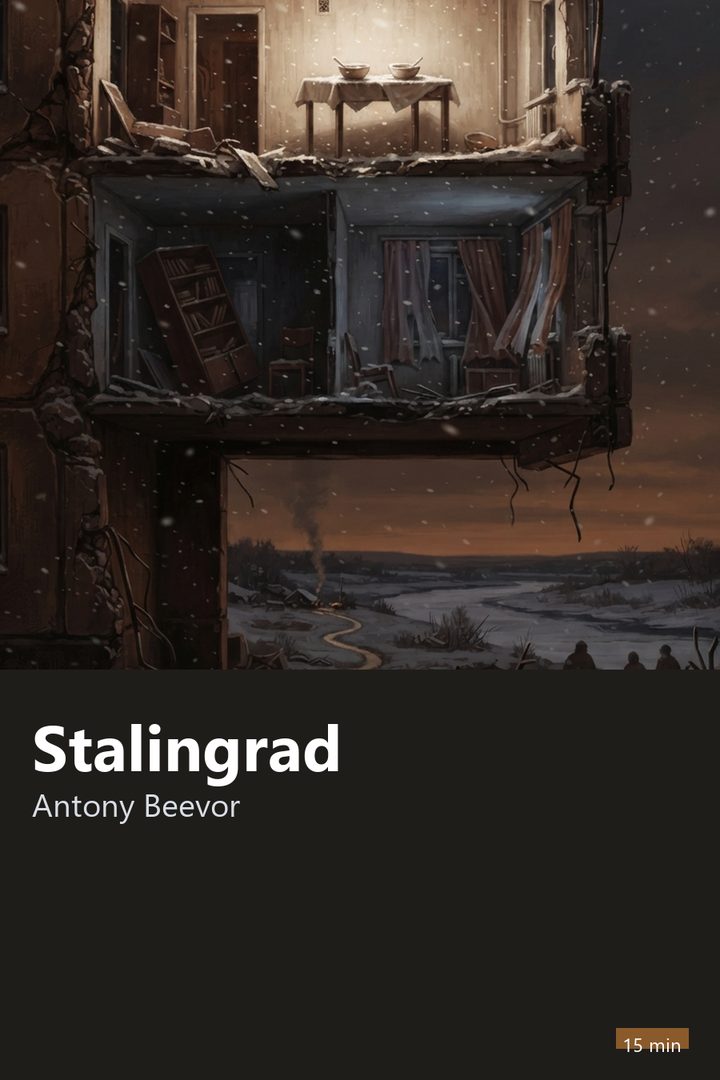
Cover of Stalingrad

History · 16 min

Stalingrad

Antony Beevor · 1998

Who it's for

For readers who want to understand, beyond the dates and the arrows on the map, what really happened to ordinary soldiers and civilians inside the deadliest encirclement of World War II. A summary for people who like military history told with names, numbers and consequences.

Read it in the app

⚡ Free to download • 🎁 One full book free every day

🎧 Audio coming soon in the app

Narration for the English summaries is on its way. Meanwhile you can read the full summary in the app.

3 ideas to take with you

1

The rat war, when the fighting moved into hallways and basements, erased the advantage of tanks and artillery and shrank the distance between enemies to a few feet of wall.

2

According to the book, one order made far from the encirclement, by someone who never felt the hunger or the cold of the men trapped inside, was enough to seal the fate of an entire army.

3

Surrendering did not end the suffering of the trapped soldiers. It only traded the battlefield for the march to captivity and the years of forced labor that followed.

“
For Beevor, it was the name of the city, tied to Stalin, that turned a secondary objective into a priority capable of moving entire armies on both sides.
An idea from Stalingrad, in the words of 15 Minutes

Preview

Start reading now

From Barbarossa to the Banks of the Volga

In June 1941, Germany invaded the Soviet Union in an offensive called Barbarossa, advancing hundreds of miles in just a few weeks. The advance stalled on the outskirts of Moscow the following winter, when the cold and Soviet resistance halted what was supposed to be a quick victory.

In the summer of 1942, Hitler tried to reverse the failure with a new offensive, code-named Case Blue, aimed at the oil fields of the Caucasus. Midway through the plan, he split his forces in two: one headed for the oil, while the other moved to protect the flank in the direction of a city on the banks of the Volga River.

This split scattered German troops across an enormous stretch of steppe, with supply lines growing longer and more vulnerable. It was in this context of overreach that the German 6th Army was ordered to take the city that gives this summary its name.

To defend such a stretched-out advance, the German command placed Romanian, Hungarian and Italian troops on the sides of the line, less well equipped and with fewer armored vehicles than the German divisions. This choice, made because there were no spare German soldiers, would weigh heavily in the months to come.
Why the City's Name Became an Obsession

From a purely military standpoint, the city did not need to be conquered street by street: it was enough to isolate its factories and cut the traffic on the river. But it carried Stalin's name, and that changed the calculation on both sides.

For Beevor, it was this symbolic weight, taking the city that bore the Soviet leader's name, that turned a secondary objective into a national priority. Hitler wanted a propaganda victory; Stalin could not allow a defeat that carried his own name.

The result was an entire army committed to winning a city yard by yard that, strategically, was worth far less than the blood spent on it. The obsession with the symbol outweighed cold military calculation.

The 6th Army Reaches the Volga

In September 1942, General Friedrich Paulus and his 6th Army entered the city with the confidence of men who had already crushed other Soviet defenses that summer. Within days, much of the urban center was under German control.

The illusion of a quick victory did not last. A few hundred yards from the Volga, the German advance stalled against a Soviet defense that refused to fall back, even when surrounded, even when outnumbered along much of the line.

It was the start of a phase of the war very different from the blitzkrieg the Germans had mastered: tanks and artillery lost their value among ruins, rubble and basements, where the distance between two trenches was sometimes no more than a wall.

13 more sections and the quiz

Continue in the app

Read the whole summary, finish with the Stalingrad quiz and follow the guided Journeys. No ads in the app.

About Antony Beevor

Antony Beevor, born in 1946, is a British military historian and former army officer who trained at the Royal Military Academy Sandhurst. After leaving the armed forces, he devoted himself to researching and writing about World War II, drawing on Soviet archives that only opened to the public after the end of the Soviet Union in the early 1990s, as well as letters and diaries from soldiers on both sides of the front. Stalingrad, published in 1998, established his name as one of the leading popular historians of the period, and after it Beevor wrote other books about the same conflict, including Berlin: The Downfall 1945 and D-Day.

Explore

Category:
History
Part of the Journeys:
World History