15 Minutes
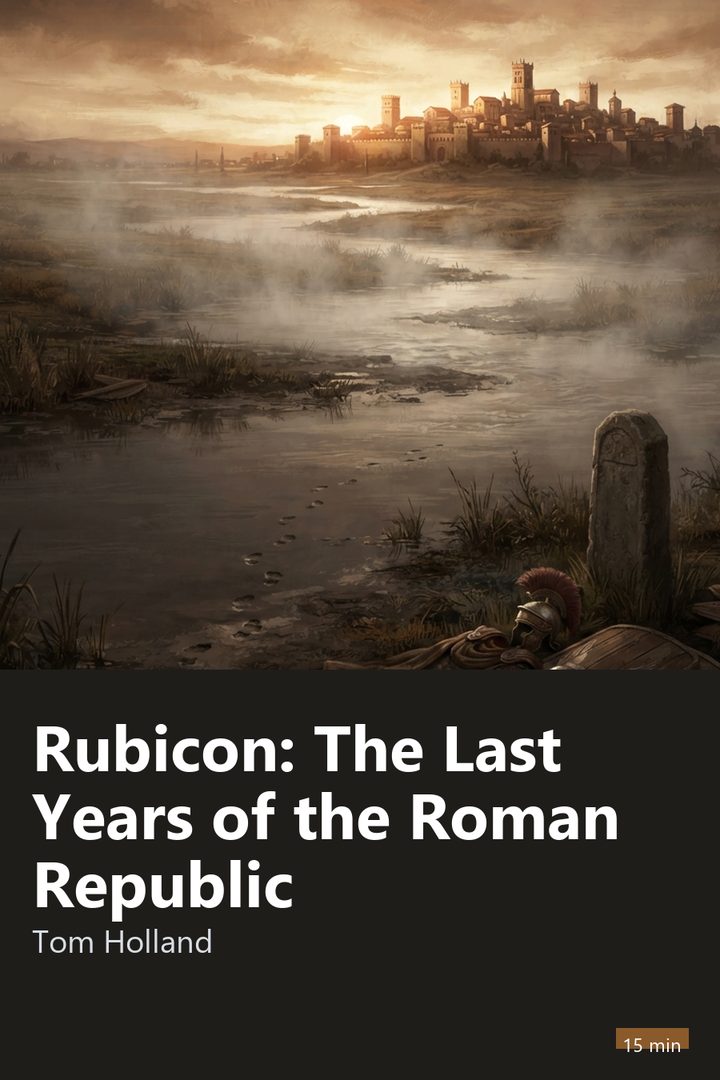
Cover of Rubicon: The Last Years of the Roman Republic

History · 17 min

Rubicon: The Last Years of the Roman Republic

Tom Holland · 2003

Who it's for

For anyone who likes history told as drama, full of ambition, rivalry and war, and wants to understand how a republic of nearly 500 years collapsed at the hands of the very elite that swore to protect it. It works just as well for people who have read about Rome before as for those who have never opened an ancient history book, because the text explains every term and every office as it comes up.

Read it in the app

⚡ Free to download • 🎁 One full book free every day

🎧 Audio coming soon in the app

Narration for the English summaries is on its way. Meanwhile you can read the full summary in the app.

3 ideas to take with you

1

A system of offices built to limit power only works as long as the competitors agree to wait their turn.

2

When the loyalty of the people carrying the weapons turns toward the commander instead of the institution, the risk of a coup stops being a distant hypothesis.

3

In Crassus's Rome, enough fortune bought as much political influence as a military victory, just without the parade or the public glory.

“
For much of the Roman elite, money alone was never the final goal: what really mattered was the name carved on a statue and remembered after death.
An idea from Rubicon: The Last Years of the Roman Republic, in the words of 15 Minutes

Preview

Start reading now

A general crosses a small river

January of 49 BC, northern Italy. General Julius Caesar stands on the bank of a stream called the Rubicon. Roman law forbade any general from entering Italy at the head of an army: anyone who crossed that river under arms automatically became an enemy of the state. Caesar knew that. He crossed anyway.

It was not sudden madness. It was the result of decades of rivalry among powerful Romans, each convinced he deserved more glory and higher office than his opponent. Tom Holland uses this crossing as the doorway into the story of how the Roman Republic, after almost 500 years, reached this point of no return.

The question that guides the whole book is simple to state: how did a system created to keep one man from ruling Rome end up destroyed by the ambition of men who, each in his own way, swore they were saving the Republic itself?
A city that swore never to have a king again

Rome was ruled by kings until 509 BC, when the last of them, accused of abuse of power, was driven out. From then on, the Romans built a system to keep any single man from gathering that much power again: two consuls in place of one king, elected for just one year, each able to veto the other.

Calling an ambitious citizen a king was the worst insult you could throw at him, even when he was acting, in practice, almost like one. That contradiction is what the book explores: a society obsessed with preventing one-man power, which created among its elites a competition so violent that it made that concentration of power almost inevitable.

Glory was the paycheck every rich Roman really wanted

For a Roman aristocrat, money alone was not enough. What truly mattered was glory: being remembered, parading in a triumph through the streets of Rome after a military victory. In the homes of the most traditional patrician families, wax masks of their ancestors' faces were kept, the so-called imagines, displayed at funerals to remind everyone how many consuls that family had given Rome.

Growing up in a family like that meant carrying, from childhood, the weight of matching or surpassing what your ancestors had done. A Roman who reached forty without having been consul felt like a failure, even if rich, because what really counted was the office and the statue in the square, not the balance in the bank.

12 more sections and the quiz

Continue in the app

Read the whole summary, finish with the Rubicon: The Last Years of the Roman Republic quiz and follow the guided Journeys. No ads in the app.

About Tom Holland

Tom Holland is a British historian and writer, known for writing ancient history in a narrative, almost literary style, without giving up research in original sources. Besides Rubicon, he is the author of Persian Fire, about the wars between Greeks and Persians, and of Dominion, about the influence of Christianity on the shaping of the Western world. He has also translated works by classical authors and, alongside historian Dominic Sandbrook, hosts the history podcast The Rest Is History.

Explore

Category:
History
Part of the Journeys:
World History