15 Minutes
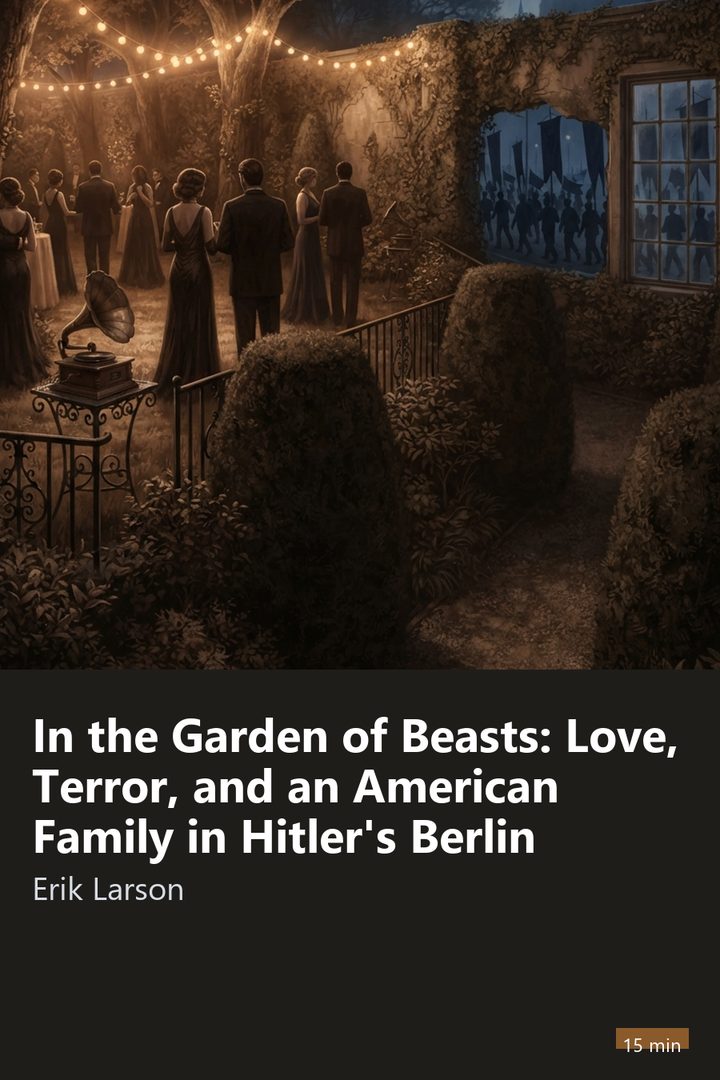
Cover of In the Garden of Beasts: Love, Terror, and an American Family in Hitler's Berlin

History · 17 min

In the Garden of Beasts: Love, Terror, and an American Family in Hitler's Berlin

Erik Larson · 2011

Who it's for

For readers who like history told as a gripping narrative, with the feel of a novel and plenty of tension, but who want to truly understand how Nazism grew inside the everyday lives of ordinary people, including well-informed foreigners who were slow to recognize the danger.

Read it in the app

⚡ Free to download • 🎁 One full book free every day

🎧 Audio coming soon in the app

Narration for the English summaries is on its way. Meanwhile you can read the full summary in the app.

3 ideas to take with you

1

A warning report only protects someone if the person receiving it is willing to read it as seriously as the person who wrote it.

2

When a whole society is changing bit by bit, someone who just arrived from outside often sees the before and after more clearly than those who lived through the transition from within.

3

Closeness to power informs, but it also traps: anyone who depends on a contact tied to the regime loses some of the freedom to judge that regime clearly.

“
Accepting an uncomfortable job for a small, personal reason can, without anyone planning it, put someone at the exact center of history.
An idea from In the Garden of Beasts: Love, Terror, and an American Family in Hitler's Berlin, in the words of 15 Minutes

Preview

Start reading now

A history professor who didn't want to be an ambassador

In 1933, Franklin Roosevelt needed someone to fill the post of U.S. ambassador to Germany, and almost nobody wanted the job. Several heavyweight names turned the offer down, afraid of what Hitler's rise might mean for anyone's career. That is how the choice fell on William Dodd, a history professor at the University of Chicago, a specialist in the American South with no experience at all in high-level diplomacy.

Dodd accepted for a practical reason: he needed time and a steady salary to finish a big book on American history that he had been writing for years. Berlin, he figured, would be a quiet post, almost a retreat paid for by the government. He had no idea how much he was about to witness.

Unlike career diplomats, he brought the habits of a public school teacher: thrift in daily life, distrust of expensive parties, a taste for solitary work. That simple style, which at first seemed out of place in an embassy, also ended up giving him a rawer view of what was happening around him.

The family arrives in a Berlin in transformation

Dodd's wife, his son, and his daughter Martha sailed with him to Germany in the very year Hitler became chancellor. The city that received them mixed two moods at once: a capital that seemed to have come out of the economic crisis, with clean streets and trains on time, and a capital full of flags, parades, and uniformed men on nearly every corner.

In the first months, most foreigners in Berlin saw only the first half of the picture. Full hotels, music in the cafés, a sense of order after years of inflation and unemployment. It was easy, for anyone not paying attention to the details, to think Germany was simply recovering.

But the details were there, and they grew fast: posters calling for a boycott of Jewish-owned shops, arrests without trial, people vanishing for days after saying the wrong thing in a bar. The Dodd family arrived right in the middle of this transition, with enough time to watch the city change its face year after year.

The garden that gives the book its name

The book's title comes from the Tiergarten, the great park in the center of Berlin, near the house where the Dodds went to live. Centuries earlier, the place had been a hunting reserve of the Prussian royals, a literal garden full of animals let loose for the amusement of the nobles. In the Dodd family's day, it was already a public park, with trails, horses, and Sunday strolls.

Erik Larson uses the name with a double meaning. On one side, the real park, where the family went riding and talking among the trees, a breather inside the tense city. On the other, a metaphor for all of Berlin: a garden beautiful on the outside, walled in, where the beasts of the new regime moved ever more freely.

That image carries the tone of the whole book: behind the greenery, the music bands, and the impeccable manners in the salons, a machinery of surveillance and violence was growing day after day, almost always out of sight of those who only strolled the avenues.

11 more sections and the quiz

Continue in the app

Read the whole summary, finish with the In the Garden of Beasts: Love, Terror, and an American Family in Hitler's Berlin quiz and follow the guided Journeys. No ads in the app.

About Erik Larson

Erik Larson is an American journalist and writer of narrative nonfiction, author of The Devil in the White City. He worked as a journalist before devoting himself full time to books that blend rigorous historical research with the pace of a novel. Besides In the Garden of Beasts, he has written other works of history told in narrative form, always built from period documents, letters, and archives.

Explore

Category:
History
Part of the Journeys:
Witnesses to History