15 Minutes
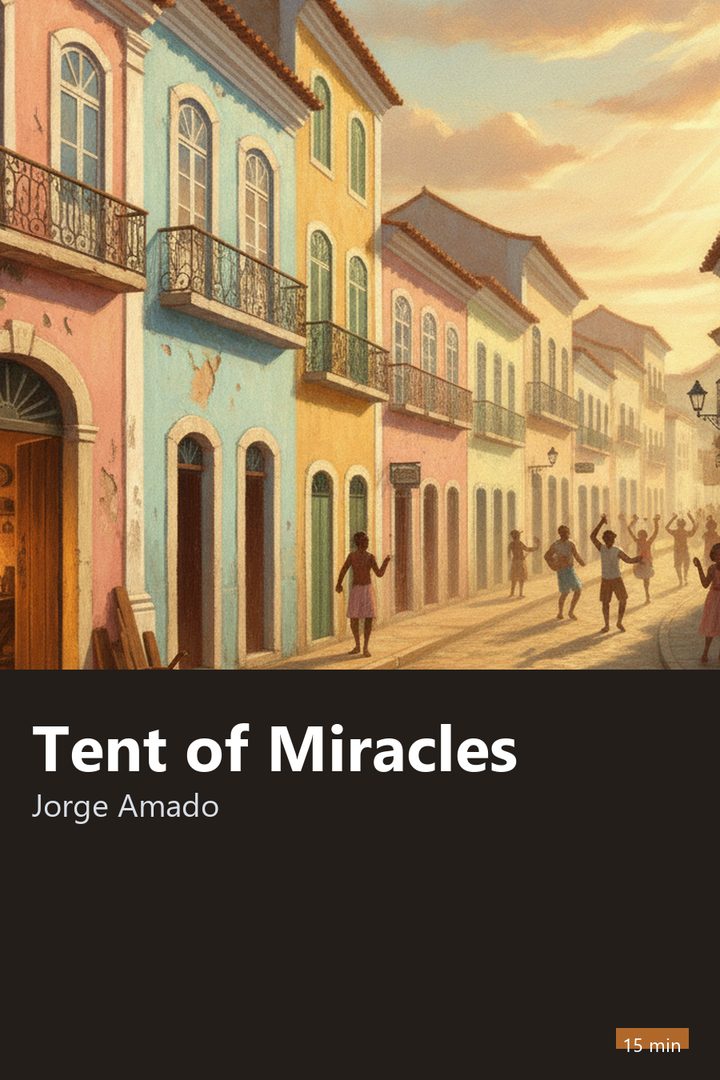
Cover of Tent of Miracles

Fiction · 15 min

Tent of Miracles

Jorge Amado · 1969

Who it's for

For readers who know Jorge Amado only as the author of cheerful stories from Bahia and want to understand the book in which he takes on Brazilian racism head-on, and for people who like to debate identity, religion, and science without a ready-made recipe.

Read it in the app

⚡ Free to download • 🎁 One full book free every day

🎧 Audio coming soon in the app

Narration for the English summaries is on its way. Meanwhile you can read the full summary in the app.

3 ideas to take with you

1

Calling someone else's religion folklore is a polite way of saying it doesn't count as a religion.

2

A book that defends a just cause can also age: you can sign off on its thesis and still see what it left out.

3

Celebrating the mixing of peoples as national pride can, without meaning to, become an excuse for not looking at the inequality that is still standing.

“
Racism with a diploma on the wall always did more damage than racism shouted on the corner, because it came looking like truth.
An idea from Tent of Miracles, in the words of 15 Minutes

Preview

Start reading now

A novel written to defend a thesis

Published in 1969, Tent of Miracles is the book in which Jorge Amado turns fiction into argument. He wants to prove, inside a story, that the mixing of peoples that shaped Bahia is neither a flaw nor a disease, but the most original heritage this country has produced.

At the center is Pedro Archanjo, a poor Black man from Salvador, a beadle at the School of Medicine, a self-taught scholar who studies and writes about his own people. Around him, the author builds a portrait of a prejudice that wore a lab coat, held a university chair, and spoke in the name of science.

This summary does not retell the plot chapter by chapter, nor does it try to replace reading the novel, which is still protected by copyright. What follows is context, discussion, and ideas, because the value of the work lies less in what happens to each character and more in what it claims about the country.

Salvador in the early twentieth century, the real setting

The city in the book is not a complete invention. In the early decades of the twentieth century, Salvador was a capital with a mostly Black and mixed-race population, run by a small white elite that controlled politics, the press, the police, and the university.

Steep streets, markets, workshops, capoeira circles, street festivals, and candomblé houses made up an intense cultural life that was, at the same time, persecuted. Playing the wrong drum, playing the wrong game, or worshipping the wrong saint could land you in jail, and for a long time it really did.

This detail is decisive for understanding the book. The central conflict is not a shouting match of opinions between two intellectuals, it is a struggle between those who had the power to define what counted as a crime and those whose own culture was criminalized.

It is worth remembering that the Bahia of that time already had newspapers, streetcars, a busy port, and an old university. It was not a rural backdrop frozen in time, it was a big city, modern by the standards of the day, and still capable of jailing people over a drum and a dance.

The racist science that ruled the universities

In the late nineteenth and early twentieth centuries, much of the Brazilian academic elite believed in theories now discarded: that superior and inferior races existed, that mixing between them produced degeneration, and that medicine could measure this in skulls, bodies, and behavior.

These ideas arrived from Europe, with authors like Gobineau and Lombroso, and fell on fertile ground in a country just out of slavery, one looking for a respectable justification to keep standing the hierarchy that the law had just knocked down on paper.

The Bahia School of Medicine was one of the centers of this output. Afro-Brazilian religions were studied as symptoms of mental backwardness, and eugenics, the project of improving the population by choosing who could have children, had defenders in neckties, with guaranteed space in the newspapers of the time.

None of this was the eccentricity of a handful of cranks. It was the content of theses, lectures, and police reports, and many decisions about who to arrest, who to commit, and who to hire came out of this frame, one that any biology student today can explain is wrong.

12 more sections and the quiz

Continue in the app

Read the whole summary, finish with the Tent of Miracles quiz and follow the guided Journeys. No ads in the app.

About Jorge Amado

Jorge Amado (1912-2001) was born on a cocoa farm in southern Bahia and published his first novel while still a teenager, eventually becoming one of the most translated Brazilian writers of all time. A Communist activist, he was arrested, had his books burned in a public square, and lived for years in exile before being elected to Congress in 1946. Starting in the 1950s he swapped the novel of direct denunciation for stories of humor, celebration, and sensuality set in Salvador, a formula that won him readers around the world and also his harshest critics. He joined the Brazilian Academy of Letters in 1961 and spent the rest of his life between Bahia and Europe, with his work adapted countless times for film, theater, and television.

Explore

Category:
Fiction
Part of the Journeys:
Classics and Stories