15 Minutes
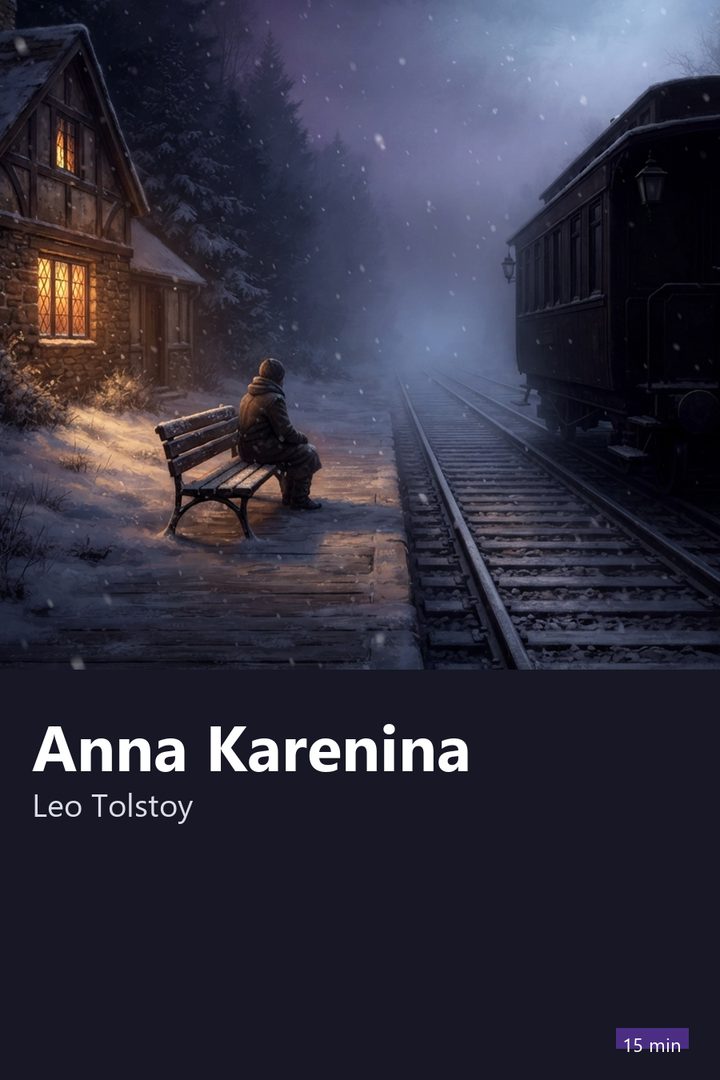
Cover of Anna Karenina

Fiction · 16 min

Anna Karenina

Leo Tolstoy · 1878

Who it's for

For readers who love a forbidden love story with an ending that hurts, but who also want to watch up close a marriage that works out in fits and starts, with no magic ending. It is also for anyone who has heard of Anna Karenina and never had the nerve to take on a thick Russian classic.

Read it in the app

⚡ Free to download • 🎁 One full book free every day

🎧 Audio coming soon in the app

Narration for the English summaries is on its way. Meanwhile you can read the full summary in the app.

3 ideas to take with you

1

For Karenin, marriage works like a government post: following protocol matters more than truly responding to what his wife feels.

2

In the novel, Vronsky keeps moving through the same drawing rooms that shut the door on Anna, even though the two of them shared the same affair.

3

According to the book, Levin finds more peace in a morning of work in the fields, scythe in hand beside the peasants, than in an elegant Moscow drawing room.

“
In the novel, Anna and Vronsky's meeting at the station happens beside a railway worker run over and killed, an omen that only makes sense to the reader in the book's final scene.
An idea from Anna Karenina, in the words of 15 Minutes

Preview

Start reading now

Moscow, a train, and a family on the verge of shipwreck

The story begins with the Oblonsky house turned upside down: Stiva, Anna's brother, was caught by his wife Dolly cheating with the children's governess. The house lives through days of tension, with the children feeling the mood without understanding why and the servants avoiding the hallway where Dolly cries alone.

Anna Karenina travels from Petersburg to Moscow at her brother's request, determined to reconcile the couple. She arrives serene, the kind of woman who walks into a room and sorts out other people's emotional mess just by talking calmly. No one there imagines that the same Anna who fixes her brother's marriage is about to set her own on fire.

Dolly gives in and agrees to stay married, swallowing her hurt because of the children and the lack of any practical alternative for a woman of that era. The book makes it clear in this very first chapter that forgiving in the name of the family has a price, and each character pays theirs in a different way throughout the story.
The station, Vronsky, and the dead railway worker

At the station where Anna steps off the train in Moscow, she meets the eyes of Count Vronsky for the first time, a young, rich officer known for collecting admirers without committing to any of them. The attraction between them is immediate, the kind both feel but pretend not to notice.

On the same platform, a railway worker is run over and killed in front of everyone. Vronsky, in a gesture of public generosity, donates money to the man's widow. Anna witnesses the scene and remarks, uneasy, that it seems like a bad omen for the day. Right there, on the first page of their meeting, the book plants the image that will close the whole story: a body and a train.

It is a device Tolstoy uses without hurry: the reader forgets the station scene for hundreds of pages, busy with balls and dinners, until it comes back with full force at the end.

The ball where Kitty loses and Anna doesn't even notice she won

Before the ball, young Kitty Shcherbatskaya turns down a marriage proposal from the landowner Konstantin Levin, a longtime friend of the family, whom she admires but does not love the way she thinks is necessary. Kitty bets everything on a proposal she expects to receive from Vronsky that same season.

At the ball, though, Vronsky spends the whole night beside Anna, not Kitty. The whole room reads the scene: an interested man making it publicly clear whom he is captivated by. Kitty leaves humiliated, sick with shame and disillusionment, not yet understanding that her rival hadn't even noticed, that night, the damage she caused.

Anna goes back to Petersburg uneasy about her own behavior, for having, without planning to, stolen the attention of a suitor who was never hers. She tries to convince herself that nothing has changed, but the book already shows her feeling the ground shake for the first time in years.

12 more sections and the quiz

Continue in the app

Read the whole summary, finish with the Anna Karenina quiz and follow the guided Journeys. No ads in the app.

About Leo Tolstoy

Leo Tolstoy was born in 1828 on the family estate, Yasnaya Polyana, in Russia, and died in 1910. He published Anna Karenina in serial form between 1875 and 1877, collected later in book form, years after War and Peace had already established his name as one of the greatest novelists of the 19th century. In old age, he gave up a good part of the family fortune and began publicly defending pacifism and a simple life, a stance that decades later influenced thinkers such as Gandhi. Tolstoy also ran his own rural estate for years, an experience that shows up directly in the pages devoted to Levin in the book.

Explore

Category:
Fiction
Part of the Journeys:
The Great Novels