15 Minutes
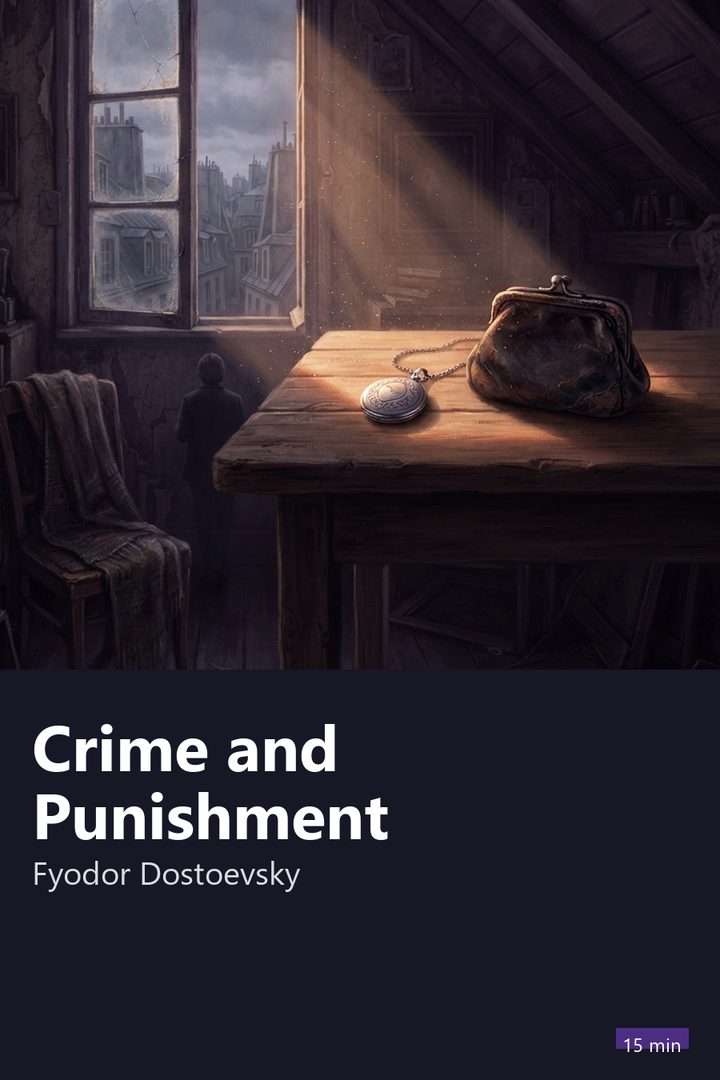
Cover of Crime and Punishment

Fiction · 17 min

Crime and Punishment

Fyodor Dostoevsky · 1866

Who it's for

For anyone who wants to understand why a beautiful theory on paper falls apart the moment it becomes an act, and how guilt collects its debt even when reason swears it owes nothing to anybody. It's also for people who like a story that mixes crime-thriller suspense with a heavy philosophical question, without having to memorize character names to keep up.

Read it in the app

⚡ Free to download • 🎁 One full book free every day

🎧 Audio coming soon in the app

Narration for the English summaries is on its way. Meanwhile you can read the full summary in the app.

3 ideas to take with you

1

For Raskolnikov, the theory of the extraordinary man worked like a new outfit for an old desperation to escape poverty.

2

Sonya and Raskolnikov each crossed, in their own way, a line that society considers unforgivable, but one did it to support a family and the other to prove a thesis.

3

Porfiry Petrovich solved the case without presenting a single piece of concrete evidence, just letting Raskolnikov's guilt do the work from the inside out.

“
Raskolnikov's body collapsed into fever before his conscience admitted any guilt out loud.
An idea from Crime and Punishment, in the words of 15 Minutes

Preview

Start reading now

St. Petersburg, July heat, and a broke student

Forget the image of snow and heavy coats: Crime and Punishment takes place in a suffocating St. Petersburg summer, with heat sticking to your clothes and the smell of sewage in the alleys. In that atmosphere lives Rodion Raskolnikov, a former law student who dropped out because he couldn't pay tuition or rent on the tiny room where he lives, so small that he compares it to a closet.

He owes money to his landlady, avoids running into her on the stairs, barely eats, and stays locked up with his own thoughts. It isn't laziness: it's the kind of poverty that eats away at you slowly, the same kind that pushes capable people out of the job market for lack of a support network.

To get by, he had been pawning the few valuables he owned at the shop of a local loan shark, Alyona Ivanovna, who charged heavy interest and treated every customer with contempt. It's this cycle of humiliation and financial squeeze that plants the seed of what comes next.
The theory of the man who can rise above the law

Months earlier, Raskolnikov published an article defending a dangerous idea: humanity is divided between ordinary people, who must obey the law, and an extraordinary minority who would have the right to clear obstacles, even spill blood, if it served a greater idea for the future. He cites Napoleon as an example.

It's tempting to read this theory as pure philosophy, but the book makes clear that it also springs from material desperation: Raskolnikov needs a grand justification for a plan that, deep down, is about stealing money from a loan shark he himself has visited as a humiliated customer. The theory becomes a new outfit for an old wish to escape poverty.

Around the same time, a letter arrives from his mother saying that his sister, Dunya, is going to marry for financial convenience to rescue the family, which reinforces the feeling that the world only runs on calculation and pushes his mind even further toward the plan he had been brewing.

The ax, the old woman, and the accident that wasn't in the plan

Raskolnikov plans the crime like someone setting up an equation: the right time, an ax under his coat, the pretext of pawning an item to get in without raising suspicion. He kills the loan shark with blows of the ax, following the cold logic of his own theory, treating it as the extermination of a social parasite.

Reality doesn't follow a script. In the middle of the scene, the old woman's half sister, Lizaveta, a simple, pregnant woman, walks in unannounced. In a panic, with no premeditation at all, he kills her too. It's her death that tears the theory out by the root: no rational calculation can justify it, only the raw instinct of someone who has already crossed the line.

He escapes almost by luck, takes items of little value without examining them properly, and hides everything under a stone in a vacant lot, never even using the money afterward. The loot was never the central point of the crime.

12 more sections and the quiz

Continue in the app

Read the whole summary, finish with the Crime and Punishment quiz and follow the guided Journeys. No ads in the app.

About Fyodor Dostoevsky

Fyodor Dostoevsky was born in Moscow in 1821 and died in St. Petersburg in 1881. He was arrested in 1849 for taking part in a group of intellectuals who discussed ideas banned by the tsarist government, was sentenced to death, and had the sentence commuted at the last minute to forced labor in Siberia. He came back from prison with failing health and a gambling addiction that haunted him for years, which forced him to write under deadline pressure to pay off debts. Besides Crime and Punishment, he wrote The Brothers Karamazov and The Idiot, novels that also investigate guilt, faith, and poverty in nineteenth-century Russia.

Explore

Category:
Fiction
Part of the Journeys:
World Classics