15 Minutes
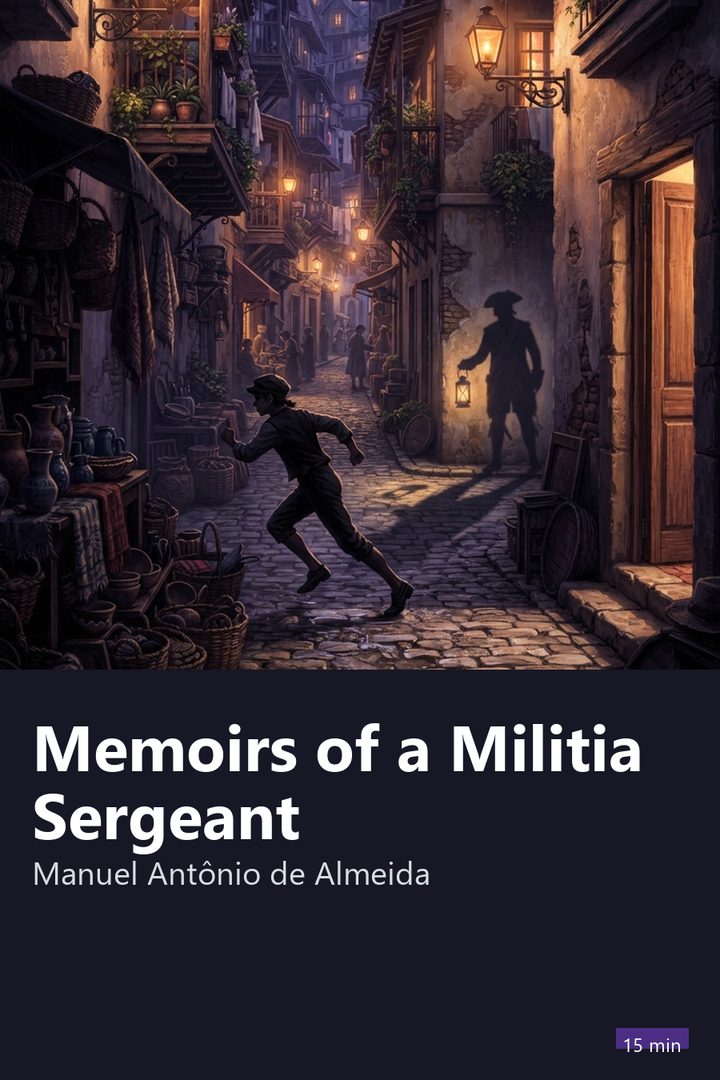
Cover of Memoirs of a Militia Sergeant

Fiction · 16 min

Memoirs of a Militia Sergeant

Manuel Antônio de Almeida · 1854

Who it's for

For anyone who has heard of Memoirs of a Militia Sergeant but never read it, and wants to meet the book that helped make the rogue a central character in Brazilian literature. It also suits readers who enjoy stories about ordinary people in old Rio, with no palaces and no wars, just cleverness, favors and luck.

Read it in the app

⚡ Free to download • 🎁 One full book free every day

🎧 Audio coming soon in the app

Narration for the English summaries is on its way. Meanwhile you can read the full summary in the app.

3 ideas to take with you

1

In the novel, forced recruitment into the army works as punishment disguised as military service: a poor young man without an important last name became a soldier on Vidigal's say-so, with no trial and no choice of his own.

2

According to scholars of the book, Leonardo moves between disorder and order without paying the full price for either one, a trait that helped create the figure of the rogue in Brazilian literature.

3

The Rio de Janeiro portrayed in the book was a city with an enslaved majority, yet Memoirs of a Militia Sergeant hardly puts that reality on the page, a gap that weighs on the portrait of everyday customs the book sets out to paint.

“
In the novel, the hero's parents don't exchange vows of love: a stomp on the foot and a pinch traded aboard the ship are enough to start the relationship that produces Leonardo.
An idea from Memoirs of a Militia Sergeant, in the words of 15 Minutes

Preview

Start reading now

Before we start: what you'll find here

This summary tells the whole story of Memoirs of a Militia Sergeant, from Leonardo's birth to the wedding that closes the book, ending included. If you still want to read it without knowing the outcome, save this summary for later: the idea here is to understand what Manuel Antônio de Almeida shows about popular life in old Rio de Janeiro.

The book first appeared in installments in the newspaper Correio Mercantil, between 1852 and 1853, signed only as A Brazilian, a pseudonym that hid the author's name, and only later became a book, in 1854 and 1855. It is fiction: the characters and plot are literary invention, but the Rio de Janeiro of the days when Dom João VI and the Portuguese court lived in the city was a concrete reality.

The book is in the public domain, and this summary does not copy the author's sentences: it is our own analysis, telling the plot in our own words. The novel also deals with imprisonment and forced recruitment into the army, parts we won't skip or treat as an easy joke.


Rio de Janeiro in the days of the king

The story takes place in the early 19th century, when the Portuguese royal family fled Napoleon and landed in Rio de Janeiro, turning a small colonial town into the temporary seat of the Portuguese kingdom. The mood of the whole book comes from this Rio of the king's day, with Dom João VI still on the throne.

While the court brought European balls and etiquette to a handful of wealthy people, most of the city went on living another way: street parties, Mass, small-time trade, neighbors who knew everybody's business. It is in this popular Rio that Manuel Antônio de Almeida decides to tell his story.

The novel avoids the solemn tone of other books of the time, bound by the rules of Romanticism, full of idealized heroes and impossible love. It prefers to follow ordinary people, a bailiff, a midwife, a barber, a sexton, showing the real life of the city beneath its official life.

A stomp on the foot and a pinch: how Leonardo is born

The protagonist is born in an almost accidental way. His parents, Leonardo-Pataca and Maria da Hortaliça, meet during the ship crossing from Portugal to Brazil, in a beginning free of romantic drama: a stomp on the foot and a pinch exchanged between the two, still on board, are enough to start everything.

There are no love letters and no solemn promises: the book describes the start of the hero's parents' relationship as something trivial, more like a street pickup line than an ordinary serial romance. It is a way of gently laughing at the very romantic genre that dominated the literature of the day.

Once on land, the boy Leonardo is born, who gives the book its name and carries the same first name as his father, which causes deliberate confusion throughout the story: when the book says Leonardo, you have to guess from context whether it means the father or the son.

12 more sections and the quiz

Continue in the app

Read the whole summary, finish with the Memoirs of a Militia Sergeant quiz and follow the guided Journeys. No ads in the app.

About Manuel Antônio de Almeida

Manuel Antônio de Almeida was born in Rio de Janeiro in 1831 and died young, in 1861, in a shipwreck at sea. He worked as a typesetter and journalist at the Correio Mercantil, where he published Memoirs of a Militia Sergeant in installments between 1852 and 1853, signing only as A Brazilian. After leaving the newspaper, he held a post tied to the Empire's official press. Today he is considered one of the creators of the rogue figure in Brazilian literature, in a period when the country still lived under the sway of Romanticism.

Explore

Category:
Fiction
Part of the Journeys:
Brazilian Literature