15 Minutes
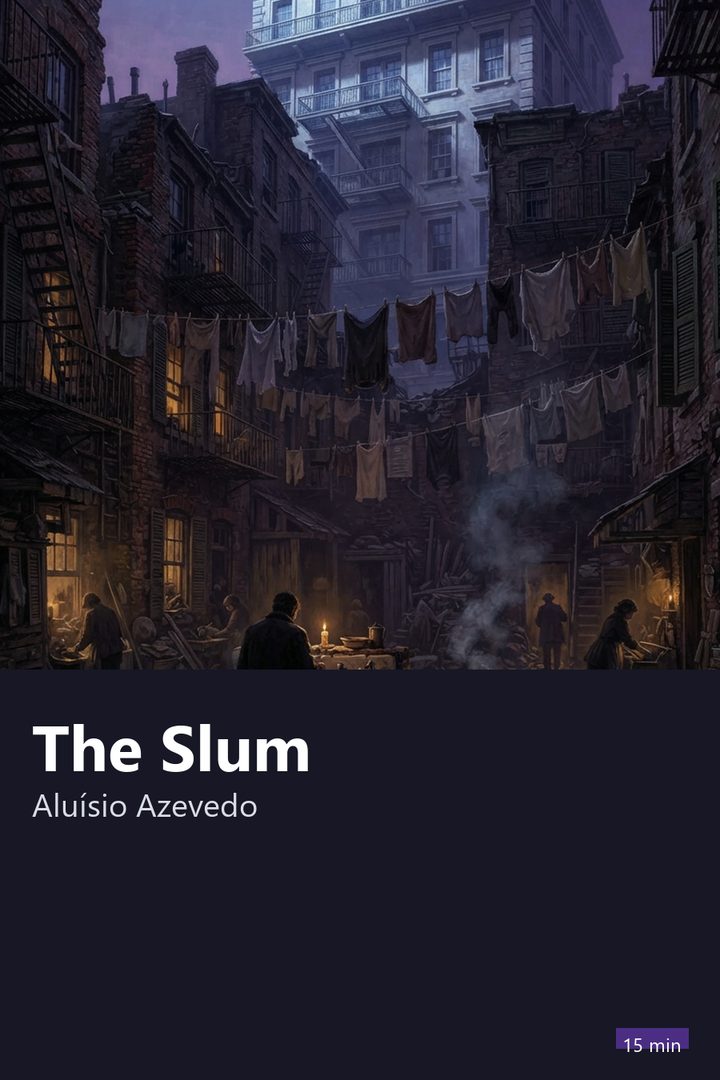
Cover of The Slum

Fiction · 17 min

The Slum

Aluísio Azevedo · 1890

Who it's for

For anyone who has heard of The Slum but never read it, and wants to understand why an 1890 novel still shows up on exams and in debates about housing and work. It is also for readers who like true-to-life stories of ambition, exploitation and survival, with no soap-opera happy ending.

Read it in the app

⚡ Free to download • 🎁 One full book free every day

🎧 Audio coming soon in the app

Narration for the English summaries is on its way. Meanwhile you can read the full summary in the app.

3 ideas to take with you

1

A letter of manumission only counts if it is officially registered. In the book, Bertoleza spends years convinced she is free, yet she stays stuck in the same work and with the same owner.

2

In the novel, the fire that hits João Romão's tenement becomes a stepping stone: he rebuilds bigger, with insurance money, while the residents lose the little they had.

3

According to the book, explaining behavior through race or climate is a thesis of its time, not a fact. Today we understand that reducing Black and mixed-race people to a fixed type is prejudice dressed up as science.

“
In the novel, João Romão does not get rich by a stroke of luck: he saves on everything, sleeps little and collects from every neighbor, even those who trust him, to pile up cent by cent until he owns an entire block.
An idea from The Slum, in the words of 15 Minutes

Preview

Start reading now

Before we start: total spoilers and a content warning

This summary tells the entire story of The Slum, including the ending. If you still want to read the book without knowing how it ends, save this summary for later. The idea here is precisely to reveal the ending, because knowing the outcome helps you see what the book is saying about ambition, exploitation and survival.

The Slum was published in 1890 by Aluísio Azevedo, a year after the Proclamation of the Republic, with the abolition of slavery still recent. It is fiction, so everything here is plot and analysis, but the backdrop (newly abolished slavery, urban poverty, racial and class prejudice) was concrete reality in Rio de Janeiro at that moment.

One direct warning: the book deals with slavery, racism, domestic violence and, near the end, suicide. We will not skip those parts, because they are the center of the story, but we will not treat any of it as spectacle or describe any method. Where it makes sense, we include help lines: call or text 988 for emotional support in the U.S., and the National Domestic Violence Hotline at 1-800-799-7233 for violence against women.


The Rio de Janeiro that becomes a character

The story takes place in Botafogo, a Rio de Janeiro neighborhood that at the time still looked like a suburb, mixing small farms, factories and a tenement, in a city growing fast with no room or infrastructure for so many poor people arriving from the countryside, from Portugal and from the newly freed population. This setting is not just a backdrop: it is the explanation the book offers for everything the characters do later.

A tenement, in the novel, is a cluster of small rooms rented one by one, almost always without decent sewage and with a single well or water tank for dozens of families to share. It is as if today several families lived in separate rooms on the same lot, sharing a bathroom and laundry area, each paying rent to the same owner.

The narrator describes the tenement almost like a living organism that grows, breathes, shouts at dawn and multiplies. That choice is no accident: naturalism, the literary movement Aluísio Azevedo followed, treated human beings as products of the environment where they are born, and the tenement is that laboratory at full scale.

João Romão, the Portuguese man who knew how to wait

João Romão arrives poor, works as a shop clerk and slowly saves money by buying a vacant lot next to his own store. He spends nothing on clothes or comfort, sleeps on top of the shop counter and collects every last cent from anyone who owes him, neighbor or supplier.

On that lot he starts building, room by room, what will become the São Romão tenement. Each new room is rented as soon as it is ready, and the rent pays for the next room, a business that grows on its own, fed by the work and the rent of people even poorer than he is.

The novel does not treat João Romão as a cartoon villain. It treats him as someone methodical, driven by cold greed, who sees every person around him, including Bertoleza, as a useful part of his own plan to get rich. Some neighbors quietly call his way of collecting usury: taking advantage of people who have no choice but to pay the price he asks.

12 more sections and the quiz

Continue in the app

Read the whole summary, finish with the The Slum quiz and follow the guided Journeys. No ads in the app.

About Aluísio Azevedo

Aluísio Azevedo was born in 1857 in São Luís do Maranhão and died in 1913 in Buenos Aires, where he served as Brazil's consul. Before becoming a writer, he worked as a caricaturist and illustrator for newspapers in Rio de Janeiro. He was one of the founders of the Brazilian Academy of Letters and is considered the greatest name in Brazilian naturalism, also the author of novels such as O Mulato. The Slum, published in 1890, is still his most widely read book.

Explore

Category:
Fiction
Part of the Journeys:
Brazilian Literature