15 Minutes
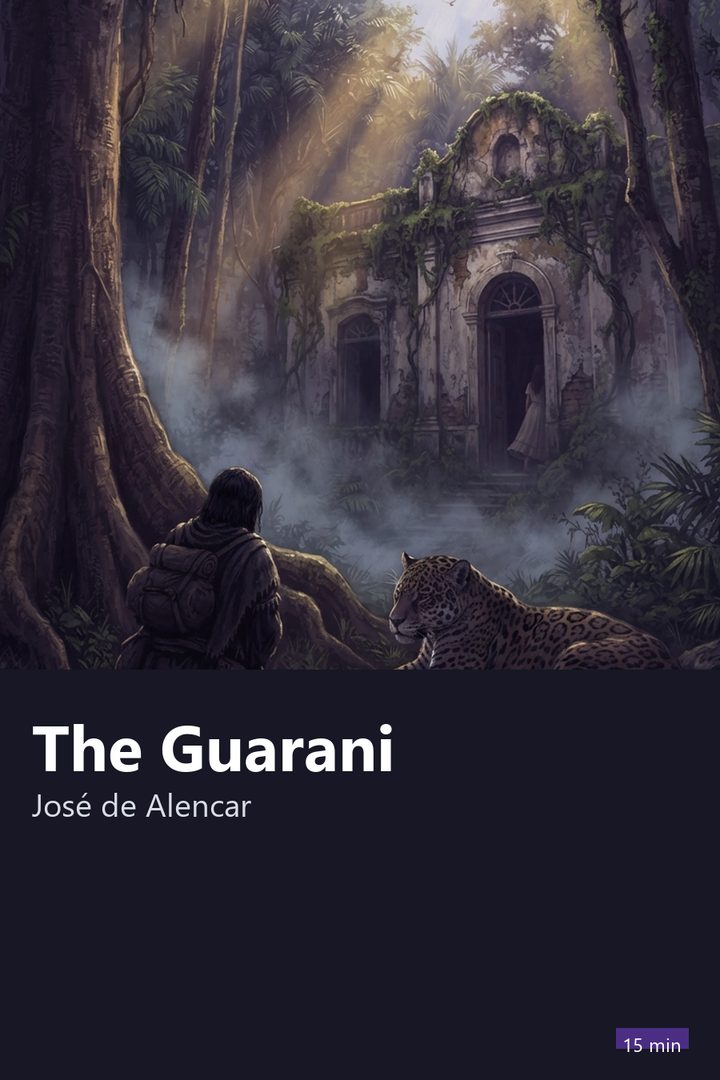
Cover of The Guarani

Fiction · 16 min

The Guarani

José de Alencar · 1857

Who it's for

Original title (Portuguese): O Guarani. For readers who love historical adventure romance and want to understand why Peri and Ceci still show up on school textbook covers and in opera overtures. It is also for anyone who wants to discuss, with a critical eye, how nineteenth-century Brazil imagined its own origins.

Read it in the app

⚡ Free to download • 🎁 One full book free every day

🎧 Audio coming soon in the app

Narration for the English summaries is on its way. Meanwhile you can read the full summary in the app.

3 ideas to take with you

1

In The Guarani, Isabel and Álvaro only find each other in love when the house is already surrounded, and their ending shows the darkest side of the novel.

2

In the novel, an accidental death becomes the spark of an all-out war, because nobody stops to find out what happened before striking back.

3

The book doesn't just tell a love story: it proposes an origin for the Brazilian people, blending European and Indigenous into a single image.

“
Peri trades the whole forest for one square yard beside Ceci, and the book treats that as the greatest gesture of love imaginable.
An idea from The Guarani, in the words of 15 Minutes

Preview

Start reading now

A Plantation Surrounded by Forest and History

The story takes place around 1604, on a fortified estate on the banks of the Paquequer River, in the interior of Rio de Janeiro. It is an isolated house surrounded by dense forest, at a time when the Portuguese colony had barely established itself there.

The man in charge is D. Antônio de Mariz, a Portuguese nobleman who served in the conquest of the land before settling there with his family. The estate works like a small, isolated kingdom, with dependents, hired soldiers and enslaved people, all relying on their own strength to survive.

In this isolated setting José de Alencar builds the rest of the story: inside the house, two daughters, an arrogant son, guests of dubious origin; outside, a forest full of Indigenous peoples, allies and enemies. The tension between inside and outside grows until it explodes.


Peri, the Warrior Who Becomes One Person's Shadow

Peri is a warrior chief of the Goitacá people, strong, agile and loyal enough to give up his free life in the forest just to live near D. Antônio's house and watch over Cecília, whom he calls his lady. He sleeps nearby, eats what is left over, and accepts being treated almost like a servant, without complaint.

The book insists that this devotion is not imposed by anyone: it is his choice. Peri could go back to the forest at any moment, but he prefers to stay near Ceci, learn Portuguese customs and even pray the way white people pray, just to be closer to her.

This devotion has a narrative price: the book treats Peri almost like a European hero dressed as an Indigenous warrior, with a knight's nobility and superhuman strength, closer to the romantic ideal than to a realistic account of seventeenth-century Indigenous peoples.

Ceci, the Young Mistress Who Thinks She Rules the Whole Forest

Cecília, called Ceci, is D. Antônio's youngest daughter, blonde, raised inside the estate, protected from almost every real danger. She treats Peri like an obedient pet, plays at giving orders, calls him my savage, and for much of the story doesn't realize how much she feels for him.

The relationship is unequal from the start: she commands, he obeys; she plays, he truly sacrifices. The book builds this as tenderness, but today it can also be read as a comfortable portrait of the hierarchy between colonizer and colonized, softened by the affection between the two.

Gradually, Ceci realizes that what she feels for Peri is more than friendship, but the book holds back this discovery almost until the end, a classic serial trick to keep readers waiting for the next chapter.

13 more sections and the quiz

Continue in the app

Read the whole summary, finish with the The Guarani quiz and follow the guided Journeys. No ads in the app.

About José de Alencar

José de Alencar was born in Ceará in 1829 and earned a law degree in São Paulo. He worked as a journalist, lawyer and congressman, and also served as the Empire's minister of justice. He is considered one of the creators of the Brazilian Indianist novel, and The Guarani was first published as a serial in the newspaper Diário do Rio de Janeiro in 1857 before becoming a book. He died in Rio de Janeiro in 1877, leaving other notable novels such as Iracema and Senhora.

Explore

Category:
Fiction
Part of the Journeys:
Brazilian Literature