15 Minutes
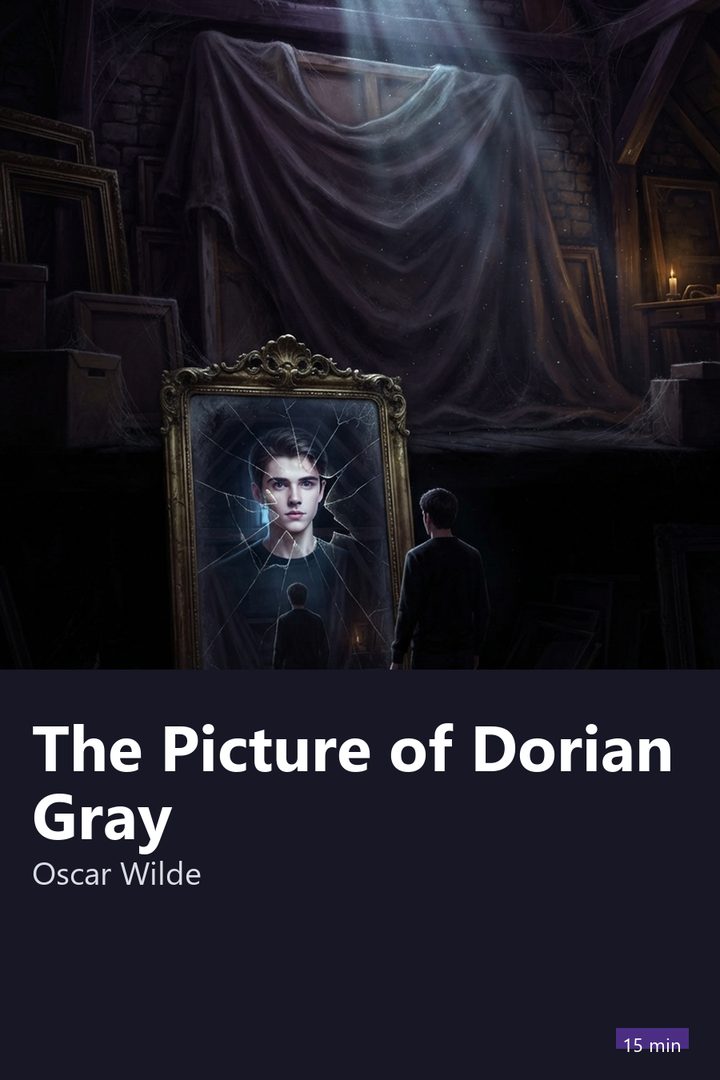
Cover of The Picture of Dorian Gray

Fiction · 15 min

The Picture of Dorian Gray

Oscar Wilde · 1890

Who it's for

For anyone who loves a classic with a gothic mood and wants to understand why this story about vanity and eternal youth is still quoted more than a hundred years later. It's also for anyone who has heard about the portrait that ages in its owner's place and wants the full story behind that image.

Read it in the app

⚡ Free to download • 🎁 One full book free every day

🎧 Audio coming soon in the app

Narration for the English summaries is on its way. Meanwhile you can read the full summary in the app.

3 ideas to take with you

1

In the book, the first change in the painting's expression shows up before any visible punishment: conscience records the damage right away, even when life looks exactly the same on the outside.

2

Killing Basil is not Dorian's first mistake in the story: it's the consequence of years spent denying smaller, earlier errors that he had already decided not to feel anymore.

3

According to the book, Dorian's final act of kindness comes more from wanting to see himself as a good person than from real change, and noticing that hidden vanity is what drives him to attack his own portrait.

“
In the novel, Dorian trades a wish made out of vanity, that the portrait age in his place, for the whole life that comes after it.
An idea from The Picture of Dorian Gray, in the words of 15 Minutes

Preview

Start reading now

Basil Hallward paints a portrait and fears what it reveals

Basil Hallward is a painter in London who meets, at a party, the most beautiful young man he has ever seen: Dorian Gray, young, rich from a recent inheritance, and still without a trace of cunning in his face. Basil becomes obsessed with him and paints the best picture of his career, a full-length portrait that seems to capture more than Dorian's looks.

The painter is afraid to show the painting in public, because he feels he has put too many feelings about his model into it, almost as if the canvas revealed Basil's own soul more than Dorian's. Even so, against his better judgment, he introduces the young man to his friend Lord Henry Wotton, worried about the influence Henry might have on someone so young and impressionable.

Lord Henry Wotton and the gospel of pleasure

Lord Henry is a cynical aristocrat who loves to provoke with short, sharp lines, true epigrams that sound more definitive than they really are. He defends a life guided by sensation and beauty, with no heavy moral guilt on top of it: to live fully, he says, is the only thing worth doing.

This way of living only for pleasure and beauty, without being tied down by duty or consequence, is a kind of hedonism that Lord Henry embodies in the novel, close to the aestheticism Oscar Wilde himself defended outside it, the idea that art and life should be guided by sensation, not by morality.

While Dorian poses for Basil, Henry stands beside him talking and plants a simple and devastating idea: youth and beauty are the only things that truly matter, because they vanish too fast. Dorian, naive until then, hears it like someone hearing a truth he always knew but had never heard said out loud.

The dangerous wish: let the painting age in my place

When the portrait is finished, Dorian sees himself for the first time as others see him: astonishingly handsome. At the same time, he notices something painful: the beauty he has now is fleeting and will wither with time, while that canvas will keep the same youth forever, untouched.

Seized by a sudden vanity, Dorian says out loud a wish that sounds like a joke: that the painting would age in his place, that he could stay young while the canvas carried the weight of the years. Basil, hurt by his friend's reaction to his own gift, even offers to destroy the canvas, but Dorian won't let him and takes the painting home.

13 more sections and the quiz

Continue in the app

Read the whole summary, finish with the The Picture of Dorian Gray quiz and follow the guided Journeys. No ads in the app.

About Oscar Wilde

Oscar Wilde (1854-1900) was an Irish writer, playwright, and poet, one of the most brilliant and controversial figures in English-language literature of the late nineteenth century. A graduate of Oxford, he became famous for his sharp wit, for plays like The Importance of Being Earnest, and for the novel The Picture of Dorian Gray, first published in a magazine in 1890 and expanded into a book the following year. In 1895, in a trial that shocked Victorian England, he was convicted and imprisoned for homosexual relationships, a crime under the law of the time. He left prison with his health ruined and died poor in Paris in 1900. The preface he wrote for the book edition of Dorian Gray, defending art free from moral judgment, was partly a response to the accusations of immorality the novel faced as soon as it was published.

Explore

Category:
Fiction
Part of the Journeys:
World Classics