15 Minutes
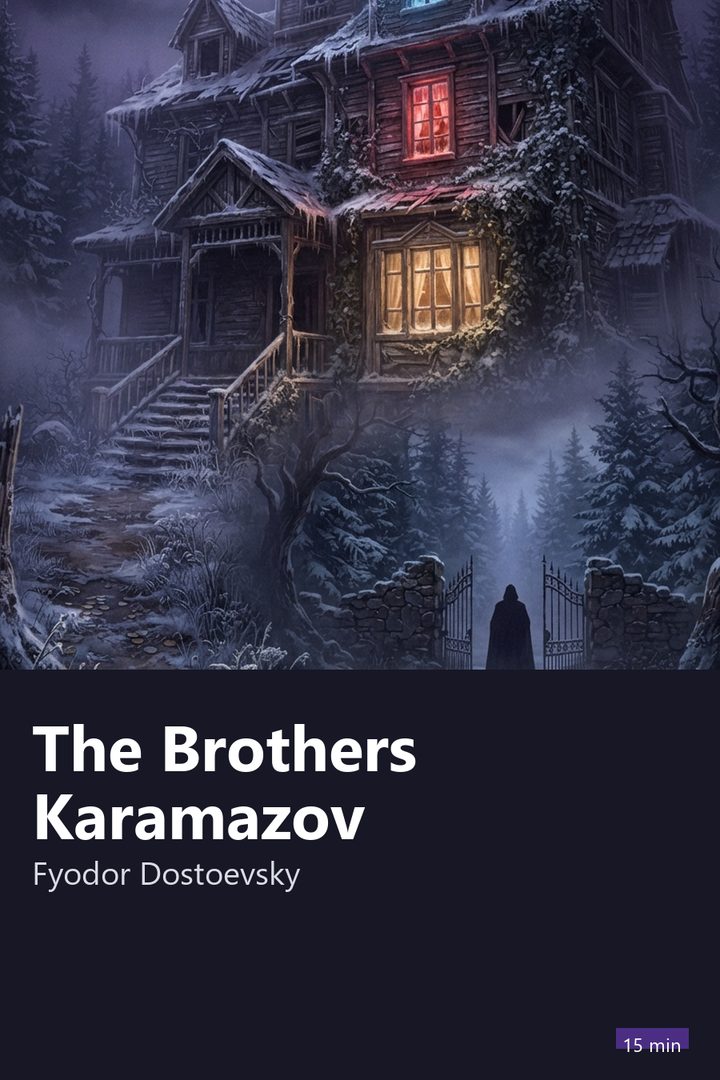
Cover of The Brothers Karamazov

Fiction · 16 min

The Brothers Karamazov

Fyodor Dostoevsky · 1880

Who it's for

For readers who are up for a dense, slow novel, full of conversation and reflection, about faith, guilt, and a family that tears itself apart over money and jealousy. It is not for anyone who wants fast action: this is a nineteenth-century Russian classic, on purpose.

Read it in the app

⚡ Free to download • 🎁 One full book free every day

🎧 Audio coming soon in the app

Narration for the English summaries is on its way. Meanwhile you can read the full summary in the app.

3 ideas to take with you

1

In the novel, an unpaid debt and jealousy over the same woman, between father and son, set the stage for the Karamazov tragedy.

2

At Dmitri's trial, the look of guilt, an impulsive gesture, and a bad reputation convince the jurors faster than concrete proof does.

3

For the elder Zosima, nobody builds a family tragedy alone: every silence, every careless word, and every grudge kept inside helps set up the outcome.

“
For the Inquisitor in Ivan's poem, most people would trade real freedom for guaranteed bread and someone to decide for them.
An idea from The Brothers Karamazov, in the words of 15 Minutes

Preview

Start reading now

A Family That Should Never Have Existed

Fyodor Pavlovich Karamazov is a landowner who got rich lending money and knows how to take advantage of any situation. The book describes him as a buffoon: he laughs at his own disgrace, humiliates whoever is nearby, and treats wives, sons, and neighbors as resources to be used. His debauchery is not a slip, it is a way of life embraced without a shred of shame.

He had three sons with two different women and never raised any of them properly: Dmitri, the oldest, was left to relatives; Ivan and Alyosha, from the second marriage, grew up away from their father after their mother died young. There is also a rumor that Smerdyakov, the servant who cooks for him, is Fyodor Pavlovich's son by a mute, homeless woman from the town.

As adults, the four circle back to the same house, each carrying a piece of what will blow the family apart: money that is missing, a woman two of them want, a head full of dangerous ideas, and a faith about to be tested.

Dmitri, the Vanished Inheritance, and the Woman They Both Wanted

Dmitri is the oldest son, a retired officer, a spender, driven by impulse and pride. He believes his father is holding back money from his late mother's inheritance, and he keeps fighting over this account that never balances.

To make things worse, father and son fall for the same woman: Grushenka, an independent young woman in town who was abandoned by a Polish officer years earlier and now amuses herself watching the two Karamazovs compete for her attention.

Dmitri also owes money to Katerina Ivanovna, a proud fiancée he has hurt and who stays tied to him by a mix of wounded love and a need for atonement. Between debt, jealousy, and shame, Dmitri spends the whole book on the edge of an explosion.

Ivan, the Cold Mind and the Question With No Answer

Ivan is the middle brother, an educated intellectual, skeptical about religion. He does not deny that God might exist; what he refuses is to accept the world that this God allowed, with all the cruelty in it.

One of the ideas Ivan argues in conversation is that, without life after death or divine punishment, no automatic moral limit is left for people: everything would become permitted, and each person would have to decide their own limits. Some readers call this stance nihilism, the idea that no moral value has a solid foundation without a divine source.

Despite his cold mind, Ivan also feels jealousy and competes for the attention of Katerina Ivanovna, the same woman hurt by Dmitri, which mixes lofty philosophy with a much more ordinary family rivalry.

12 more sections and the quiz

Continue in the app

Read the whole summary, finish with the The Brothers Karamazov quiz and follow the guided Journeys. No ads in the app.

About Fyodor Dostoevsky

Fyodor Dostoevsky was born in Moscow in 1821 and trained as a military engineer before devoting himself to literature. Arrested in 1849 for taking part in a political discussion group, he was sentenced to death, had the sentence commuted just before the execution, and served years of hard labor in Siberia. The Brothers Karamazov, published in 1880, was the last novel he finished: Dostoevsky died in January 1881, a few months later, without writing the sequel he had planned.

Explore

Category:
Fiction
Part of the Journeys:
The Great Novels