15 Minutes
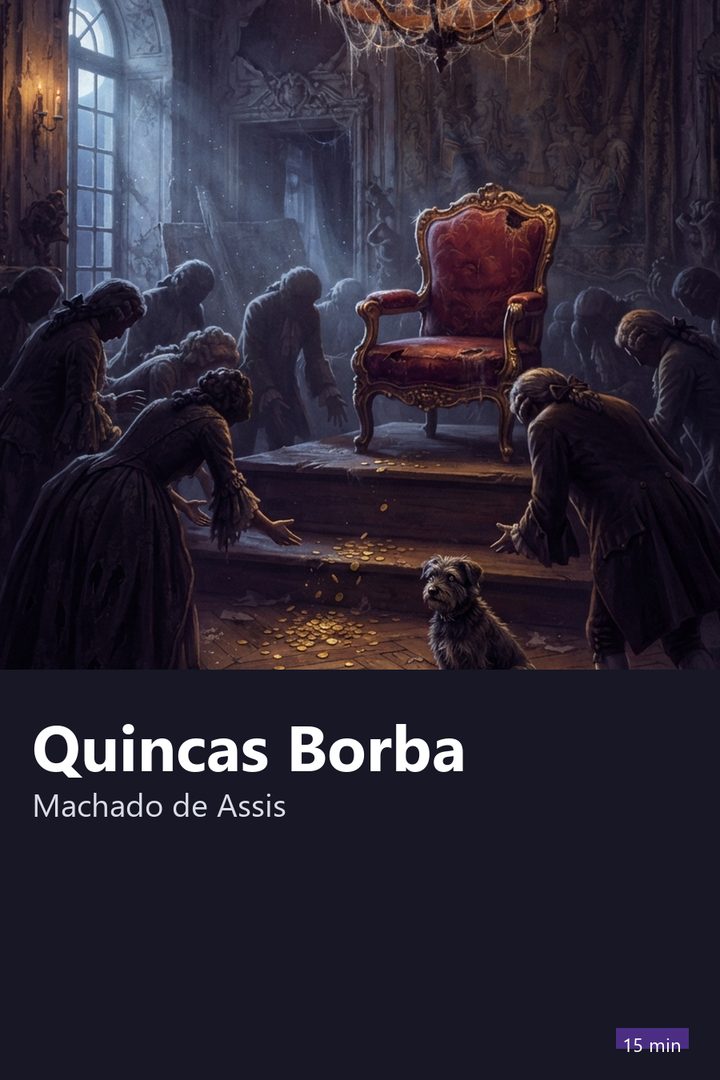
Cover of Quincas Borba

Fiction · 16 min

Quincas Borba

Machado de Assis · 1891

Who it's for

Original title (Portuguese): Quincas Borba. This is for anyone who wants to understand why Machado de Assis is considered the greatest Brazilian writer without tackling a book that's hard to follow, since here the story has plot, romance, and madness growing chapter by chapter. It's also for people who like thinking about how easy money changes the way others treat you, and how much of that is still true today.

Read it in the app

⚡ Free to download • 🎁 One full book free every day

🎧 Audio coming soon in the app

Narration for the English summaries is on its way. Meanwhile you can read the full summary in the app.

3 ideas to take with you

1

For the author, any philosophy that explains why the strongest side is right is usually born on the side of whoever is already winning the contest.

2

In Palha, Machado shows a friendship that lasts only as long as there is money to lend and credit to use.

3

In the novel, Rubião's madness works as an escape: becoming an emperor in his own head hurts less than accepting he was fooled with his eyes wide open.

“
In the novel, the inheritance first changes the people who start circling Rubião, long before it changes who he is.
An idea from Quincas Borba, in the words of 15 Minutes

Preview

Start reading now

A small-town teacher who becomes an heir overnight

Rubião is a teacher in Barbacena, in the countryside of Minas Gerais, when the turn of events that changes everything arrives: his close friend, the eccentric philosopher Quincas Borba, is in fragile health and comes to rely on Rubião to look after him in his final days.

When Quincas Borba dies, the will surprises the whole town: his entire fortune goes to Rubião, a teacher with no real assets, no business history, and no experience at all with money on a large scale. The only condition is to take care of the philosopher's pet dog, which was given, while its owner was alive, the same name as him.

From one month to the next, Rubião stops being the modest teacher everyone greeted on the street and becomes the rich man nobody knew existed until last week. And, like anyone who has never had real money, he doesn't quite know what to do with the fortune besides spend it fast and show up more.

It's the same feeling as winning a big lawsuit settlement, getting an unexpected inheritance, or hitting the lottery: your phone rings more, the neighborhood group chat gets friendlier, and cousins who vanished years ago start texting to ask how you're doing.
The philosopher Quincas Borba and the dog who inherited his name

Quincas Borba is not a new character for anyone who has read another Machado de Assis novel: he appears, still young, as a beggar philosopher in The Posthumous Memoirs of Brás Cubas. Here, years later, he reappears rich, owner of a fortune he made on his own, and old enough to be near the end of his life.

Besides the money, Quincas Borba leaves behind a doctrine of his own, created by himself over the years, and a pet dog that was given, while its owner was still alive, the same name as his: Quincas Borba. Sharing his own identity with an animal already sets the tone of irony that runs through the whole book.

The dog becomes a recurring character in the story, almost a silent mirror of its human owner's fate. While the people around Rubião leave as the money runs out, the dog is the only one who stays nearby until the final scene, asking nothing in return.

Humanitism: the philosophy of "to the victor, the potatoes"

The philosopher Quincas Borba christens his own doctrine Humanitism: the idea that there is a universal principle called Humanitas, present in everything that exists, and that the constant struggle among living beings is the natural law governing that principle.

The phrase that sums up the doctrine is famous even outside the book: to the victor, the potatoes. In practice, this means that whoever wins the contest eats, and whoever loses goes hungry, and this is presented as something natural, almost scientific, rather than as a choice or an injustice.

Machado uses Humanitism as satire: a complicated philosophy, full of hard terms and grand explanations, that basically serves to give a fancy name to a simple rule that is convenient for whoever is already winning. Throughout the novel, more than one character falls back on this logic to justify a decision that only benefits themselves.

12 more sections and the quiz

Continue in the app

Read the whole summary, finish with the Quincas Borba quiz and follow the guided Journeys. No ads in the app.

About Machado de Assis

Machado de Assis was born in Rio de Janeiro in 1839, the son of a house painter and a washerwoman, and taught himself to read and write without regular schooling. He worked as a typesetter, proofreader, and journalist before establishing himself as a writer and civil servant. He published novels, short stories, newspaper columns, and plays, among them The Posthumous Memoirs of Brás Cubas and Dom Casmurro, and he founded the Brazilian Academy of Letters in 1897, serving as its first president. He died in Rio de Janeiro in 1908, and today he is regarded as the greatest name in Brazilian literature.

Explore

Category:
Fiction
Part of the Journeys:
Brazilian Literature