15 Minutes
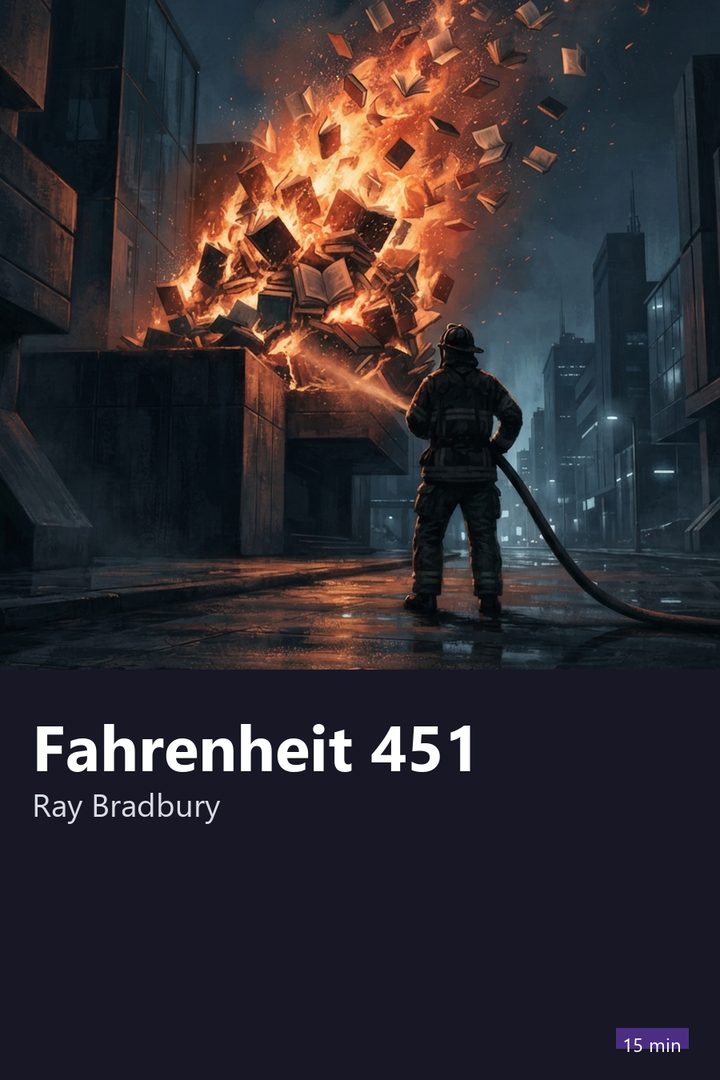
Cover of Fahrenheit 451

Fiction · 13 min

Fahrenheit 451

Ray Bradbury · 1953

Who it's for

For anyone who feels like they spend the day on autopilot, caught between screens and notifications, and wants to understand why this 1953 classic is still quoted. It's also for people who have heard of the book where books get burned and don't know what actually happens in it.

Read it in the app

⚡ Free to download • 🎁 One full book free every day

🎧 Audio coming soon in the app

Narration for the English summaries is on its way. Meanwhile you can read the full summary in the app.

3 ideas to take with you

1

Constant noise works like anesthesia: without silence, we stop hearing our own dissatisfaction.

2

In Beatty's version, society gave up books little by little, by its own choice, and not by decree.

3

Keeping an idea in your memory and passing it on can be safer than depending only on an object.

“
A simple question, asked without hurry, can shake a whole life lived on autopilot.
An idea from Fahrenheit 451, in the words of 15 Minutes

Preview

Start reading now

A Fireman Who Lights the Fire

Fahrenheit 451 is a science fiction classic set in the near future, in a country where books are banned. The title refers to the temperature at which, according to the book, paper catches fire. In this society, firemen don't put out fires: they are called in to burn down houses where someone is hiding books.

The protagonist is Guy Montag, a career fireman who likes what he does. He takes pleasure in watching pages turn into sparks, and he goes home with the smell of kerosene on his clothes and the feeling of a job well done, never asking himself what he is destroying.

Think of a worker who follows orders to the letter, clocks in, takes the packed bus, and goes through the routine without questioning what the company really does. That's Montag: a model employee in a world where being a model employee has come to mean burning ideas.


The Neighbor Who Asks a Simple Question

One night on his way home, Montag meets Clarisse, a seventeen-year-old neighbor who walks everywhere, notices the dew, and talks with her family at dinner. She throws him off with a simple question: is he happy?

Montag answers with a laugh, but the question sticks to him. Everyone sees Clarisse as odd, because she prefers talking, walking, and observing to spending the day in front of screens. In a rushed world, she makes time feel slow.

After a few conversations, she disappears, and the book suggests she was hit by a car. It makes no fuss about it, and that restraint is what hurts: no one in the neighborhood seems surprised, and life goes on.

A House Full of Screens and Emptiness

At home, Montag finds his wife, Mildred, lying down with tiny earpieces stuffed in her ears, listening to the radio all the time. She spends most of the day in front of entire walls turned into screens, chatting with characters she calls her family.

One night, Mildred swallows a whole bottle of sedatives. Two technicians arrive, pump her stomach like it's routine maintenance, send a bill, and leave. The next day she remembers nothing and goes on with life as if nothing had happened.

The scene shows a world where discomfort is treated as a technical defect, and sadness is wiped away with noise and distraction. It's like a house where the TV stays on all day so no one has to look inside themselves.

12 more sections and the quiz

Continue in the app

Read the whole summary, finish with the Fahrenheit 451 quiz and follow the guided Journeys. No ads in the app.

About Ray Bradbury

Ray Bradbury was born in 1920 in Waukegan, Illinois, and died in 2012 in Los Angeles. He never went to college and said he learned in public libraries. He wrote Fahrenheit 451 on a typewriter rented by the hour in a library at the University of California, Los Angeles. He is also the author of The Martian Chronicles, from 1950.

Explore

Category:
Fiction
Part of the Journeys:
Dystopias and Warnings