15 Minutes
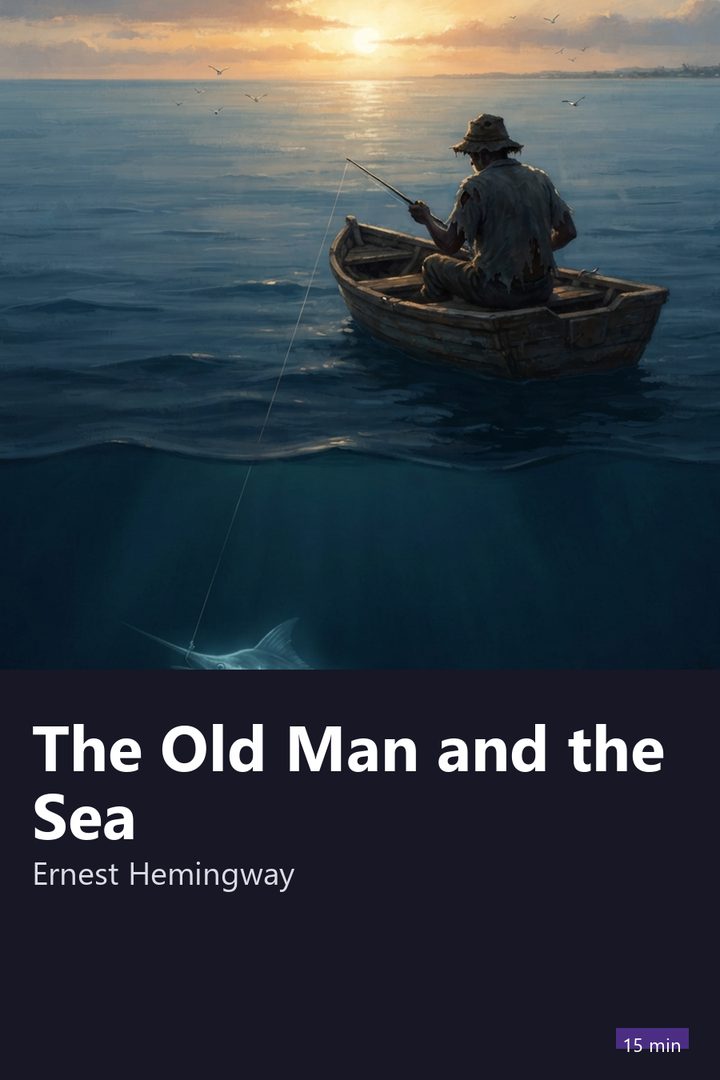
Cover of The Old Man and the Sea

Fiction · 13 min

The Old Man and the Sea

Ernest Hemingway · 1952

Who it's for

For anyone who wants a short, deep story about persistence, pride, and loss, the kind that fits into one Sunday and stays with you all week. It's also for anyone who heard about the book in school and still isn't sure what actually happens in it.

Read it in the app

⚡ Free to download • 🎁 One full book free every day

🎧 Audio coming soon in the app

Narration for the English summaries is on its way. Meanwhile you can read the full summary in the app.

3 ideas to take with you

1

When a battle lasts for days, the memory of an old trial becomes fuel: remembering what you've already endured helps you keep going.

2

Winning the hard part doesn't guarantee you keep the prize, because forces the original effort never accounted for can eat away at what you won.

3

For this book, a person's worth shows more in how they persist than in the final score.

“
Real friendship shows in the bad times: whoever keeps showing up when you have no results is worth more than easy applause.
An idea from The Old Man and the Sea, in the words of 15 Minutes

Preview

Start reading now

An Old Man, a Boat, and 84 Days Without a Fish

The story takes place in a fishing village near Havana, Cuba, and follows a single man: Santiago, an old fisherman, thin, with scars on his hands and eyes that haven't aged. For 84 days he has gone out to sea and come back with nothing, and the talk in the village is that the man is finished for good.

Think of a salesman who goes almost three months without closing a deal, or a rideshare driver who works the whole month and ends up in the red. Everyone around already has the verdict ready, and the book starts exactly there, with Santiago's reputation at a low and his dignity still standing.

It's a short book, a novella, with very few characters and almost everything happening inside a tiny boat. That simplicity is on purpose: with no decoration, all that's left is the work, the body, and the will not to let go.


The Boy Who Won't Leave the Old Man

Manolin is a boy who learned to fish from Santiago and loves him like a second father. For the first forty days without a catch he still went along, but his parents decided the old man was unlucky and sent the boy to another boat, one that catches fish.

In the village, the word for the worst kind of bad luck is salao. Even so, the boy keeps showing up at the end of the day to help carry the gear, fetch coffee, and talk. It's a friendship that doesn't depend on results, a rare thing when everybody just wants to stay close to whoever is winning.

The two talk about baseball, about a great Yankees player named DiMaggio, and Santiago clings to that hero the way you cling to an example: someone who endures the pain of a bone spur in his heel and keeps playing well. The evening talk shows the old man as he is: stubborn, proud, and full of tenderness.

Day 85: Going Too Far

On the morning of day 85, before dawn, Santiago wakes the boy, drinks the coffee he brought, and heads out in the skiff, a small boat with a sail and oars. He decides to go farther than the other fishermen, where the sea is deeper and the fish, in theory, are bigger. It's a calculated risk by a man who doesn't have much left to lose.

Along the way he notices everything: the birds that show where the fish are schooling, the flying fish, the patches on the water, the Gulf Stream running warm near the Cuban coast. In this part the book almost becomes a manual on paying attention, because the old man reads the sea the way a cab driver reads traffic, anticipating what's coming from small signs.

He talks to himself out loud, thinks of the sea as a woman who gives or withholds favors, and checks every hook, prepared with the care of someone who knows that luck, if it comes, needs to find everything in order.

11 more sections and the quiz

Continue in the app

Read the whole summary, finish with the The Old Man and the Sea quiz and follow the guided Journeys. No ads in the app.

About Ernest Hemingway

Ernest Hemingway was born in 1899 in Oak Park, Illinois, and began his writing life as a journalist. He served as an ambulance driver in World War I and later covered the Spanish Civil War, experiences that shaped his writing. He wrote The Old Man and the Sea in Cuba, where he lived for about twenty years, and won the Nobel Prize in Literature in 1954. He died in 1961 in Ketchum, Idaho.

Explore

Category:
Fiction
Part of the Journeys:
World Classics