15 Minutes
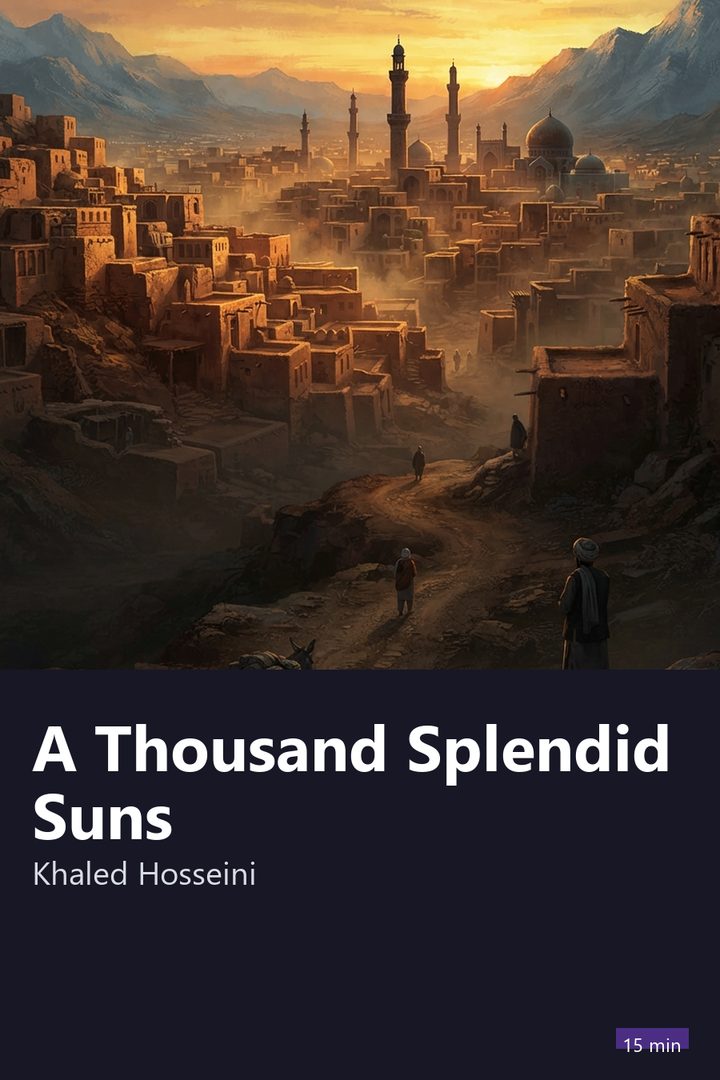
Cover of A Thousand Splendid Suns

Fiction · 15 min

A Thousand Splendid Suns

Khaled Hosseini · 2007

Who it's for

For readers who love an emotional novel and want to understand, through two women, how war and the power of extremist regimes reach into women's lives. Warning: it includes intense scenes of domestic violence and war.

Read it in the app

⚡ Free to download • 🎁 One full book free every day

🎧 Audio coming soon in the app

Narration for the English summaries is on its way. Meanwhile you can read the full summary in the app.

3 ideas to take with you

1

A childhood friendship can be the first place where someone discovers they are worth something, and that memory can hold a person up through years of hardship.

2

The story shows that rules that erase women from public life also reach their health, their income, their schooling, and their safety inside the home.

3

A lie told at a moment of deep vulnerability can decide years of someone's life, which is why serious news calls for more than one source.

“
Waiting at the door of someone who doesn't want to receive you costs more than the answer they might have given.
An idea from A Thousand Splendid Suns, in the words of 15 Minutes

Preview

Start reading now

A novel about women in a country at war

A Thousand Splendid Suns was published in 2007 by Khaled Hosseini, the same author as The Kite Runner. The title comes from a seventeenth-century Persian poem praising Kabul, describing a city so beautiful that a thousand splendid suns hide behind its walls. The book draws a painful contrast between that imagined beauty and the reality its heroines live.

The story covers about thirty years of Afghan history, from the mid-1970s to the first years after 2001, passing through the coup, the Soviet invasion, the civil war, Taliban rule, and the fall of the regime. Everything is seen through two women of different generations who would never have met outside these circumstances.

It is a heavy read, with scenes of domestic violence and war. If you are going through a delicate time, it's worth reading carefully and in small doses.


Mariam, the daughter who was never supposed to exist

The first heroine is Mariam, born around 1959 near Herat, in western Afghanistan. She is the daughter of Nana, a housekeeper, and Jalil, a wealthy man who owns the town's movie theater and has three wives and many legitimate children. Because she was born outside of marriage, she is called a harami, a bastard, and carries the stigma of that word her whole life.

Mariam lives with her mother in an isolated shack on the edge of a hill, and Nana keeps repeating that the world is cruel to women and that their only strength is to endure. Even so, Mariam loves Thursdays, when Jalil visits, brings gifts, and tells stories. She wants to believe she is loved, even though her father never takes her to his big house.

It's a pain many people recognize: the child who idealizes the absent father because she needs him, while the wounded mother becomes the hard, bitter figure. The book shows how this tug-of-war will shape the girl's entire life.

The day her father didn't open the door

On her fifteenth birthday, Mariam asks her father to take her to his movie theater. Jalil stalls and puts it off, and she decides to go to town on her own. She spends the night on the sidewalk in front of his house, waiting to be let in. One of her father's employees shows up and takes her back, and Jalil never comes out to see her.

When she gets home, she finds her mother dead: Nana, desperate at the thought of being abandoned by her daughter, took her own life. Mariam comes to carry the guilt of having left and of having believed in her father. It is one of the hardest moments in the book, and it explains much of how she will treat herself from then on.

Think of anyone who has spent hours at someone's door waiting for a sign and walked away with nothing. It hurts more than an honest answer. Hosseini turns that closed door into a symbol: the place where the girl discovers that the love she was waiting for came in small, conditional doses.

11 more sections and the quiz

Continue in the app

Read the whole summary, finish with the A Thousand Splendid Suns quiz and follow the guided Journeys. No ads in the app.

About Khaled Hosseini

Khaled Hosseini was born in Kabul in 1965, the son of an Afghan diplomat. The family moved to France in 1976 and, after the Soviet invasion, applied for asylum in the United States in 1980. He trained as a doctor and practiced medicine before turning to writing. He debuted as a novelist with The Kite Runner in 2003, then published A Thousand Splendid Suns in 2007 and And the Mountains Echoed in 2013.

Explore

Category:
Fiction
Part of the Journeys:
Vacation Reads