15 Minutes
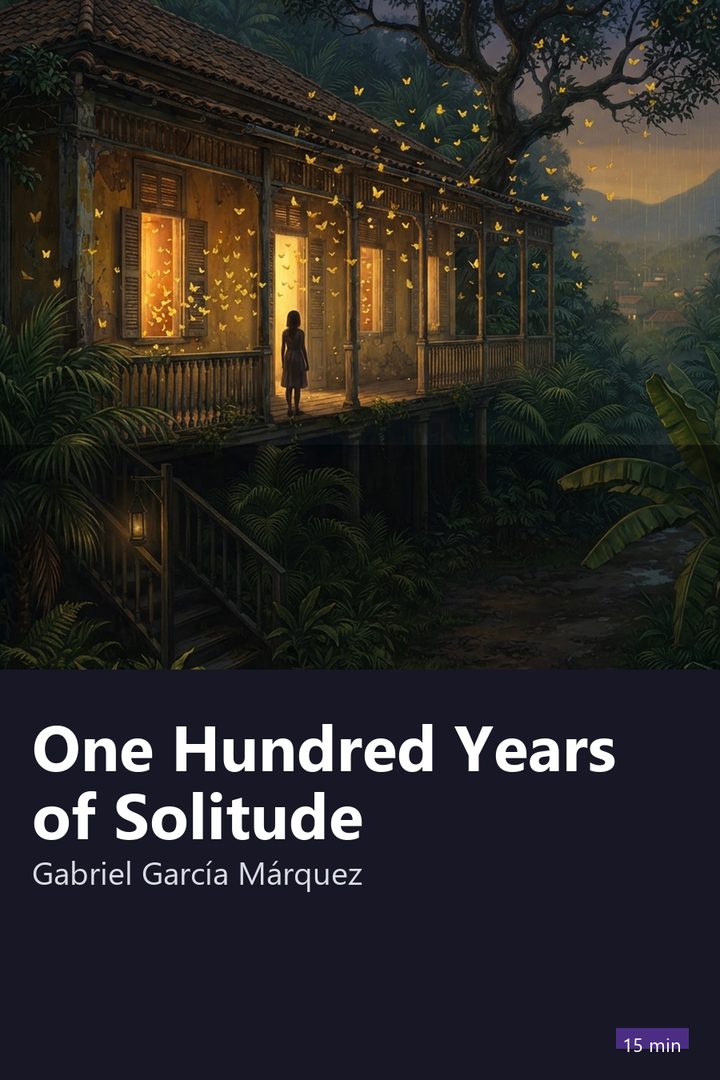
Cover of One Hundred Years of Solitude

Fiction · 14 min

One Hundred Years of Solitude

Gabriel García Márquez · 1967

Who it's for

For anyone who wants to understand what one of the most famous novels of the twentieth century is about, without getting lost in a family tree of repeated names. It also helps those who plan to take on the book for real and want to reach the end with a map in hand.

Read it in the app

⚡ Free to download • 🎁 One full book free every day

🎧 Audio coming soon in the app

Narration for the English summaries is on its way. Meanwhile you can read the full summary in the app.

3 ideas to take with you

1

The book suggests that people who spend their lives in wars they cannot win end up losing, along the way, the very thing they wanted to defend.

2

In the most common reading, the solitude of the title is less about being alone and more about being unable to love or communicate, even when surrounded by people.

3

The story of Aureliano Segundo shows that abundance without a plan is a party that turns into ruin when the rain arrives.

“
Those who are dazzled by the ice from abroad sometimes fail to see the miracle sitting on the table at home.
An idea from One Hundred Years of Solitude, in the words of 15 Minutes

Preview

Start reading now

Macondo: the town where everything fits

One Hundred Years of Solitude, published in 1967 by Gabriel García Márquez, tells the story of seven generations of the Buendía family in the imaginary town of Macondo, lost between the jungle and a river, from its birth to its disappearance. The book became a symbol of so-called magical realism, a style in which the extraordinary is told as if it were ordinary.

So a priest levitates after drinking hot chocolate, a young woman rises into the sky while folding sheets, yellow butterflies follow a man in love, and the narrator neither explains nor is surprised. The author said he wrote with the same straight face his grandmother used to tell absurd stories.

The result is a family saga that also speaks about the history of Latin America: civil wars, the arrival of foreign companies, official forgetting. Even memory becomes a character.


The fear of the pig's tail and the founding

José Arcadio Buendía and Úrsula Iguarán are cousins and marry, even though they were warned that close relatives can have children with a pig's tail, as had happened in a neighboring family. Úrsula, terrified, refuses intimacy for months, until a neighbor, Prudencio Aguilar, mocks José Arcadio after a cockfight.

Furious, José Arcadio kills the man with a spear. But the dead man begins to appear in their house, washing his wound, and the couple cannot bear the guilt. They leave the village with some friends and, after months of walking, José Arcadio dreams of a city of mirrors and founds Macondo on the bank of a river.

Already at the origin are two marks of the book: the fear of punishment for a forbidden union and the guilt over a crime that will not fade. They return, in other forms, generation after generation.

Gypsies, magnets, and ice: the craze for novelty

Macondo is so isolated that Melquíades's gypsies show up every year with inventions that look like magic: magnets that drag pots along, giant magnifying glasses, and, greatest of all, ice, which José Arcadio treats as if it were a diamond. He falls in love with the inventions and spends the family's money on alchemy experiments.

Obsessed, he spends his nights trying to find a route to the outside world and ends up going mad. The family ties him to a chestnut tree in the yard, where he stays for years, speaking Latin. He dies under a rain of yellow flowers that covers the streets.

The scene speaks of curiosity and failure: the fascination with novelty that scorns what is right next to you. Think of someone who gets dazzled by the latest gadget and doesn't notice their own house falling apart.

12 more sections and the quiz

Continue in the app

Read the whole summary, finish with the One Hundred Years of Solitude quiz and follow the guided Journeys. No ads in the app.

About Gabriel García Márquez

Gabriel García Márquez was born in Aracataca, Colombia, in 1927, and died in Mexico City in 2014. He began as a journalist and wrote short stories and novels before winning worldwide fame with One Hundred Years of Solitude, published in 1967. His other works include Chronicle of a Death Foretold and Love in the Time of Cholera. He received the Nobel Prize in Literature in 1982.

Explore

Category:
Fiction
Part of the Journeys:
World Classics