15 Minutes
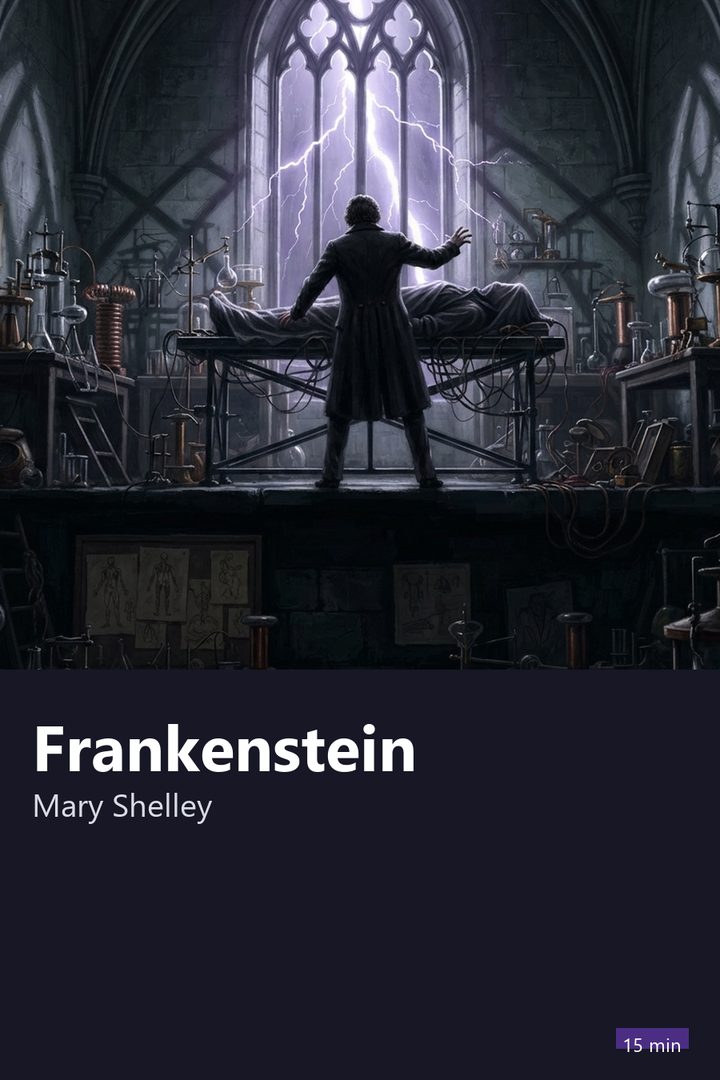
Cover of Frankenstein

Fiction · 16 min

Frankenstein

Mary Shelley · 1818

Who it's for

For anyone who knows the green movie monster and wants to find out what the real novel says about creation, abandonment and responsibility. It's also for people who think about the consequences of technologies and projects we launch without knowing where they will end up.

Read it in the app

⚡ Free to download • 🎁 One full book free every day

🎧 Audio coming soon in the app

Narration for the English summaries is on its way. Meanwhile you can read the full summary in the app.

3 ideas to take with you

1

Staying silent when you know the truth and letting an innocent person pay is a way of taking part in the wrong.

2

The story suggests that giving in to a request out of guilt and then backing out of fear hurts more than choosing clearly from the start.

3

According to the book, science becomes a threat when it forgets to ask about what comes after, not because of knowledge itself.

“
Whoever rushes so hard to get something that they never ask what they'll do afterward ends up a prisoner of their own result.
An idea from Frankenstein, in the words of 15 Minutes

Preview

Start reading now

A Challenge on a Stormy Night

Frankenstein was born from a challenge. In the summer of 1816, an eighteen-year-old Englishwoman, Mary Shelley, was staying in a house near Lake Geneva with the poet Percy Shelley, the writer Lord Byron and the doctor John Polidori. Heavy rain kept them indoors, and Byron proposed that each of them write a ghost story.

Mary spent days without an idea, until a conversation about experiments with electricity and life led her to a kind of waking dream: a pale student, kneeling beside a thing he had put together, watching it open its eyes. The novel grew out of that, published in 1818 without her name on the cover, with the subtitle The Modern Prometheus.

The book has little of the green monster with bolts in his neck that the movies made popular. It's a sadder and more philosophical story, about responsibility, loneliness and the consequences of what we create.
Letters from the Arctic: The Captain and the Stranger

The novel opens with letters from Robert Walton, captain of an exploration ship, to his sister in England. He is looking for a passage through the North Pole and wants fame. The ship gets stuck in the ice. One morning, the crew sees a sled driven by a gigantic figure and, hours later, picks up another sled carrying a thin, sick, exhausted man.

It is Victor Frankenstein. Little by little he recovers and decides to tell Walton his story, saying that if he had heeded a warning in time, he might have avoided his misfortune. This story within a story is what makes up the book: letters that hold Victor's words, which hold the creature's words.

The structure works like a Russian doll and puts the reader in front of three people, each with his own truth. Nothing is told by a neutral voice, and it's up to the reader to judge who can be trusted.

Geneva, the Family and the Curious Boy

Victor is born in Geneva, Switzerland, into a wealthy, loving family. His parents take in Elizabeth, a girl who grows up with him like a sister and who will later be his fiancée. He also has a childhood friend, Henry Clerval, and two younger brothers, Ernest and William.

His childhood is happy, but Victor has a hunger to know. He reads the old alchemists, dreams of discovering the secret of life and death and, when his mother dies of scarlet fever, caught while caring for Elizabeth, that hunger takes on the tone of a challenge. He then leaves to study at the university of Ingolstadt, in Germany.

Think of a young man from a small town who goes to study in the big city, with the glow of the first semesters and no family watching over him. The book shows how curiosity, without conversation and without limits, can turn into isolation.

12 more sections and the quiz

Continue in the app

Read the whole summary, finish with the Frankenstein quiz and follow the guided Journeys. No ads in the app.

About Mary Shelley

Mary Shelley was born in London in 1797, the daughter of the writer Mary Wollstonecraft and the philosopher William Godwin. She wrote Frankenstein at eighteen, during a summer in Switzerland with the poet Percy Shelley, whom she would marry months later. The novel came out anonymously in 1818 and got a revised edition in 1831. She also wrote other books, such as The Last Man, and died in 1851.

Explore

Category:
Fiction
Part of the Journeys:
Vacation Reads