15 Minutes
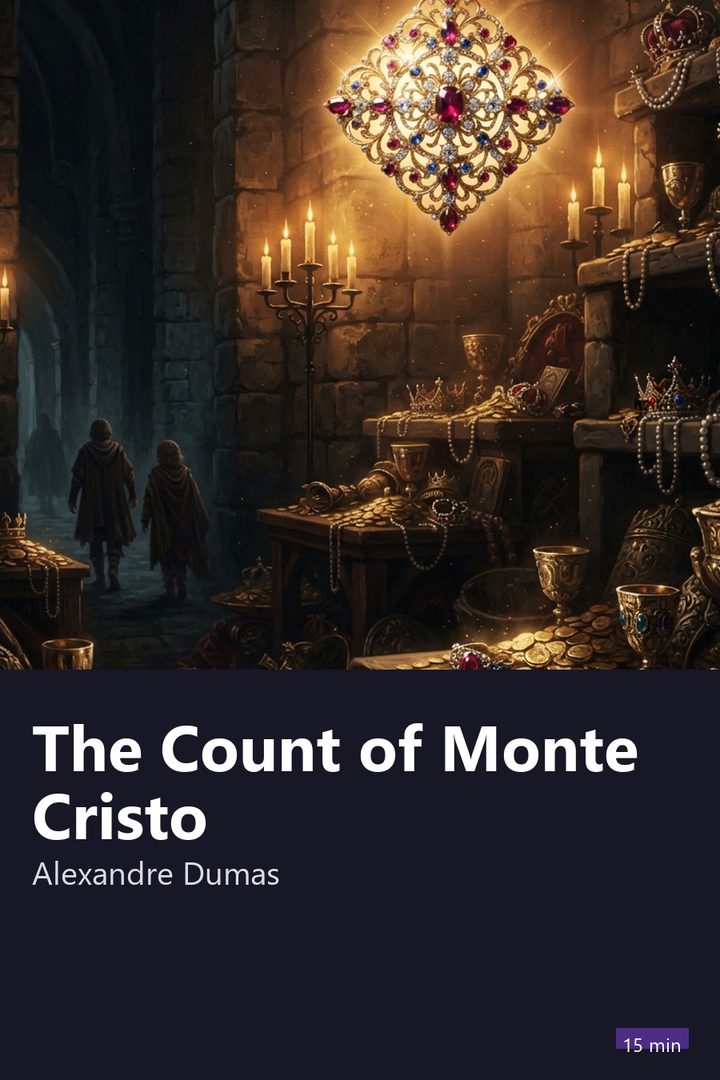
Cover of The Count of Monte Cristo

Fiction · 15 min

The Count of Monte Cristo

Alexandre Dumas · 1844

Who it's for

For readers who love big stories of adventure, injustice and revenge, with plot twists and a moral question underneath. It is a nineteenth-century French classic that still keeps readers hooked.

Read it in the app

⚡ Free to download • 🎁 One full book free every day

🎧 Audio coming soon in the app

Narration for the English summaries is on its way. Meanwhile you can read the full summary in the app.

3 ideas to take with you

1

Fortunes built on credit and appearances are more fragile than they look, as the fall of the book's banker shows.

2

Planning revenge for years consumes the one who plans it, and the price can reach people who were not to blame.

3

In a classic written as a serial, the coincidences and period stereotypes call for a critical reading, even when the plot is thrilling.

“
Envy, jealousy and the silence of those who see and say nothing are enough to ruin an entire life.
An idea from The Count of Monte Cristo, in the words of 15 Minutes

Preview

Start reading now

Marseille, 1815: a man at the peak of happiness

The story begins with a young man who has everything going for him. Edmond Dantès is nineteen, first mate of the ship Pharaon, has just come back from a voyage, and is about to be promoted to captain. He has an elderly father who adores him, he is well liked by the shipowner, Mr. Morrel, and he is going to marry Mercédès, a young woman from a fishing community in the city.

His happiness is simple and well earned, and that is exactly why it bothers some people. On the voyage home, the ship's captain died, and Edmond took command, made good decisions, and stopped at an island, Elba, where he carried out the captain's last request: to receive a letter and take it to Paris.

It seemed like just a favor. But this is a delicate moment for France, with Napoleon in exile and a king newly restored to the throne. Whoever carries a message from the emperor may be delivering a sentence against himself.


Three envies and one accusation

Dantès's downfall is the work of three men, each driven by a different feeling. Danglars, the ship's accountant, wants the captain's post and cannot stand the young man who rose faster than he did. Fernand Mondego, Mercédès's cousin, loves the bride-to-be and sees Edmond as an obstacle. Caderousse, Dantès's neighbor, is driven not by desire but by weakness: he watches the conspiracy and does nothing.

One night over drinks and conversation, Danglars writes an anonymous letter accusing Dantès of being a Napoleonic agent. Fernand hands it to the authorities, and Caderousse, drunk, sees it all without acting. The injustice comes from a sum: ambition, jealousy and ordinary cowardice.

Dumas shows that evil rarely needs a great villain. All it takes is an envious man with a pen, a lover with no scruples, and a witness who prefers to stay quiet. Plenty of real injustice is born the same way: from small omissions that, added together, crush someone.

The prosecutor Villefort and the burned letter

Dantès is arrested at his own engagement party and taken to the king's prosecutor, Villefort, an ambitious young man with a lot to lose. While questioning him, Villefort sees that the young man is innocent, and almost frees him. But he discovers that the letter Dantès was carrying is addressed to his own father, Noirtier, a known Bonapartist.

Villefort realizes that if the contents become public, his career is over. He burns the letter, convinces Dantès that everything is settled, and secretly sends him to the fortress of the Château d'If, a prison on an island, without a trial. Ambition sacrifices justice with no apparent remorse.

This is the moral center of the opening of the book. The man who should defend the law uses it to protect himself. The scene is a harsh critique of power that hides behind official titles and decides the fate of ordinary people out of convenience.

11 more sections and the quiz

Continue in the app

Read the whole summary, finish with the The Count of Monte Cristo quiz and follow the guided Journeys. No ads in the app.

About Alexandre Dumas

Alexandre Dumas was born in 1802 in Villers-Cotterêts, France, and became famous as a novelist and playwright. His father was a general of Haitian origin who served in the French Revolution. Among his best-known works are The Three Musketeers and The Count of Monte Cristo, both published as serials. He wrote with collaborators, spent fortunes, and died in 1870.

Explore

Category:
Fiction
Part of the Journeys:
Addictive Fiction