15 Minutes
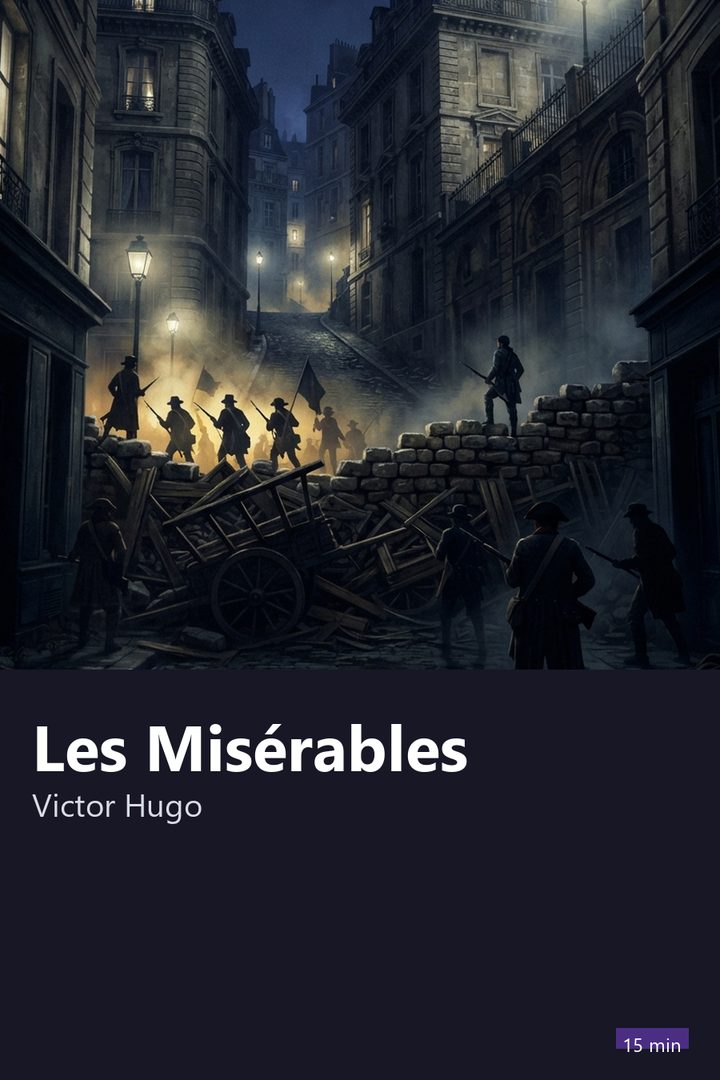
Cover of Les Misérables

Fiction · 13 min

Les Misérables

Victor Hugo · 1862

Who it's for

For readers who want to get to know one of the great classics of world literature without tackling its thousand-plus pages all at once. It also suits anyone who enjoys stories of redemption, social injustice, and the clash between law and conscience.

Read it in the app

⚡ Free to download • 🎁 One full book free every day

🎧 Audio coming soon in the app

Narration for the English summaries is on its way. Meanwhile you can read the full summary in the app.

3 ideas to take with you

1

According to the book, sincere mercy can change a person more deeply than punishment does.

2

A rule applied with no room for exceptions can be honest and still crush the person on the other side.

3

In the novel, telling the truth costs a great deal, but it is what lets the character live at peace with himself.

“
A child carrying buckets in someone else's house is working, even when the name for it is help.
An idea from Les Misérables, in the words of 15 Minutes

Preview

Start reading now

A Giant Novel With a Name That Hurts

Les Misérables is one of the greatest novels of the nineteenth century, written by the Frenchman Victor Hugo and published in 1862. It is set in France, starting in 1815, and follows many lives across almost twenty years of history. The word in the title means the wretched, people crushed by poverty and injustice, not people who are wicked.

The book is enormous, full of characters and detours, with entire chapters about battles, sewers, and convents. Even so, the central thread is simple: a convicted man, a child, a police officer, a young man in love, and a city on the verge of boiling over. Everything is woven around one question that runs through the pages: what does society owe the people it pushes down itself?


The Loaf of Bread and the Nineteen Years

The story begins with Jean Valjean leaving prison after nineteen years. He had been convicted of stealing a loaf of bread to feed his starving nephews and nieces, and his sentence was extended after escape attempts. On his way out, he carries a document that brands him an ex-convict, and because of it no one will give him work or shelter.

Anyone who has seen this in real life understands quickly. The former inmate who looks for a job and runs into closed doors, the criminal record that follows someone for years after the sentence is served, all of it appears here. The book shows how a conviction, without support to start over, becomes a life sentence in disguise.

Valjean leaves jail harder than when he went in. The sentence taught him to hate and to distrust everyone, and that is the state in which the reader meets him.

The Bishop and the Candlesticks

Rejected everywhere, Valjean is taken in at Digne by a kindly bishop, Monseigneur Myriel. In the night, the ex-prisoner runs off with the household silver. Caught by the police, he is brought back, and the bishop says the silver was a gift and even gives him two candlesticks, declaring that with them he is buying Valjean's soul for good.

The gesture disarms Valjean. He expected punishment and receives forgiveness. Later, in a moment of weakness, he steals a coin from a boy on the road and soon after is overcome with shame. That conflict marks the beginning of his inner transformation.

The scene shows one of the book's central ideas: mercy, when sincere, has more power to change someone than punishment. It is not naivety, but a bet that people can remake themselves.

12 more sections and the quiz

Continue in the app

Read the whole summary, finish with the Les Misérables quiz and follow the guided Journeys. No ads in the app.

About Victor Hugo

Victor Hugo was born in 1802 in Besançon, France, and was a poet, novelist, and playwright. He wrote Notre-Dame de Paris in 1831 and became a respected political voice. After Napoleon III's coup, he lived almost twenty years in exile on islands in the English Channel, where he finished Les Misérables. He returned to France in 1870 and died in 1885, with a funeral that drew huge crowds.

Explore

Category:
Fiction
Part of the Journeys:
World Classics