15 Minutes
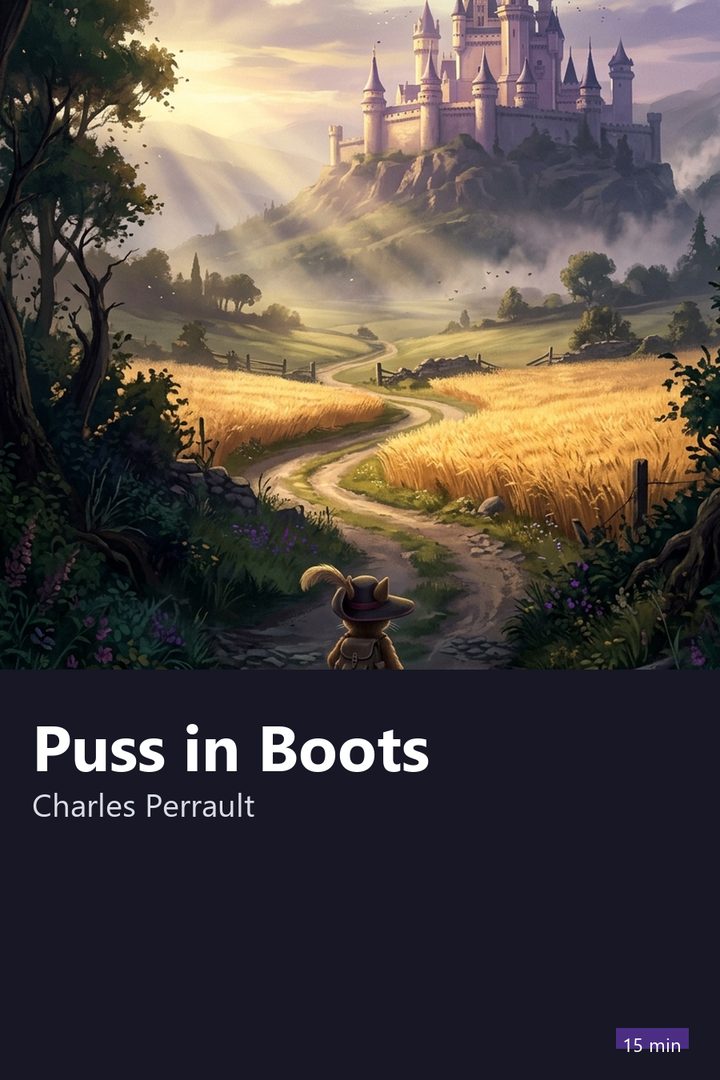
Cover of Puss in Boots

Fiction · 15 min

Puss in Boots

Charles Perrault · 1697

Who it's for

For anyone who wants to revisit a childhood tale through adult eyes, or introduce the story to children and discuss what it teaches about cleverness, appearances, and social advancement. It is also for readers who enjoy discovering where classic fairy tales come from.

Read it in the app

⚡ Free to download • 🎁 One full book free every day

🎧 Audio coming soon in the app

Narration for the English summaries is on its way. Meanwhile you can read the full summary in the app.

3 ideas to take with you

1

In this tale, the hero barely takes action: the point is that having an attentive ally can be worth more than owning property.

2

An opponent's vanity can be the most effective weapon against him, and that is how the cat defeated the ogre.

3

Perrault's two morals slightly contradict each other, and that tension between talent and wardrobe is what keeps the story alive.

“
Getting less than everyone else at the starting line hurts, but that alone does not determine the rest of the story.
An idea from Puss in Boots, in the words of 15 Minutes

Preview

Start reading now

Who Wrote It and Where the Cat Came From

Puss in Boots is one of France's best-known tales, published in 1697 by Charles Perrault in Stories or Tales of Times Past, also known as Tales of Mother Goose. At the time, Perrault was a respected intellectual at the court of Louis XIV, and the tales appeared under his son's name, probably to protect the father's reputation as a serious writer.

The clever cat's story did not begin with Perrault. Similar versions were already circulating in Italy, in collections by Straparola and Basile, while other versions appeared in European oral tradition. What Perrault did was give it an elegant style, an ironic tone, and two explicit morals at the end, making it appealing to the court's audience and to children alike.

This summary covers the entire plot from beginning to end, including the ending, then explores what the story says about cleverness, appearances, and social advancement. Since Perrault's text is in the public domain, we can follow the plot in detail, always in our own words.


The Unfair Inheritance: A Mill, a Donkey, and a Cat

The story begins with a miller's death. He leaves three sons and three possessions: a mill, a donkey, and a cat. There is no complicated will: the oldest gets the mill, the middle son gets the donkey, and the youngest gets what is left, the cat. No one challenges the division, because the brothers think it is fair.

The two older brothers do well for themselves. With the mill and the donkey, they can work together and earn a living. The youngest, alone with a kitty, thinks aloud that after eating the cat and making a warm garment from its skin, he will starve. The scene is funny but quite realistic: the youngest is the heir the family forgot.

Imagine three children of a bakery owner today. One gets the storefront, another gets the delivery van, and the third inherits an old stereo. The story asks what someone does when the division of an inheritance, or life itself, gives them less than everyone else.

The Cat Speaks and Makes a Strange Request

That is when the cat, who has been listening to everything, decides to speak. He asks his master not to despair: all he needs is a sack and a pair of boots for walking through the woods, and the young man will soon see that his inheritance is not as bad as it seems. It is a bold request, but the young man agrees.

His reason for trusting the cat is curious. Perrault explains that the young man had already seen the cat pull tricks to catch rats and mice, such as playing dead while hanging by his paws or hiding in flour. Anyone that clever, his master thinks, might know how to help him. This detail shows how much the story values observation.

The scene also says a lot about the hero's character. He has no special talent, money, or prestige, but he has a rare quality: he gives credit to someone who shows ability, even an animal. In today's terms, he is the boss who listens to an intern proposing a different idea.

10 more sections and the quiz

Continue in the app

Read the whole summary, finish with the Puss in Boots quiz and follow the guided Journeys. No ads in the app.

About Charles Perrault

Charles Perrault was born in Paris in 1628 and died in 1703. He was a writer, an official at the court of Louis XIV, and a member of the French Academy. He earned his place in history with the tales collected in 1697, including Cinderella, Sleeping Beauty, Little Red Riding Hood, and Bluebeard. He also took part in the Quarrel of the Ancients and the Moderns, defending the writers of his own time.

Explore

Category:
Fiction