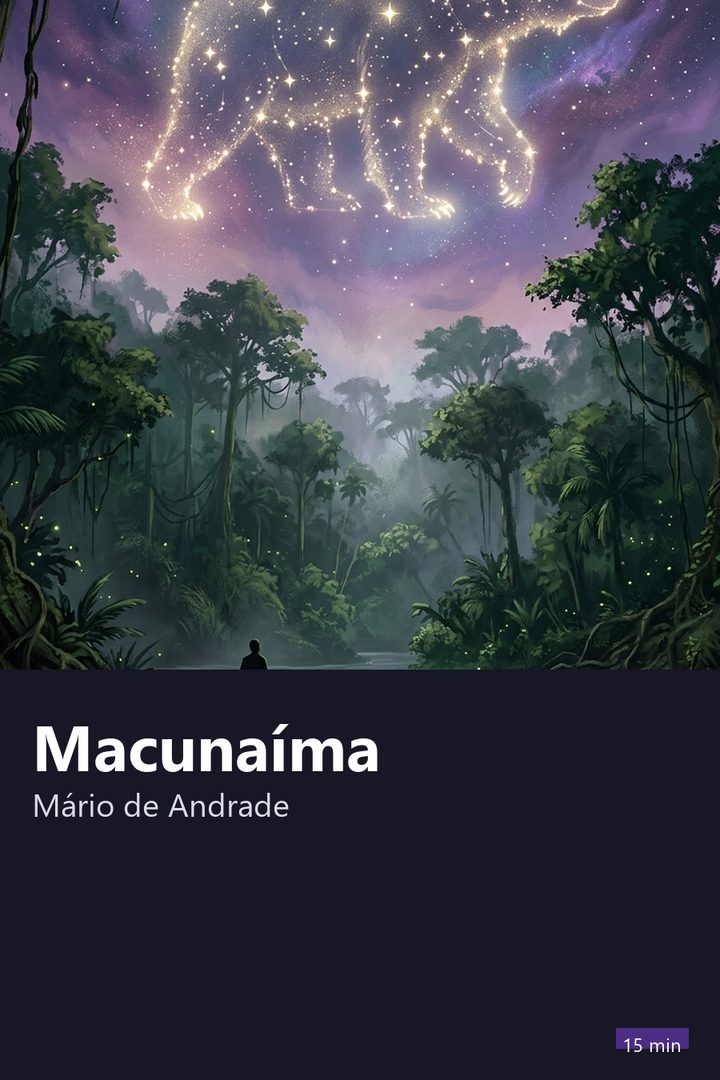
A Hero Who Isn't Really a Hero
Macunaíma, published by Mário de Andrade in 1928, is one of Brazilian literature's strangest and most important books. Its subtitle gives fair warning: the hero with no character. That doesn't mean he's someone without morals, but rather someone without a fixed identity, who changes his shape, mood, and manner whenever it suits him. Anyone expecting a traditional novel with a neatly arranged beginning, middle, and end will find it strange, and that's part of the point.
The author called the book a rhapsody, a word that suggests a patchwork quilt of songs and stories. He gathered Indigenous legends, folk tales, regional speech, urban anecdotes, and references to modern life, stitching everything into an adventure that travels from the Amazon rainforest to São Paulo and back.
Mário wrote the first version in just a few days in 1926, while taking a break in the countryside of São Paulo state. He then revised it into its final form. He drew heavily on legends collected by a German ethnographer, Theodor Koch-Grünberg, among peoples of northern South America.
The work is in the public domain in Brazil, and this summary covers the entire plot, including the ending.