15 Minutes
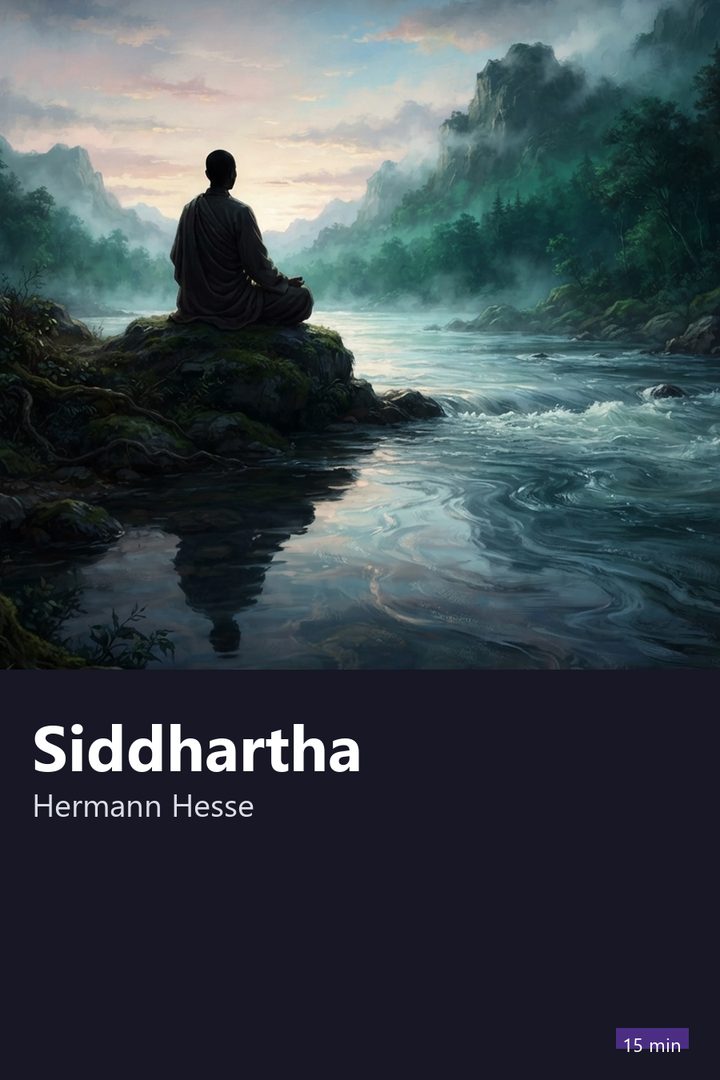
Cover of Siddhartha

Fiction · 14 min

Siddhartha

Hermann Hesse · 1922

Who it's for

For anyone who wants a short classic about the search for meaning, with no need to understand anything about Eastern religions. It suits those who are tired of ready-made answers and want to think about what we learn from life and what we learn from books.

Read it in the app

⚡ Free to download • 🎁 One full book free every day

🎧 Audio coming soon in the app

Narration for the English summaries is on its way. Meanwhile you can read the full summary in the app.

3 ideas to take with you

1

According to the novel, teachers can point the way, but only each person's own experience turns knowledge into wisdom.

2

Money, pleasure, and success can be learned like a game, and the danger lies in forgetting that it is a game.

3

Listening without hurry and without trying to correct the other person is a daily exercise, and the ferryman Vasudeva practices it with the river.

“
Cutting comfort, pleasure, and desire out of the body can turn into just another way of running from yourself.
An idea from Siddhartha, in the words of 15 Minutes

Preview

Start reading now

A young man who has everything and feels something missing

Siddhartha lives in ancient India, the son of a respected Brahmin, handsome, intelligent, and loved by everyone. His friend Govinda follows him like a shadow, and the young women watch him from afar. From the outside, his life is all set: study the sacred texts, perform the rituals, and take his father's place.

On the inside, it's another story. Siddhartha feels that the knowledge he receives does not quench his thirst. His teachers talk about the self, the universe, and the path to peace, but none of them leads him to actually live that peace. He realizes that he knows a lot about things and little about himself.

He's the guy with a steady job, a proud family, and a degree, who lies awake at night asking the ceiling if this is all there is. The book begins with that restlessness, which is not ingratitude but a sign that an important question has not been asked yet.

The night at his father's door

Siddhartha decides to join the Samanas, wandering ascetics who live on alms and give up comfort. He goes to tell his father, who says no. The young man stands before him all night, in silence, without moving a muscle, until the father understands that the decision will not change.

The father lets him go. The scene shows a calm stubbornness: no shouting, no slamming doors, just firmness. It also shows the price, because the one who leaves is leaving a home that wishes him well. Plenty of young people know the feeling of leaving their parents' house to study in another city, with a tight chest and the certainty that they have to go.

Govinda decides to go along with his friend, and the two set out. From then on the story is a long crossing: each stage teaches something, and each teacher, in the end, is left behind.

The Samanas and the escape from oneself

Among the Samanas, Siddhartha learns fast. He learns to fast for days, to endure pain, heat, and cold, to empty his mind in long meditations, and to wait without hurry. He becomes so good that he impresses the elders. On the outside, he is an exemplary ascetic.

After a few years, however, he notices something uncomfortable: all that discipline is a way of running from himself. By silencing his desires, he only postpones the question, and the self is still there, waiting. His body grew thin, but his anguish did not move an inch.

In today's terms, it's the person who tries to fix everything with radical discipline, diets, predawn workouts, a monk-like routine, and is still unsatisfied. The book does not look down on effort, but it points out the risk of using it as a hiding place.

11 more sections and the quiz

Continue in the app

Read the whole summary, finish with the Siddhartha quiz and follow the guided Journeys. No ads in the app.

About Hermann Hesse

Hermann Hesse (1877-1962) was born in Germany and spent a good part of his adult life in Switzerland, where he became a citizen in 1924. The son and grandson of missionaries who had lived in India, he grew up surrounded by stories of the East and by discussions about faith. He wrote novels such as Demian, Steppenwolf, and The Glass Bead Game, and received the Nobel Prize in Literature in 1946. Siddhartha, published in 1922, became a beloved read for several generations.

Explore

Category:
Fiction
Part of the Journeys:
World Classics