15 Minutes
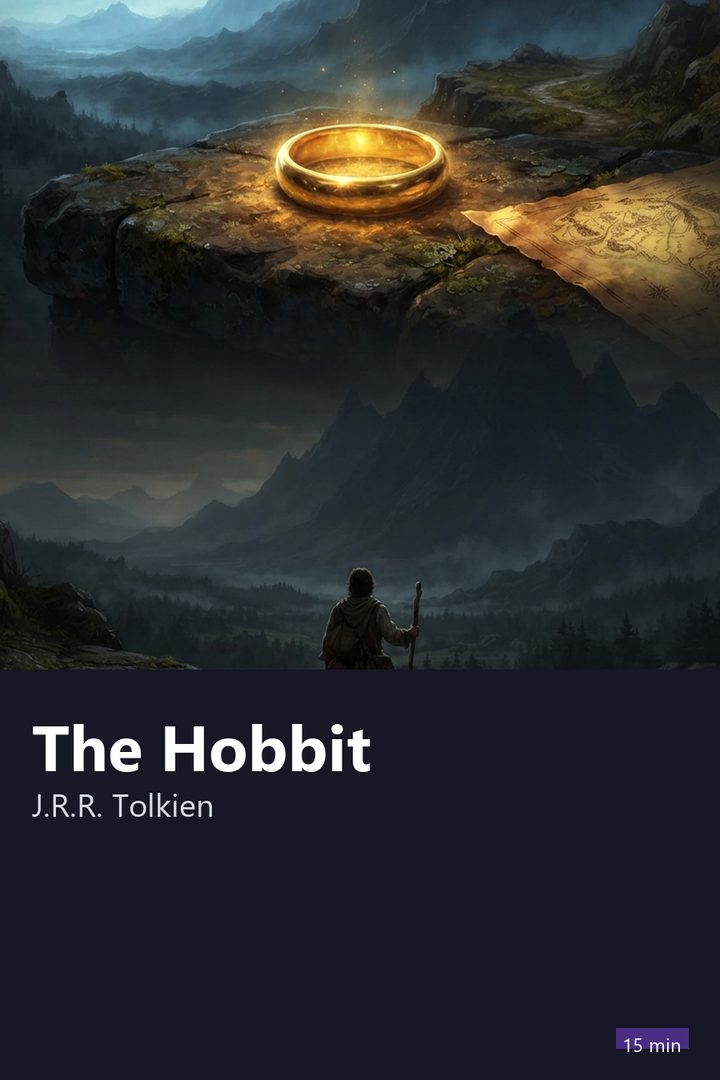
Cover of The Hobbit

Fiction · 16 min

The Hobbit

J.R.R. Tolkien · 1937

Who it's for

For anyone who wants to discover, or revisit, one of the great fantasy adventures, full of humor and the courage of ordinary people. It also works for those reading along with their kids or wanting to understand where Middle-earth comes from.

Read it in the app

⚡ Free to download • 🎁 One full book free every day

🎧 Audio coming soon in the app

Narration for the English summaries is on its way. Meanwhile you can read the full summary in the app.

3 ideas to take with you

1

Asking for guidance from someone with more experience lets you see what you couldn't see alone: the map only revealed the secret door in Elrond's hands.

2

Avoiding a war may require a gesture that looks like betrayal to your own friends, and the book treats that choice as courageous.

3

Coming home changed is part of the adventure: the neighbors find you strange, and the hero learns he doesn't need everyone's approval.

“
Leaving your comfort zone is scary, but it's on the outside that you find out how much courage you have.
An idea from The Hobbit, in the words of 15 Minutes

Preview

Start reading now

A hobbit who loves his quiet life

Bilbo Baggins is a hobbit, a small, furry-footed creature who lives in a comfortable hole in the Shire. He likes eating at regular hours, tea, a pipe, and a predictable life. Adventure, to him, is something for odd people, and the neighbors think the same.

One morning, a wizard named Gandalf shows up at his door and invites him on an adventure. Bilbo, wary, says he'd rather stay home and tries to wriggle out of the invitation with good manners. It's a scene everybody knows: the uncle who prefers the couch and the Sunday barbecue to any invitation to travel.

The book starts here because this is its big theme: what happens to someone who lives comfortably settled and gets dragged, almost against his will, out the front door.
Thirteen dwarves and a wizard at teatime

The next evening, Bilbo's house is invaded by dwarves who arrive one by one, asking for food and drink. There are thirteen of them, led by Thorin Oakenshield, a dwarf with enormous pride. Bilbo scurries back and forth serving them, distressed by the mess and the emptying pantry.

The dwarves explain the plan: years ago, the dragon Smaug took over the Lonely Mountain, where they lived, and carried off all the treasure. Now they want it back. Gandalf recommended Bilbo as the expedition's burglar, a job he has never done. The dwarves doubt him, and Bilbo, offended, accepts just to avoid looking weak.

It's a pressure the reader knows well: accepting a challenge out of pride and only later realizing how big it is. The next morning, Bilbo runs out of the house, late, without a handkerchief or a hat, and the journey begins.

The dwarves' names are so alike that readers get lost, and the book plays with that. The fun lies in the contrast between the solemn mission and the chaos in the home of a hobbit who only wanted a quiet day.

The trolls and the wizard's cunning

In the first days of travel, the group gets into trouble. On a rainy night, Bilbo is sent to investigate a light and finds three trolls roasting mutton. He tries to steal a purse from one of them and gets caught, and the dwarves, coming to help, are captured one by one and stuffed into sacks.

Gandalf is the one who saves them, imitating the trolls' voices and stirring up an argument among them until sunrise turns them to stone. The book shows there that cunning can beat brute force, and that not everything is solved with a sword.

In the trolls' lair the group finds treasure and weapons, among them an elven blade that Bilbo receives as if it were a small dagger and that makes him feel more capable. Tools help, but it's confidence that makes use of them.

11 more sections and the quiz

Continue in the app

Read the whole summary, finish with the The Hobbit quiz and follow the guided Journeys. No ads in the app.

About J.R.R. Tolkien

Tolkien (1892-1973) was born in South Africa and grew up in England, where he studied at Oxford and became a professor of ancient languages and literature. He fought in World War I, an experience that left its mark on his writing. He created languages and the geography of an entire world, Middle-earth, and published The Hobbit in 1937, written first to entertain his children. He later wrote The Lord of the Rings, which made him one of the most influential fantasy authors in history.

Explore

Category:
Fiction
Part of the Journeys:
Addictive Fiction