15 Minutes
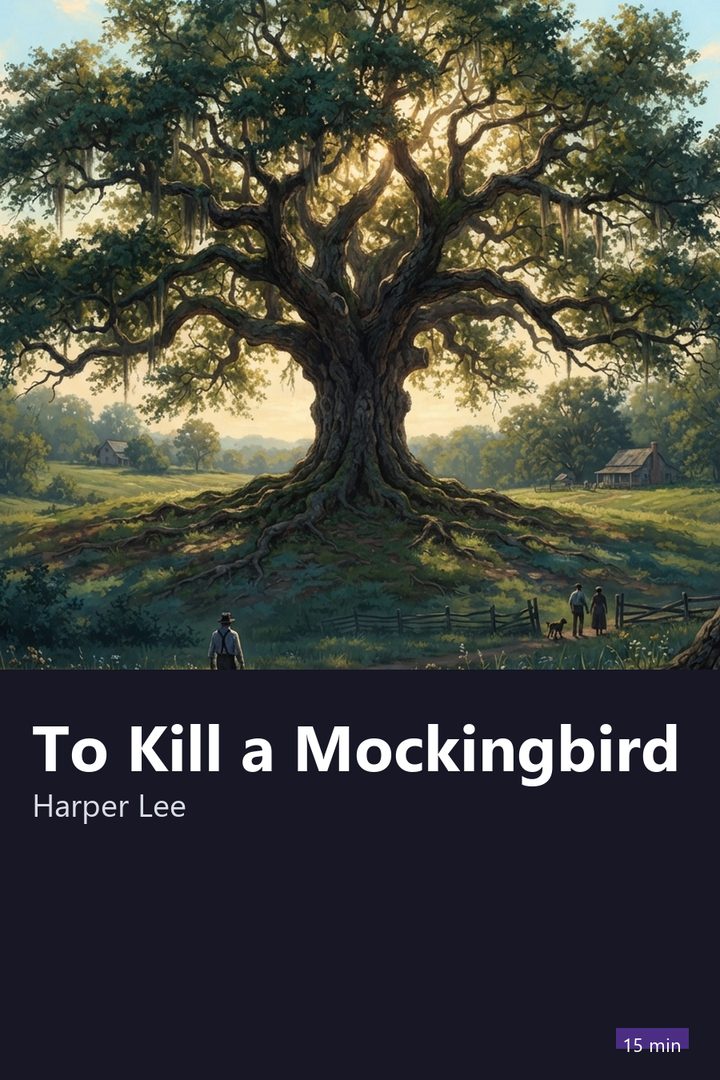
Cover of To Kill a Mockingbird

Fiction · 17 min

To Kill a Mockingbird

Harper Lee · 1960

Who it's for

For anyone who wants to revisit, in just a few minutes, one of the most widely read novels in schools about racism, justice and childhood. It also works for anyone who wants to talk with kids and students about empathy and moral courage.

Read it in the app

⚡ Free to download • 🎁 One full book free every day

🎧 Audio coming soon in the app

Narration for the English summaries is on its way. Meanwhile you can read the full summary in the app.

3 ideas to take with you

1

According to the book, teaching by example is worth more than a lecture: kids learn from what they see their parents do when nobody is watching.

2

The bird in the title stands for people who only do good and get destroyed anyway, an image readers can apply to many injustices.

3

Seeing the world from someone else's window, as the girl does at the end, is the first step toward understanding it.

“
Not every shadow in the window is a monster: sometimes it's just someone nobody taught how to be seen.
An idea from To Kill a Mockingbird, in the words of 15 Minutes

Preview

Start reading now

Maycomb, 1930: a small town with old rules

To Kill a Mockingbird, by Harper Lee, published in 1960, takes place in Maycomb, a little town in Alabama, in the American South, in the early 1930s, in the middle of the Great Depression. Everybody knows everybody, poverty is everywhere and social rules weigh heavily: who belongs to which family, who goes to which church, who stays on which side of the racial line.

Segregation is both law and custom: Black and white people go to school, pray and live in separate spaces, and the justice system tends to favor whites. In this setting, typical of Southerners of the time, the book shows the life of a family and a community.

The story is told by Scout, a six-year-old girl at the start, looking back as a grown woman. That perspective makes the world appear with a child's curiosity and frankness, which makes everything cut deeper: she asks what the adults have already learned to keep quiet about.
Scout, Jem and Dill: the summer of curiosity

Scout lives with her brother, Jem, four years older, and with her father, Atticus Finch, a widower and lawyer. Her mother died when she was very small. The one who helps raise the two kids is Calpurnia, the family's Black cook, who demands obedience and teaches good manners without making any concessions. Every summer Dill arrives, a boy from another town who spends his vacation at his aunt's house next door, and he becomes the third member of the group.

The trio invents games, makes bets and spends their days between the street and the yard. One of their obsessions is trying to catch a glimpse of the mysterious figure inside the Radley house, just a few yards away. Neighborhood life, with its gossip and neighbors who know everything, feels like any small-town street.

The kids understand the world only through what they hear, and since they hear all kinds of things, they gradually sort out what makes sense from what doesn't. That is how the book slowly reveals the contradictions of the adult world.

Boo Radley, the neighbor nobody sees

The Radleys live in a gloomy house with shuttered windows, where Boo lives, a reclusive man who hasn't gone out in years. The rumors say everything: that he's dangerous, that he eats raw animals, that he attacks anyone who gets close. The kids feed the legend and turn the subject into a game, somewhere between fear and fascination.

Little by little, small gifts begin to appear in the hollow of a tree in the Radley yard: chewing gum, old coins, little figures carved from soap, a broken watch. Someone is trying to communicate. When the hollow is plugged with cement, the kids realize they have lost that neighbor's only channel of affection.

On another night, someone drapes a blanket over Scout's shoulders without her noticing. The lesson, which the end of the book will deliver in full, is that the monster of the rumors was a shy and caring person, and that collective imagination sometimes creates villains where there is only loneliness.

11 more sections and the quiz

Continue in the app

Read the whole summary, finish with the To Kill a Mockingbird quiz and follow the guided Journeys. No ads in the app.

About Harper Lee

Harper Lee was born in 1926 in Monroeville, Alabama, a small town that inspired the Maycomb of the novel. She studied law but dropped out to write, and she was a childhood friend of the writer Truman Capote, who inspired the character Dill. To Kill a Mockingbird, published in 1960, won the Pulitzer Prize for fiction in 1961 and became a movie in 1962. In 2015 Go Set a Watchman came out, written earlier and presented as a sequel, and the author died in 2016.

Explore

Category:
Fiction
Part of the Journeys:
Vacation Reads