15 Minutes
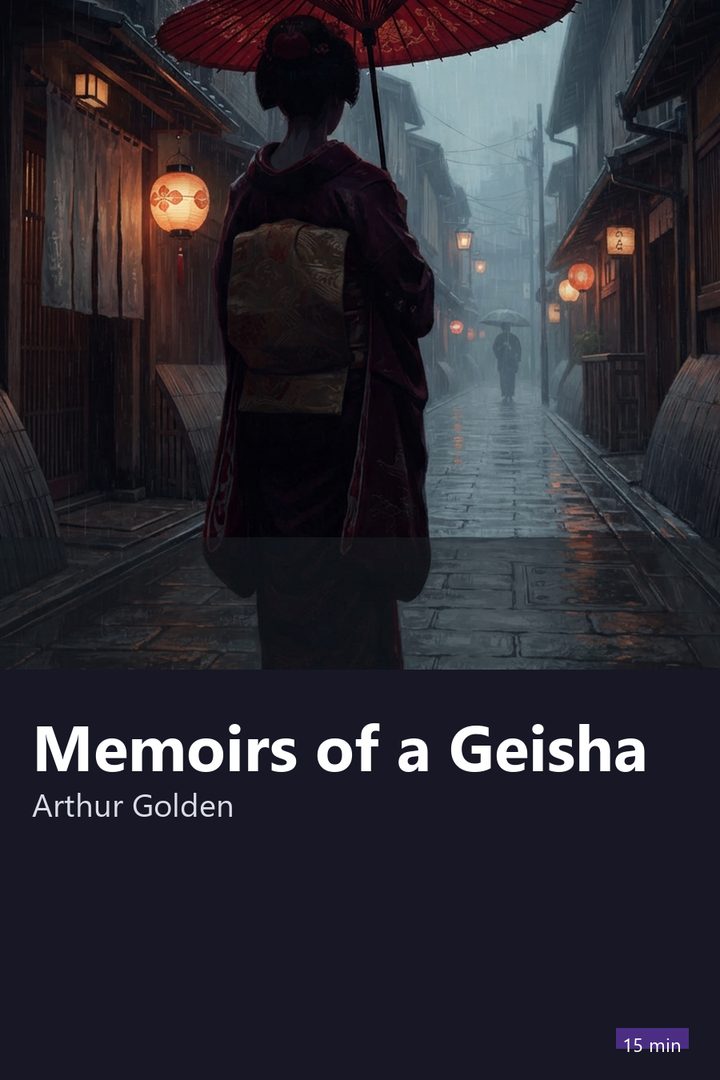
Cover of Memoirs of a Geisha

Fiction · 15 min

Memoirs of a Geisha

Arthur Golden · 1997

Who it's for

For readers who enjoy long, absorbing novels about women who have to make their way through a harsh world with intelligence. It also works for anyone who wants to understand, with a critical eye, how the book shaped the image of geishas in the West.

Read it in the app

⚡ Free to download • 🎁 One full book free every day

🎧 Audio coming soon in the app

Narration for the English summaries is on its way. Meanwhile you can read the full summary in the app.

3 ideas to take with you

1

A single act of kindness, even a brief one, can become the compass of an entire life, but it can also lock the person who receives it into one direction.

2

War shows how a world that seemed eternal can end in a short time, and those who were ready to adapt suffer less.

3

The story suggests that even inside an imposed destiny, there is still room to make choices, even small ones.

“
Anyone who starts life in debt to the house they live in rarely manages to own their own path.
An idea from Memoirs of a Geisha, in the words of 15 Minutes

Preview

Start reading now

A Book That Pretends to Be a Confession

Memoirs of a Geisha is a novel, but it presents itself as the true account of an elderly woman. In the opening, a supposed historian says he gathered the recollections of Nitta Sayuri, a former geisha living in New York. After that, she is the one speaking, in the first person, looking back.

This frame is a literary trick: the reader enters the story like someone listening to a grandmother tell about the past, with affection, vanity, and a few gaps. It's worth remembering the whole time that none of it is real biography. It is fiction, written by an American, inspired by research on Japan in the first half of the twentieth century.

The Girl from the Fishing Village

It all begins in a small fishing village by the sea, in the late 1920s. Chiyo, nine years old, has blue-gray eyes that are rare in that region, and she lives with her father, already old, and her mother, who is very ill. The house is poor, crooked, and smells of fish, and the family gets by as best it can.

A local merchant, Mr. Tanaka, sees opportunity where others see misfortune. In exchange for money, he takes Chiyo and her older sister, Satsu, to the big city, with the promise of better work. Their father accepts because he sees no way out, and their mother has no strength to stop it. It is the act that tears the girl away from her childhood.

The book treats the scene soberly, but it leaves a sense of unease: a child is sold, and everyone around her finds excuses to call it an opportunity. The story thus begins with a kind of exploitation that, in other forms, still exists today, when poverty is used as an argument to take away the choice of people who have no way to refuse.

Two Sisters, Two Fates

The train ride to Kyoto is the last time Chiyo sees the world she knew. On arrival, the sisters are separated. Satsu is taken to a brothel, a fate the book shows with discretion, and Chiyo is sent to a geisha house in the Gion district, called an okiya.

The separation is the protagonist's first great wound. For years, she tries to find her sister again, and that search is one of the threads of the story. The contrast between the two, one thrown into a worse fate and the other into a world full of luxury and traps, shows how chance decides entire lives.

12 more sections and the quiz

Continue in the app

Read the whole summary, finish with the Memoirs of a Geisha quiz and follow the guided Journeys. No ads in the app.

About Arthur Golden

Arthur Golden was born in 1956 in Chattanooga, Tennessee. He studied art history at Harvard, specialized in Japanese history at Columbia University, and earned a master's degree in English in Boston. He spent some time in Japan, where he deepened his research on the country's culture. Memoirs of a Geisha, published in 1997, took about six years to write, became a worldwide best seller, and inspired a film released in 2005.

Explore

Category:
Fiction
Part of the Journeys:
Addictive Fiction