15 Minutes
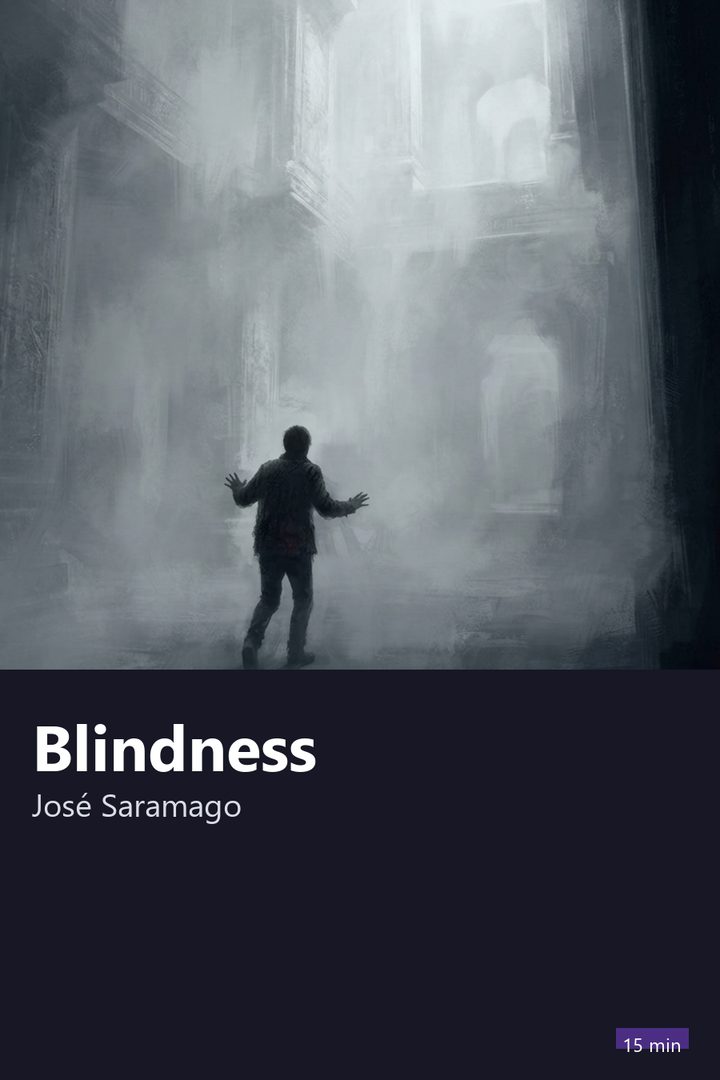
Cover of Blindness

Fiction · 15 min

Blindness

José Saramago · 1995

Who it's for

For readers who like novels that use an impossible situation to talk about morality, power, and solidarity. It contains scenes of violence, including sexual violence, handled soberly, and it asks for patience with the author's style.

Read it in the app

⚡ Free to download • 🎁 One full book free every day

🎧 Audio coming soon in the app

Narration for the English summaries is on its way. Meanwhile you can read the full summary in the app.

3 ideas to take with you

1

Whoever controls an essential resource, like food, ends up giving the orders, and in the story, collective organization is the counterweight to that power.

2

In the novel's pessimistic view, civilization depends on small everyday agreements, and when they fail, the distance to violence can be short.

3

Using blindness as a metaphor for moral failure is a literary device. It does not portray the lives of blind people, who study, work, and live independently.

“
Whoever can see in a world where almost no one can receives a duty, not a privilege.
An idea from Blindness, in the words of 15 Minutes

Preview

Start reading now

The Light That Turns Green and the Car That Won't Move

The story begins at an ordinary intersection in a city that is never named. The light turns green, the cars move forward, and one of them doesn't budge. The driver, stopped in the middle of the road, says he can't see. But it isn't darkness: he says he sees everything white, as if he were submerged in a sea of milk.

A man shows up to help, takes the blind man home, and then steals his car. The wife arrives, worried, and takes her husband to the eye doctor. The exams show nothing wrong with his eyes. Neither science nor common sense can explain what happened.

José Saramago's book never explains the cause of the blindness, and that's on purpose. He isn't writing science fiction: he's writing an allegory, a story in which the impossible is used to show something true about people and about society.
The Blindness That Spreads

The white blindness begins to spread. The car thief goes blind, then the eye doctor who treated the first man, then the people who were in the waiting room of the office: a young woman in dark glasses, an old man with a black patch over one eye, a boy with a squint. Before long, anyone who has had contact with them loses their sight too.

The author treats the phenomenon as contagion, and the government's reaction is the one you'd expect from a frightened power: isolate. Before any medical help comes the order to separate the sick from the healthy. Fear comes before compassion, and the decision is made by those who can still see, in the name of protecting the majority.

The image is powerful because it recalls real epidemics. When a new disease appears, the first collective reaction is usually to look for someone to blame and to push away the infected, even before understanding what is happening.

The Quarantine in the Old Asylum

The first blind people are taken to an abandoned asylum, turned into a quarantine space. Soldiers keep watch outside and have orders to let no one leave. Anyone who tries to escape is shot. As more people go blind, they are sent there too, and the place begins to fill up.

The building is a symbol of exclusion: a space that once served to hide people society didn't want to see. Now the blind are placed there, far from the eyes of those who can still see, receiving food tossed in by soldiers who are afraid to come near.

From the first pages, the novel shows that when authorities treat people as a problem to be stored away, dignity is lost quickly. There are no doctors, no explanations, only rules announced over a loudspeaker and the promise that everything will be sorted out.

11 more sections and the quiz

Continue in the app

Read the whole summary, finish with the Blindness quiz and follow the guided Journeys. No ads in the app.

About José Saramago

José Saramago was born in 1922 in Azinhaga, Portugal, and worked as a locksmith, a civil servant, and a journalist before devoting himself to literature. Among his best-known books are Baltasar and Blimunda (Memorial do Convento) and The Gospel According to Jesus Christ. He received the Nobel Prize in Literature in 1998, three years after this novel. He spent his last years on the island of Lanzarote, in Spain, where he died in 2010.

Explore

Category:
Fiction
Part of the Journeys:
Vacation Reads