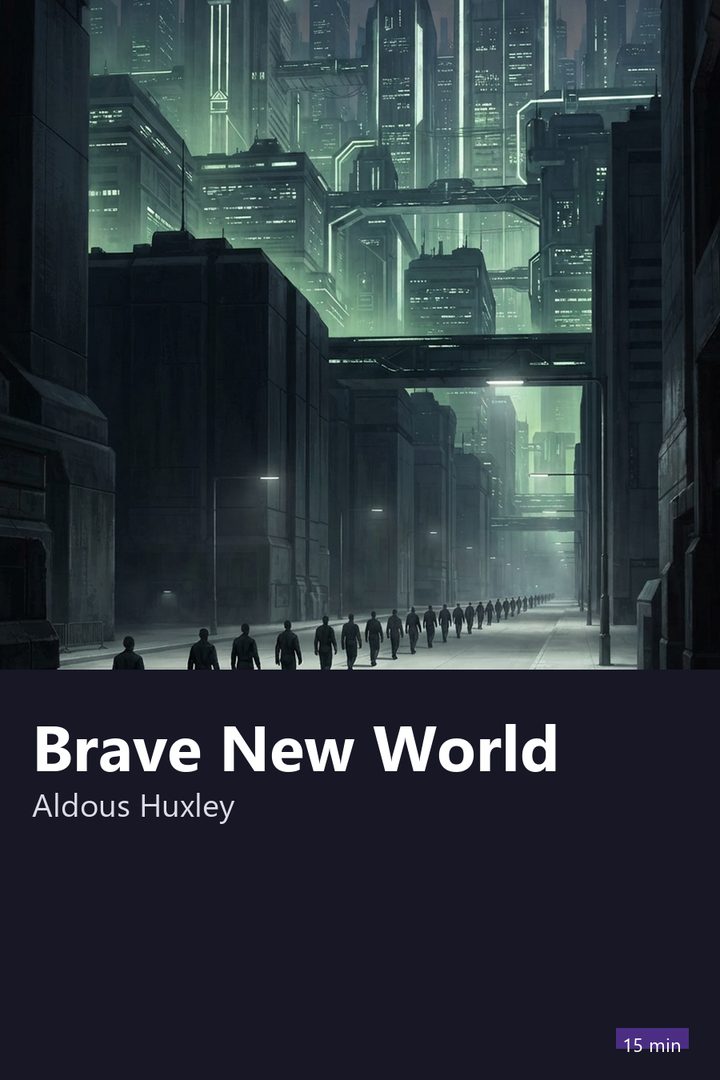
15 Minutes
Cover of Brave New World

Fiction · 15 min

Brave New World

Aldous Huxley · 1932

Who it's for

For anyone who wants to get to know the science fiction classic about a society where everyone seems happy and no one is free. Also for those who like to debate technology, consumption, and social control, knowing that this summary tells the whole story.

Read it in the app

⚡ Free to download • 🎁 One full book free every day

🎧 Audio coming soon in the app

Narration for the English summaries is on its way. Meanwhile you can read the full summary in the app.

3 ideas to take with you

1

The world of the book buys stability with planned inequality: each caste is manufactured to like the place it was given, and no one has to be forced to obey.

2

In the story, nonstop entertainment works like anesthesia: no one suffers, but no one asks any questions either, and the silence passes for happiness.

3

The character Helmholtz realizes he writes far too well about nothing, and the novel suggests that art needs some pain and some freedom to have something to say.

“
A lot of what seems like your own taste may have been taught so early that you don't even remember choosing it.
An idea from Brave New World, in the words of 15 Minutes

Preview

Start reading now

London, Year 632 After Ford

The story is set in the distant future, in London, in the year 632 After Ford. The calendar changes because the cult hero of this world is Henry Ford, the carmaker who invented the assembly line. People make the sign of the T instead of the sign of the cross, and they say Our Ford where they once said Our Lord.

The planet is governed by a World State whose motto is Community, Identity, Stability. There is no war, hunger, disease, or painful old age. Everyone has work, food, leisure, and pleasure. In exchange, no one has a family, religion, old books, or the freedom to choose their own destiny.

The novel opens in a hatchery, where a director shows young visitors how the system works. The scene looks like a school field trip, but little by little it reveals the price of manufactured happiness.
The People Factory

In this world, no one is born from a mother. Babies are made in a lab, from fertilized eggs developed in bottles on a production line. A process called Bokanovsky splits a single egg into dozens of identical embryos, so that one single cell produces a whole batch of twins.

Society is divided into castes: Alphas, Betas, Gammas, Deltas, and Epsilons. Alphas are the smartest and most gifted, and they do the work of command. Epsilons, at the other extreme, are produced with reduced oxygen, on purpose, to have little intelligence and do the heaviest labor.

The logic is cold and functional: each caste gets only what it needs to play its role, and none is trained to want more. That way, no one envies those above or looks down on those below, because everyone was made to like what they are.

None of this is presented as cruelty. Inside the system, it is treated as efficiency, and the professionals talk about it with the pride of engineers. The reader feels uneasy precisely because the tone is one of routine.

Conditioned From the Cradle

The babies are not only born ready-made, they are trained from an early age. In a famous scene, children are placed in front of books and flowers, and when they reach for them, they get a shock and hear sirens. After this is repeated many times, they come to feel fear and disgust toward books and nature. The goal is that they won't want to read or take walks in the countryside, and will consume instead.

There is also hypnopedia, teaching during sleep. Phrases are repeated in a low voice in the dormitories for years, until they become convictions. Slogans like it's better to wear old clothes than to mend them get etched into the mind and steer behavior.

This means no one has to be forced to obey. The system doesn't command, it convinces, and it convinces so early that people don't remember having chosen. It is a form of control that doesn't look like control, and that is why it is so effective.

11 more sections and the quiz

Continue in the app

Read the whole summary, finish with the Brave New World quiz and follow the guided Journeys. No ads in the app.

About Aldous Huxley

Aldous Huxley was an English writer, born in 1894 into a family of scientists and intellectuals, and the grandson of the biologist Thomas Henry Huxley. He wrote novels, essays, and screenplays, and moved to the United States in the 1930s, where he lived until his death in 1963. Brave New World, from 1932, is his most famous book, and the title comes from a line in Shakespeare's play The Tempest. He later also wrote Island and The Doors of Perception.

Explore

Category:
Fiction
Part of the Journeys:
Dystopias and Warnings