15 Minutes
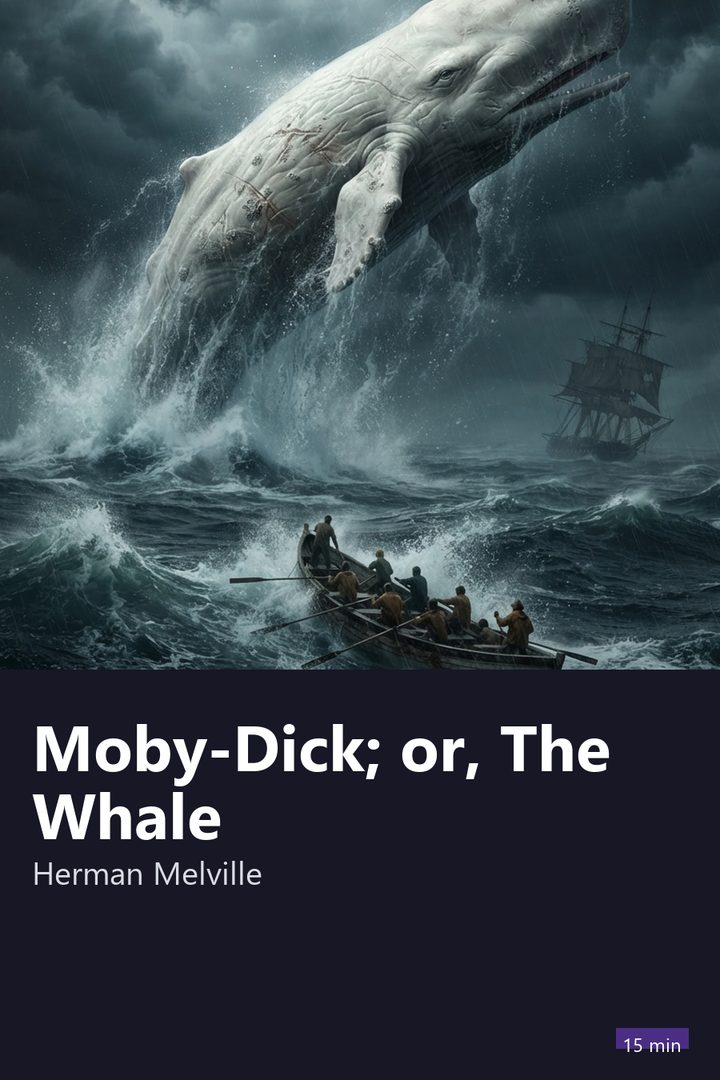
Cover of Moby-Dick; or, The Whale

Fiction · 15 min

Moby-Dick; or, The Whale

Herman Melville · 1851

Who it's for

For anyone who has heard of Captain Ahab and the white whale but never tackled the classic. It's also for anyone who has watched a boss or a coworker sacrifice everything for a goal and wants to understand that machinery through literature.

Read it in the app

⚡ Free to download • 🎁 One full book free every day

🎧 Audio coming soon in the app

Narration for the English summaries is on its way. Meanwhile you can read the full summary in the app.

3 ideas to take with you

1

Ahab doesn't order the hunt: he sells it, with gold, a speech and a toast, and an obsession packaged that way spreads like a fad.

2

Over the three days of the chase, every failure becomes a reason to try again: obsession doesn't learn, it just raises the bet.

3

In the book, the whale's whiteness is frightening less because it's ugly and more because it's empty: everyone sees in it whatever they fear most.

“
A stranger in the first hour, a partner in the second: sharing the same roof knocks down a lot of prejudice.
An idea from Moby-Dick; or, The Whale, in the words of 15 Minutes

Preview

Start reading now

A Narrator in Search of the Sea

The story is told by Ishmael, a young man with no money and no direction, who describes himself as someone seized by a sadness that shows up whenever life turns gray. His remedy is an old one: go to sea. Instead of going as a passenger, he wants to sign on as a common sailor, because that way he gets paid to work instead of paying to travel.

He leaves Manhattan and heads to the port town of New Bedford, where the whaling ships set out. It's the mid-nineteenth century, and whaling was a huge industry: the oil lit homes and lubricated machines, much as petroleum would later. Think of a port town where everyone makes a living, one way or another, off the same commodity.

Ishmael warns right away that the book will be strange: it has adventure, but also science, religion, humor and philosophy, all mixed together. Anyone who comes in expecting only a hunt will be surprised by how many detours the voyage takes.


The Bed Shared with Queequeg

At the inn, the owner says there's only one bed left and that Ishmael will have to share it with a harpooner who hasn't come back yet. When the man arrives, he turns out to be an enormous, tattooed Polynesian with a frightening look, who sells embalmed human heads. Ishmael nearly runs away.

The harpooner is named Queequeg, comes from a distant island, is the son of a chief, and left home to see the world of the Christians. He smokes a pipe in bed and prays before a wooden idol, and Ishmael gradually realizes he is a far more dignified man than plenty of people with a fancy family name.

The two become inseparable friends, to the point that Ishmael considers himself married to him. The friendship serves as a counterpoint to the brutality of the rest of the book and knocks down one prejudice at a time: it shows how living side by side dismantles the fear of the different.

Jonah's Sermon and the Departure

Before shipping out, Ishmael steps into a chapel and hears Father Mapple, a former whaler, preach about Jonah, the prophet who fled the mission God gave him and was swallowed by a great fish. The sermon is about obedience, fear and repentance, and it sets the religious and tragic tone of the voyage.

In Nantucket, Ishmael and Queequeg present themselves to Peleg and Bildad, two retired Quakers who own shares of the ship Pequod and choose the crew. No one there gets a fixed salary: each sailor receives a slice of the profit, and Ishmael's is tiny. If the boat doesn't catch anything, nobody gets paid.

A stranger named Elijah warns, in riddles, that the ship's captain is a dangerous man and that they will regret it. Ishmael ignores him. The reader, already alerted by the sermon and the prophecy, boards knowing the story may end badly.

10 more sections and the quiz

Continue in the app

Read the whole summary, finish with the Moby-Dick; or, The Whale quiz and follow the guided Journeys. No ads in the app.

About Herman Melville

Herman Melville was born in New York in 1819 and died in 1891. As a young man, he shipped out on a whaler and lived through adventures in the Pacific that fed his first books, such as Typee, from 1846. Moby-Dick came out in 1851 and sold poorly, and he spent a good part of his life working as a customs inspector in New York. Only decades after his death, in the 1920s, was the book rediscovered and recognized as one of the great novels in the English language.

Explore

Category:
Fiction
Part of the Journeys:
The Great Novels