15 Minutes
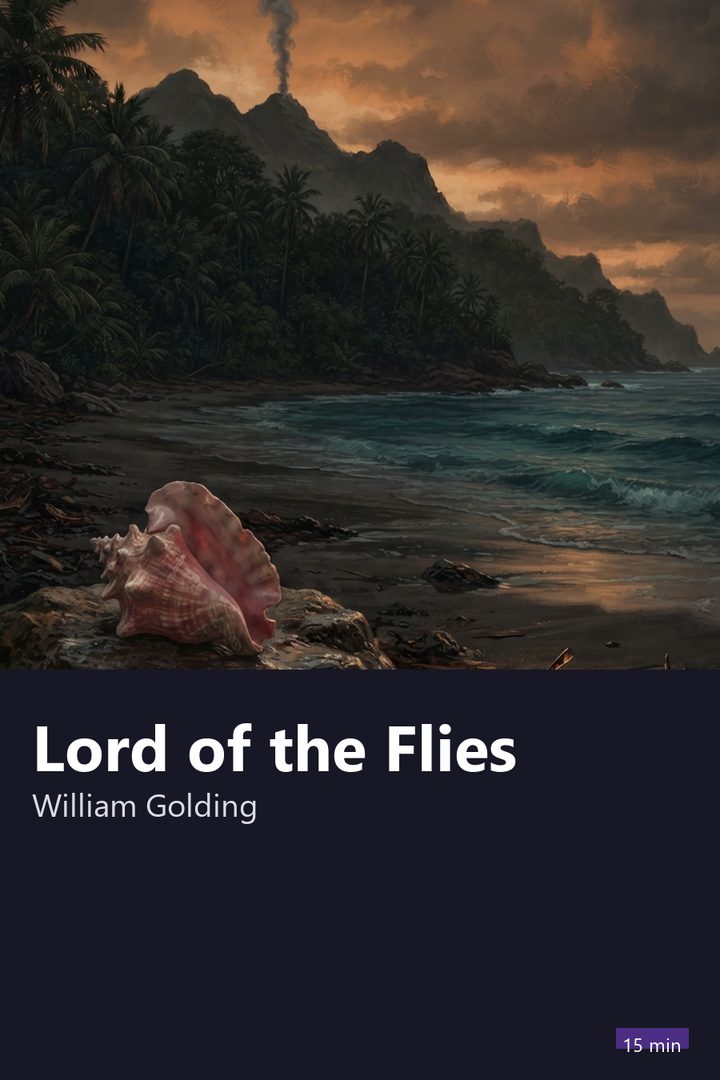
Cover of Lord of the Flies

Fiction · 14 min

Lord of the Flies

William Golding · 1954

Who it's for

For you if you remember the title from school but never made it to the end, or if you want to understand why a group without clear rules can slide into violence. This is a summary of the story, what it means, and what's worth discussing about it.

Read it in the app

⚡ Free to download • 🎁 One full book free every day

🎧 Audio coming soon in the app

Narration for the English summaries is on its way. Meanwhile you can read the full summary in the app.

3 ideas to take with you

1

Faceless fear is fuel: the less concrete the threat, the easier it is to use it to control others.

2

The boring, unapplauded job, like keeping the fire going, is what holds a group together, and it's the first thing the group drops when something fun comes along.

3

In this book, being right without having status isn't enough: the correct warning, given by the wrong person, usually gets ignored.

“
A rule only works as long as the group believes in it: the conch was just a conch until everyone decided it was in charge.
An idea from Lord of the Flies, in the words of 15 Minutes

Preview

Start reading now

A plane crashes and no adult survives

The story begins in the middle of a war. A plane carrying English boys away from danger, a kind of child evacuation, is shot down and crashes on a deserted tropical island. The pilot dies, and the only ones left are boys, roughly six to twelve years old. There are no adults, no working radio, and nobody in the world knows where they are.

Imagine being left alone outside school with nobody coming to pick you up, only multiplied by a thousand. At first, though, the mood is like a party. There's fruit, there's a beach, there's water, and nobody telling them to take a bath. The book, published in 1954, uses that early excitement precisely so it can show the bill coming due later.

From day one, Ralph tries to treat the situation as a problem to solve: who will explore the island, where the water is, how to let people know they're there. Everyone happily agrees that some adult will show up soon. That calm certainty is the starting point of the book, and it will be taken apart bit by bit.

The conch and the first rule

Two boys meet on the beach: Ralph, blond, athletic, about twelve, and a chubby, bespectacled, asthmatic boy whom everyone ends up calling Piggy, a nickname he hates. The two find a big conch shell in the lagoon, and Ralph discovers that when he blows into it, it makes a sound that carries far.

The sound gathers the others for an assembly. That's where the group's first rule is born: whoever holds the conch speaks, and the others listen. It's like whoever owns the ball in a neighborhood pickup game: the ball itself doesn't boss anyone around, but everybody agrees that it does, and that's why the game works. Ralph is chosen as leader by a vote, more for his calm manner and the conch than for any plan.

Ralph and Piggy: leadership and brains

Ralph wants two things: to be rescued and to keep order. For that, he needs a fire that makes smoke and decent shelters. But he isn't the one who has the ideas; he's the one who wants the right thing. The thinker is Piggy: he remembers the rules, sees the risks, and has the glasses that will later become the most valuable object on the island.

The problem is that nobody listens to Piggy. He's fat, he talks differently, he's annoying, and the others treat what he says as the words of someone with no clout. Here the book shows an uncomfortable lesson: being right doesn't guarantee power. If you've ever been the coworker who warned that the deadline wouldn't work and got ignored until everything went wrong, you know exactly what this is about.

12 more sections and the quiz

Continue in the app

Read the whole summary, finish with the Lord of the Flies quiz and follow the guided Journeys. No ads in the app.

About William Golding

William Golding was born in 1911 in Cornwall, in southwestern England, and worked as a teacher before making a living from writing. He served in the British Royal Navy during World War II, an experience that shaped his view of human violence. Lord of the Flies was his first novel, published in 1954 after being rejected by several publishers. He received the Nobel Prize in Literature in 1983 and died in 1993.

Explore

Category:
Fiction
Part of the Journeys:
Dystopias and Warnings