15 Minutes
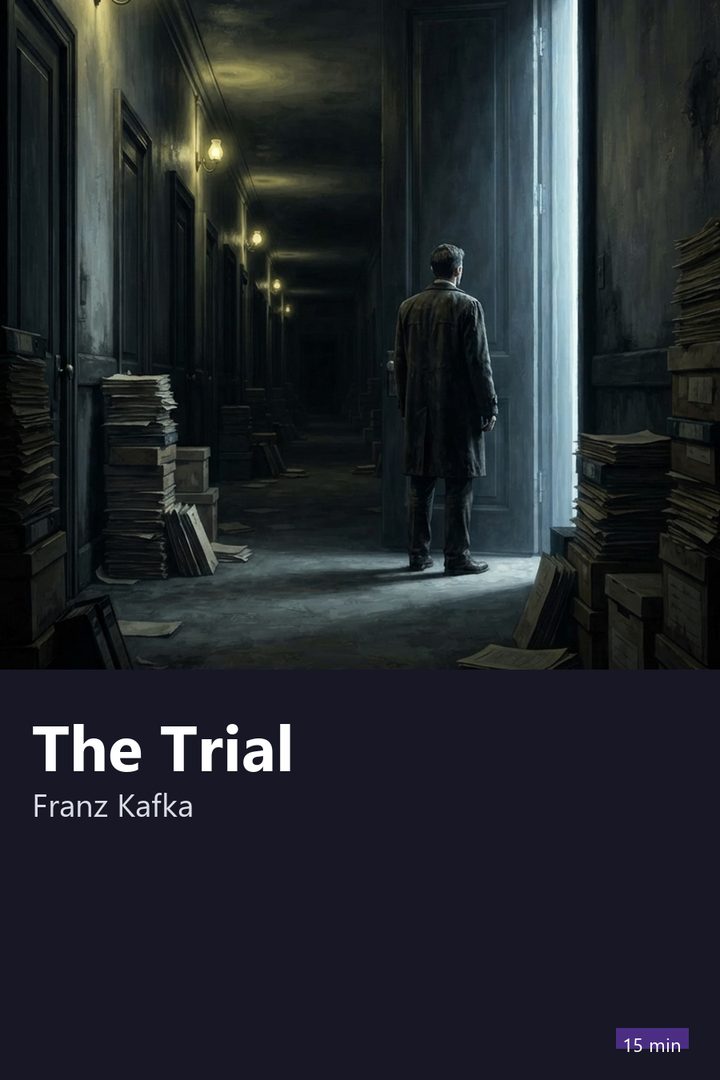
Cover of The Trial

Fiction · 15 min

The Trial

Franz Kafka · 1925

Who it's for

For anyone who has ever felt stuck in a government office line, an endless customer service call, or a demand for payment that nobody will explain. It is a short, heavy-atmosphere novel for readers who want to understand where the word Kafkaesque comes from.

Read it in the app

⚡ Free to download • 🎁 One full book free every day

🎧 Audio coming soon in the app

Narration for the English summaries is on its way. Meanwhile you can read the full summary in the app.

3 ideas to take with you

1

In the book, K.'s brilliant speech changes nothing: speaking well does not help when the people who decide are not even listening.

2

Whoever hands their whole life over to a case becomes its employee: the merchant Block gave up everything and came to live only on waiting.

3

The word Kafkaesque describes a situation with too many rules, none of which seems to answer your question.

“
When nobody says what the accusation is, waiting is already a form of punishment.
An idea from The Trial, in the words of 15 Minutes

Preview

Start reading now

A Morning Without Breakfast

The story begins with a sharp blow: Josef K., a senior bank officer, single, with a tidy life, wakes up on his thirtieth birthday and notices that the boardinghouse cook has not brought his breakfast. Instead, a stranger in a uniform walks in and declares that he is under arrest.

K. asks what for. Nobody answers. The men say they were not the ones who decided, that they only follow orders, and that the authorities never err when they go looking for the guilty. They take his breakfast, rummage through his clothes, and keep an eye on his bed and his table, as if the room were already inspection territory.

This is the image that sums up the book: an ordinary person, whose conduct is correct by his own standards, suddenly inside a case whose rules nobody explains. The first shock is not violence, it is a lack of information. Today it would be like getting a message saying there is a problem with your Social Security number, without saying what.


Arrested, but Free

An inspector arrives and announces officially: K. is under arrest, but he can go on with his normal life, go to the bank, sleep at home. He only has to stay available for when he is called. Three of K.'s own coworkers are in the room as witnesses, which makes the scene even more humiliating.

K.'s mind works like this: first irritation, then an attempt to rationalize. He tells himself it is just a misunderstanding, that a man like him has nothing to worry about, and that the best way to handle it is to keep up appearances. He goes to the bank as if nothing had happened.

That is the trick of the case: it does not hold the body, it holds the mind. Someone who is free but accused starts calculating every gesture, every glance from a neighbor, every delay. Think of someone who waits years for an answer that never comes, like a benefit stuck in the Social Security system: nobody handcuffs you, but life is put on pause.

The Night at the Boardinghouse

That evening, K. worries about his reputation. He talks with the landlady, Mrs. Grubach, who treats him kindly but shows concern. He tries to reassure her by saying it is all a mistake, and gets irritated when she mentions shame.

Then he wants to apologize to his neighbor, Miss Bürstner, because the guards handled her belongings. He waits at her door, enters her room at night, talks more than he should, acts out the arrest as if it were a play, and ends up suddenly kissing her, in a clumsy and invasive way.

The scene shows something important about K.: he has little empathy, he is vain, he uses the people around him as an audience for his drama, and he treats his own situation as more important than anyone else's. The book does not ask us to like him, it asks us to notice how he reacts. The night ends with no relief and no answer.

10 more sections and the quiz

Continue in the app

Read the whole summary, finish with the The Trial quiz and follow the guided Journeys. No ads in the app.

About Franz Kafka

Franz Kafka was born in Prague in 1883 into a German-speaking Jewish family and died in 1924, near Vienna, of tuberculosis. He trained as a lawyer and spent much of his life working at a workers' accident insurance institute, writing in his free hours. In his lifetime he published stories such as The Metamorphosis, in 1915, and asked his friend Max Brod to burn his unpublished manuscripts. Brod did not obey and published The Trial in 1925.

Explore

Category:
Fiction
Part of the Journeys:
Dystopias and Warnings