15 Minutes
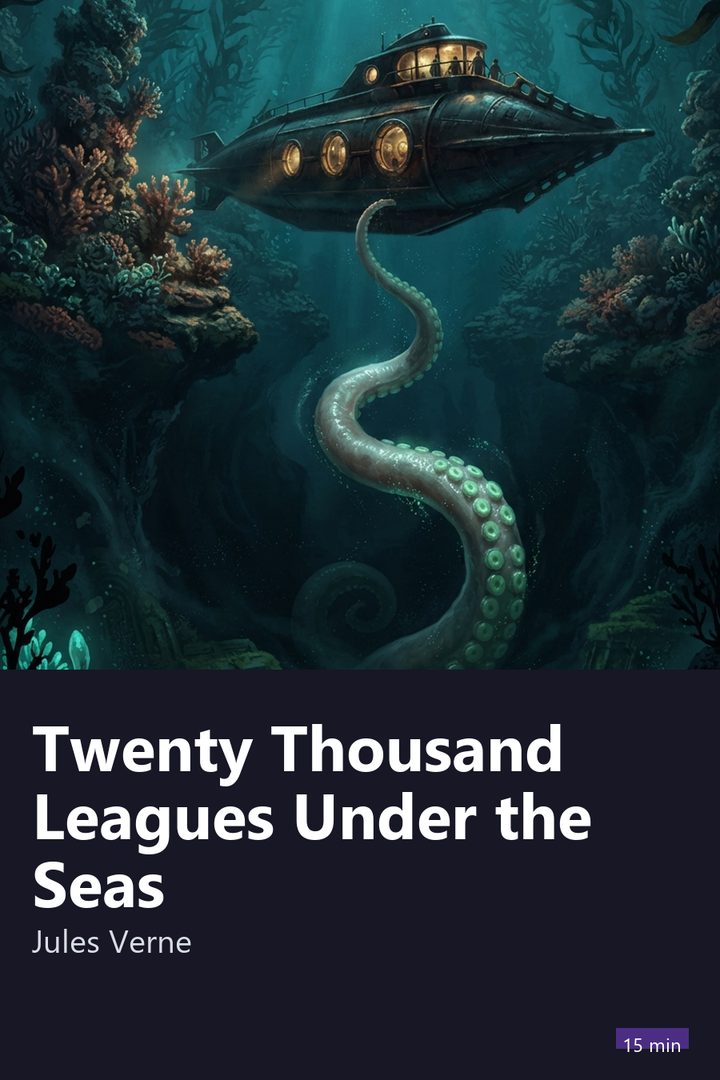
Cover of Twenty Thousand Leagues Under the Seas

Fiction · 17 min

Twenty Thousand Leagues Under the Seas

Jules Verne · 1870

Who it's for

For anyone who loves maritime adventure and classic science fiction, and is curious how a book written before the real submarine existed imagined the ocean floor. It is also for readers who want to understand why Captain Nemo is still a reference today in movies, theme parks, and even the name of a real submarine.

Read it in the app

⚡ Free to download • 🎁 One full book free every day

🎧 Audio coming soon in the app

Narration for the English summaries is on its way. Meanwhile you can read the full summary in the app.

3 ideas to take with you

1

In the giant squid attack, Verne puts Nemo, Ned Land, and the crew in hand-to-hand combat, with no time for any plan.

2

When Nemo sinks the ironclad, Verne shows that his revenge does not erase the old pain that provoked it.

3

The escape near the Maelstrom gives Aronnax, Conseil, and Ned Land their freedom back, and leaves the fate of Nemo and the Nautilus open.

“
In the novel, the rumor of the sea monster travels the world before any ship confirms whether it really exists.
An idea from Twenty Thousand Leagues Under the Seas, in the words of 15 Minutes

Preview

Start reading now

A Monster Haunts the Seas of 1866

In 1866, ship captains on several oceans start reporting the same scare: something enormous, fast, and glowing slams into the hulls of their boats and vanishes into the water. The press of the day picks up the rumor and spreads it fast, the way a viral video today runs through the neighborhood group chat before anyone checks whether it's true.

The most accepted theory is a giant cetacean, a kind of whale never cataloged, strong enough to puncture a ship's plating. Governments and shipping companies are pressured to act, because no vessel wants to risk the route without knowing whether it will come back in one piece.

In this climate of collective panic, the United States outfits a warship, the frigate Abraham Lincoln, with a single mission: hunt the monster and end the mystery.


Aronnax Joins the Hunt

The French professor Pierre Aronnax is the narrator of the story: a marine biologist and author of books about the depths of the ocean, curious enough to say yes to any strange voyage. He is in New York when he gets the invitation to board the Abraham Lincoln, and he accepts on the spot, more out of scientific fascination than courage.

He brings along Conseil, his personal servant, an organized and loyal fellow who classifies everything in zoological order, even danger itself. On board, the two meet Ned Land, a Canadian harpooner hired to be the best whale hunter available on the continent.

Ned is Aronnax's opposite: practical, distrustful of science, trusting only his own harpoon. This mix, the scientist who wants to understand and the hunter who wants to solve things, repeats itself throughout the whole book.

The Chase Turns Into a Shipwreck

After months crossing the Pacific with no sign of the monster, the crew was almost ready to give up when the creature finally appears: a strong light under the water, too fast to be an animal. The frigate charges at it, and in the middle of the maneuver comes the collision nobody expected.

The supposed monster neither sinks nor bleeds: it withstands the impact as if it were made of metal, because that is exactly what it is. In the chaos of the crash, Aronnax, Conseil, and Ned Land fall into the sea and find themselves floating on a smooth, hard hull, too far from the ship to swim back.

That was when the trio realized the truth: the sea monster of the press was, in reality, a machine built by man, a submarine decades ahead of anything that really existed in 1866.

13 more sections and the quiz

Continue in the app

Read the whole summary, finish with the Twenty Thousand Leagues Under the Seas quiz and follow the guided Journeys. No ads in the app.

About Jules Verne

Jules Verne was born in Nantes, France, in 1828, and died in 1905. He became known as one of the creators of modern science fiction, with adventure novels published in the Voyages Extraordinaires series by the editor Pierre-Jules Hetzel. Twenty Thousand Leagues Under the Seas came out in installments between 1869 and 1870 and got a sequel years later, The Mysterious Island, which reveals more about Captain Nemo's past. Verne never went aboard a real submarine: he imagined the Nautilus decades before that kind of machine actually existed.

Explore

Category:
Fiction
Part of the Journeys:
Vacation Reads