15 Minutes
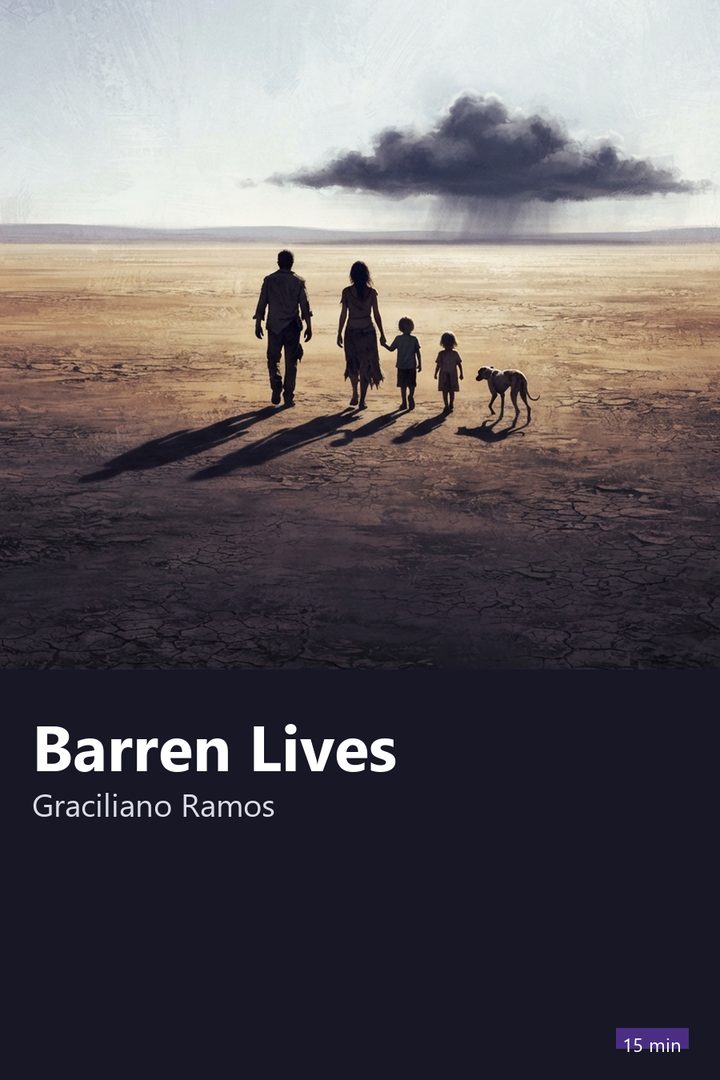
Cover of Barren Lives

Fiction · 15 min

Barren Lives

Graciliano Ramos · 1938

Who it's for

Original title (Portuguese): Vidas Secas. For readers who want to get to know a classic of Brazilian literature without any fluff, and to understand why the hunger, the silence and the drought endured by a family of migrants still say so much about inequality in Brazil. It's also for anyone who likes characters who speak little but carry a whole world inside.

Read it in the app

⚡ Free to download • 🎁 One full book free every day

🎧 Audio coming soon in the app

Narration for the English summaries is on its way. Meanwhile you can read the full summary in the app.

3 ideas to take with you

1

Locked up by the yellow-uniformed soldier for no reason, Fabiano loses more than a day: he carries the rage of that humiliation for a very long time.

2

In the chapter about the older boy, his curiosity about the word hell shows that people without access to words stay a step behind those who know how to explain things.

3

In the novel, the boss exploits Fabiano without any violence at all: all it takes is handing over a bill with interest that the cowhand has no education to dispute.

“
In the novel, Fabiano swallows his own opinion before he even forms the whole sentence, with no words to argue with the boss or the soldier.
An idea from Barren Lives, in the words of 15 Minutes

Preview

Start reading now

A family fleeing the drought

Barren Lives begins in the middle of the road, which already says a lot about the whole book: there is no heroic beginning, just a family of migrants walking across the backlands, exhausted, in a kind of lethargy that only real rain can cure. Fabiano, his wife Sinha Vitória, their two unnamed boys and the dog Baleia are running from yet another drought, carrying the little that was left after the cattle died and the earth cracked.

The hunger on this journey is so bad that the family ends up killing and eating the pet parrot they had brought along, a bird that used to talk with them and that, by then, had become the only food available. It's a short scene, almost without comment from the narrator, but it already sets the tone for the entire novel.

The family finds an abandoned ranch, a desolate place with hardly a neighbor around, and decides to settle there. Fabiano starts working as a cowhand for the landowner, who lives far away and rarely shows up. It's the start of a routine that seems stable but is born already knowing it will end.

Fabiano, the man who thinks he's an animal

Fabiano is a cowhand, taciturn and strong, who knows every inch of the caatinga and handles cattle like few others. Even so, he constantly describes himself as an animal: he compares himself to a horse, a dog, any creature that can take punishment in silence.

This self-image comes from the place he occupies: he owns none of the land where he lives, and he is subject to the boss's orders, the violence of the police, and a drought that decides whether he eats that year or not. Fabiano struggles to put a sentence together when he has to disagree with someone, and he prefers silence to risking a wrong answer in front of the people in charge.

It isn't complete muteness, but it comes close: inside, he feels anger and injustice, but he doesn't know how to turn those feelings into speech. It is one of the book's strongest insights, showing that a silent person carries a whole world with no tools to say it out loud.

Arrested for doing nothing

On a trip to town, Fabiano gets caught up in a silly confrontation with a soldier, tempers flare, and he ends up hauled off to jail without it ever being clear, to him or to the reader, what crime he actually committed. It's the machinery of the state treating a poor man from the backlands as someone born suspect.

In jail, he gets beaten and humiliated, is locked up for hours with no charges or explanation, and feels the weight of being at the mercy of people who have a uniform when he has nothing. The book doesn't dramatize the scene with big speeches: it shows his body curled up, the silence, the urge to fight back that never turns into action.

When he gets out, Fabiano is even more wary of uniforms and authority, with no court to complain to and no one who will listen to a cowhand against a soldier. This unresolved injustice piles up with others throughout the book, forming a rage he swallows every time.

13 more sections and the quiz

Continue in the app

Read the whole summary, finish with the Barren Lives quiz and follow the guided Journeys. No ads in the app.

About Graciliano Ramos

Graciliano Ramos was born in 1892 in Quebrangulo, Alagoas, and died in 1953 in Rio de Janeiro. He worked as a journalist and a shopkeeper, and even served as mayor of Palmeira dos Índios, in the interior of Alagoas, before devoting himself fully to literature. In 1936 he was arrested by the Getúlio Vargas government without formal charges and spent about a year in jails and prisons, an episode he wrote about decades later in the book Memórias do Cárcere (Prison Memoirs), published posthumously in 1953. He is the author of novels such as Caetés, São Bernardo, Angústia and Vidas Secas, central works of what critics call the Generation of 30 novel, the regionalist and social literature that portrayed the drought and poverty of Brazil's Northeast.

Explore

Category:
Fiction
Part of the Journeys:
Classics and Stories