15 Minutes
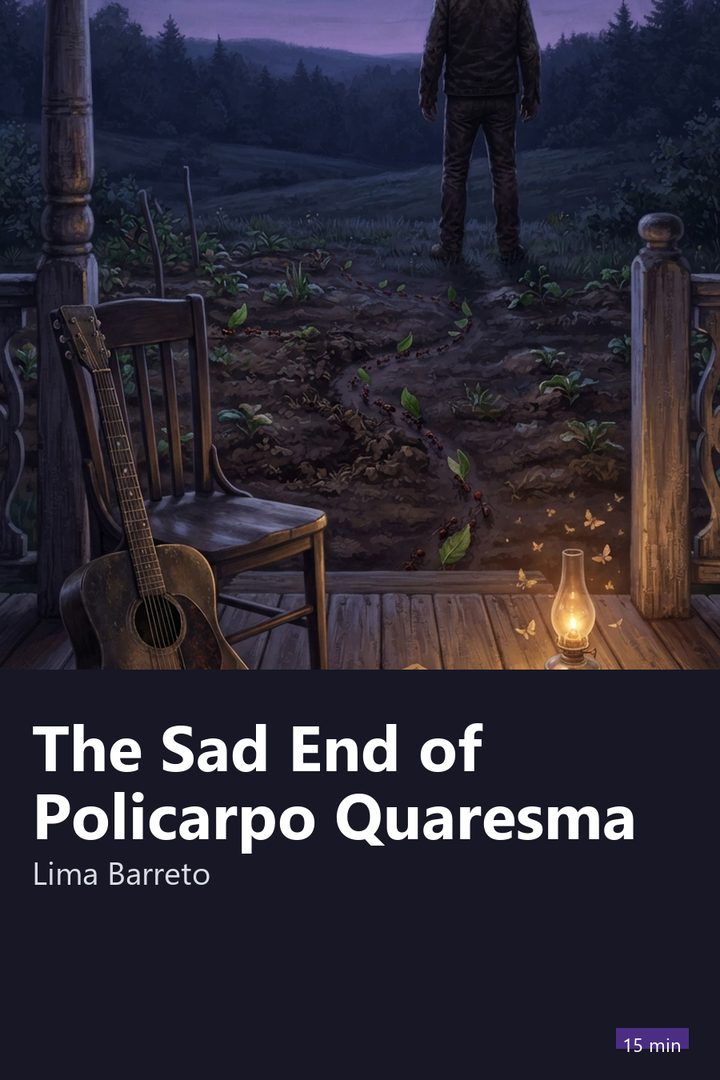
Cover of The Sad End of Policarpo Quaresma

Fiction · 15 min

The Sad End of Policarpo Quaresma

Lima Barreto · 1915

Who it's for

Original title (Portuguese): Triste Fim de Policarpo Quaresma. This one is for you if you enjoy sharp social satire and want to see, from inside a story, how Brazil treated people who took patriotism and ideals far too seriously in the early twentieth century. It is also a good fit if you like classic Brazilian literature with irony on every page and a truly sad ending.

Read it in the app

⚡ Free to download • 🎁 One full book free every day

🎧 Audio coming soon in the app

Narration for the English summaries is on its way. Meanwhile you can read the full summary in the app.

3 ideas to take with you

1

For the author, a society that does not know what to do with excessive devotion tends to treat too much idealism as an illness, instead of asking why almost nobody else has that much of it.

2

In the novel, Quaresma values the viola and the modinha precisely because they are popular, at a time when Rio's elite respected only what was copied from Europe.

3

Quaresma's life alongside Albernaz and Genelício shows that sincere devotion and cynical careerism can share the same room without one rubbing off on the other.

“
In the novel, a well-built argument convinces no one when it arrives at the wrong time and before the wrong audience: Congress laughs at Quaresma's petition before discussing a single line of it.
An idea from The Sad End of Policarpo Quaresma, in the words of 15 Minutes

Preview

Start reading now

Before You Start: What You're About to Read

This is a summary of a work of fiction, so it tells the whole story of the book, from beginning to end, including the ending. If you would rather come to the novel without knowing how it ends, save this summary for after you read it.

The Sad End of Policarpo Quaresma first appeared in installments, published in the Jornal do Commercio in 1911, and became a book, revised by the author himself, in 1915. It is a satire about naive nationalism, bureaucracy, and the politics of the period known as the Republic of the Sword, told in a tone that mixes irony, humor, and tragedy.

The story is divided into three parts, each with a different dream of the protagonist: language, land, and armed politics. All three end in failure, and that pattern is where the novel's title comes from.

Lima Barreto writes from inside the suburbs and government offices of Rio de Janeiro, a portrait very different from the elegant city that showed up in the novels of the time. It is precisely because he knows this behind-the-scenes Brazil, that of the civil servant and the poor neighborhood, that the satire hits its target so well.


Who Policarpo Quaresma Is

Policarpo Quaresma is a civil servant at Rio de Janeiro's War Arsenal, a middle-aged bachelor who lives in a simple house with his sister Adelaide and raises his goddaughter Olga with a father's affection.

What sets Quaresma apart from every other character in the book is his sincerity: he loves Brazil in a literal way, without any irony, and believes that dedication and good will are enough to prove, in practice, everything good that school textbooks say about the country.

This unfiltered sincerity, which would sound beautiful in any other context, becomes a running joke among the people around him, because no one else takes patriotism as seriously as he does.

He reads everything he can find about Brazilian history, geography, and culture, keeps maps and statistics memorized, and treats every dinner-table conversation as a chance to defend the country with facts in hand. It is this same excess of study, with no sense of when to stop, that keeps pushing Quaresma toward each of the novel's three tragedies.

A Patriot Studying the Viola and the Modinha

One of the first proofs of Quaresma's patriotism is musical: he starts studying the viola and the modinha, Brazil's popular songbook, at a time when Rio's elite respected only what was copied from France and European opera.

It is in this world of the modinha that he gets close to Ricardo Coração dos Outros, a bohemian guitar player and composer, a central figure of Rio's popular nightlife and, at the same time, a suitor of Olga.

For Quaresma, liking the viola is not an amateur's whim, it is a statement that Brazilian popular culture is worth just as much as anything imported. To his more refined circle of friends, such as General Albernaz's family, this only confirms that he is an eccentric.

It is a small detail of the book that still makes sense today: liking what is made close to home, whether music, food, or crafts, often demands a justification that nobody asks of people who prefer only what comes from abroad.

11 more sections and the quiz

Continue in the app

Read the whole summary, finish with the The Sad End of Policarpo Quaresma quiz and follow the guided Journeys. No ads in the app.

About Lima Barreto

Lima Barreto, full name Afonso Henriques de Lima Barreto, was born in Rio de Janeiro in 1881 and died in the same city in 1922. He was one of the first great Black novelists in Brazil, worked as a government clerk for much of his life, and studied at the Polytechnic School of Rio de Janeiro without finishing. He went through episodes of mental suffering tied to alcoholism and was even committed to the National Hospice for the Insane, the same institution portrayed in the novel. Today he is recognized as one of the central voices of Brazilian pre-modernist literature, and also wrote Recordações do Escrivão Isaías Caminha.

Explore

Category:
Fiction
Part of the Journeys:
Brazilian Literature