15 Minutes
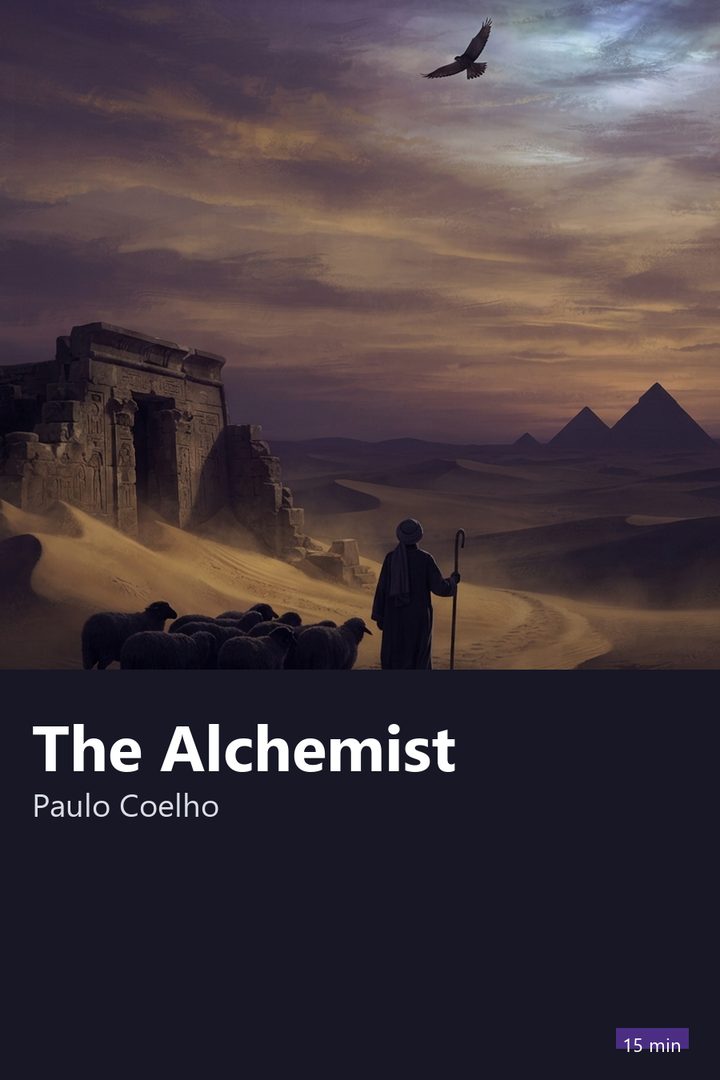
Cover of The Alchemist

Fiction · 16 min

The Alchemist

Paulo Coelho · 1988

Who it's for

For you if you feel routine slowly swallowing an old dream and you want a short fable about choosing between the familiar and the uncertain. The Alchemist also suits anyone who likes a story with a symbolic layer, without needing heavy theory to follow along.

Read it in the app

⚡ Free to download • 🎁 One full book free every day

🎧 Audio coming soon in the app

Narration for the English summaries is on its way. Meanwhile you can read the full summary in the app.

3 ideas to take with you

1

Melchizedek teaches that the Personal Legend usually gets lost little by little, under layers of excuses and routine, not in one big act of giving up.

2

In the desert, Santiago learns that paying attention to small signs teaches more than the book theory the Englishman bet everything on.

3

For the book, the fear of failing weighs more than failure itself, an idea the Alchemist repeats to Santiago before the final crossing.

“
In the novel, Santiago decides to take a recurring dream seriously, and that decision is what pulls the shepherd out of his familiar routine.
An idea from The Alchemist, in the words of 15 Minutes

Preview

Start reading now

An Andalusian shepherd and a dream that keeps coming back

Santiago is a young shepherd from Andalusia, in southern Spain. He left the seminary because he preferred traveling through different lands to spending his whole life in a single town, even if it meant giving up a steady income and a more predictable future. Tending sheep gave him what he valued most: the freedom to move.

Sleeping near a ruined church with a sycamore growing inside the old sacristy, he has the same dream two nights in a row: a child takes him to the Pyramids of Egypt and promises to show him a hidden treasure there, but the dream always breaks off before the reveal.

It's the kind of omen many people would forget in the rush of the next day. Santiago decides to take it seriously and look for someone who can interpret dreams, something the shepherds in the area don't usually do.


The gypsy woman of Tarifa and the price of decoding a dream

In the town of Tarifa, Santiago finds a gypsy woman willing to interpret the dream, but she charges for it: if the treasure is found, she gets a share. Santiago thinks the price is outrageous, since she's only offering an opinion, not a map, but he agrees anyway.

The gypsy confirms that there really is a treasure near the Pyramids of Egypt and that he must go there to find it. She gives no further detail, only the confirmation that the dream deserves to be followed.

The episode already shows a pattern that repeats throughout the book: whoever helps Santiago along the way usually charges something, whether money, work, or sacrifice. Nothing on this journey comes free, not even a simple dream interpretation.

The old man in the square and the idea of a Personal Legend

Soon after, Santiago is approached by an old man who introduces himself as Melchizedek, king of Salem. The old man wears a metal breastplate set with stones and insists on talking about the dream Santiago never told him he'd had.

Melchizedek presents the central idea of the book: every person carries a Personal Legend, the thing they always wanted to do since they were young, before piling up the excuses and fears that push that desire to the back of the drawer. According to the old man, there is also a favorable principle: when someone truly decides to pursue their own Personal Legend, the circumstances around them tend to line up to help.

As a gesture of good faith, the old man hands over two stones, Urim and Thummim, one black and one white, which Santiago can use to choose between a yes and a no when the answer is hard to see on his own.

13 more sections and the quiz

Continue in the app

Read the whole summary, finish with the The Alchemist quiz and follow the guided Journeys. No ads in the app.

About Paulo Coelho

Paulo Coelho is a Brazilian writer born in Rio de Janeiro in 1947. Before devoting himself to literature, he worked as a lyricist in Brazilian popular music, writing songs with names like Raul Seixas. He first published The Alchemist in 1988, and the book became one of the most translated Brazilian titles in history, with editions in dozens of languages around the world. He has been a member of the Brazilian Academy of Letters since 2002.

Explore

Category:
Fiction
Part of the Journeys:
Addictive Fiction