15 Minutes
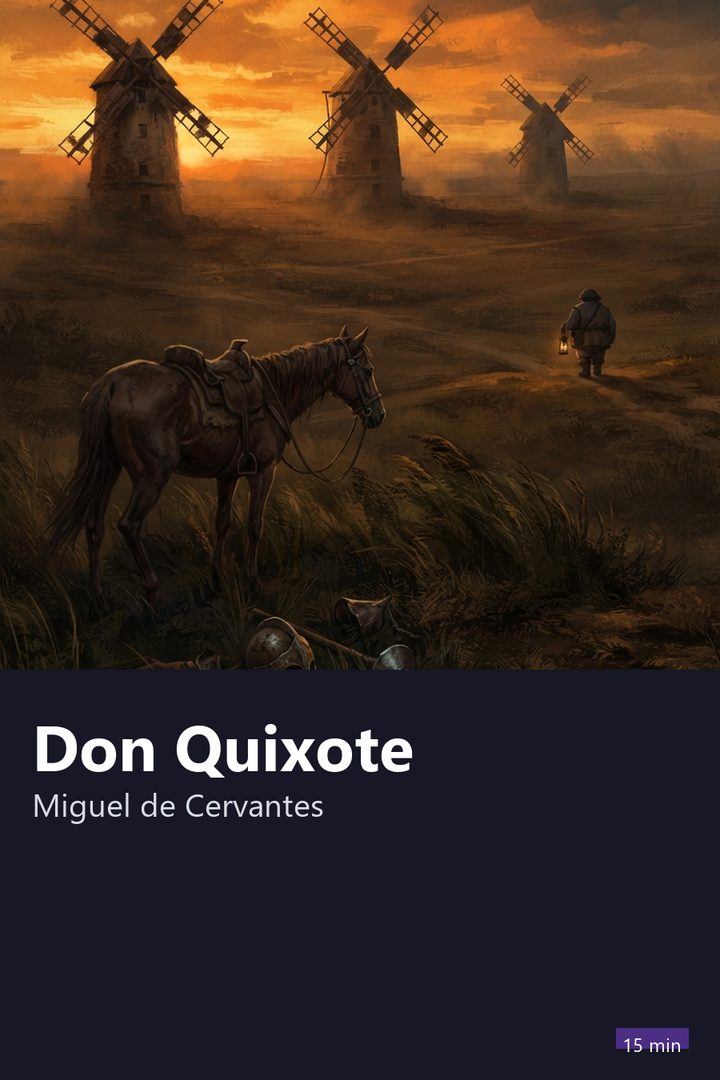
Cover of Don Quixote

Fiction · 16 min

Don Quixote

Miguel de Cervantes · 1605

Who it's for

For anyone who loves humor with depth and wants to understand why a book more than four hundred years old is still called the first modern novel. It's also for anyone who has felt the distance between the dream they chase and the real world that keeps getting in the way.

Read it in the app

⚡ Free to download • 🎁 One full book free every day

🎧 Audio coming soon in the app

Narration for the English summaries is on its way. Meanwhile you can read the full summary in the app.

3 ideas to take with you

1

Dulcinea exists far more in Don Quixote's head than in the life of Aldonza Lorenzo, the peasant woman he never actually gets to know up close.

2

The priest and the barber burn Don Quixote's books to cure him, and Cervantes shows that the problem was never only on the pages.

3

In the second part, the duke and duchess turn Don Quixote's madness and Sancho's naivety into entertainment for the court, and their laughter weighs heaviest on those who have the least to lose.

“
Facing the windmills, Don Quixote prefers to change the explanation rather than the dream: it was the enchanters who turned the giants into windmills.
An idea from Don Quixote, in the words of 15 Minutes

Preview

Start reading now

A Gentleman Who Reads Too Much

In a small village in the region of La Mancha, Spain, there lived a thin, middle-aged hidalgo of modest means. His name was Alonso Quijano, and he had just one vice: reading chivalric romances, stories full of knights, dragons, and damsels rescued from danger, which were all the rage at the time.

He read so much, and slept so little, that his brain dried up, as the book itself says without mincing words. He sold land to buy more books and slowly lost the border between the page and reality. Little by little, he came to believe that all of it, giants, enchantments, duels of honor, had really happened.

That's when he decided to become a knight-errant himself: to ride out into the world fighting for justice, winning fame, and serving a lady, like the heroes of the books he so admired. To any neighbor, it was the fantasy of a lonely old man. To him, it was the most serious mission of his life.
Don Quixote Is Born: A New Name, Patched Armor, a Horse Named Like a Hero

Before leaving home, Alonso Quijano took care of the details: he changed his own name to Don Quixote de la Mancha, because a knight-errant needs a grand name, and dug up an old family suit of armor, patching what was missing with cardboard.

He even gave his horse a new name, a tired old nag he christened Rocinante, a name that, in his view, sounded noble enough to carry a hero. It's the kind of gesture that shows Don Quixote's logic: if the real world isn't grand enough, he invents the grandeur it lacks.

On his first outing, alone and without a squire, he came upon a roadside inn and treated it like a castle, asking the owner, whom he saw as a noble lord, to knight him right there on the spot. The innkeeper, amused, played along and performed the ritual.

Dulcinea: The Lady Who Exists Only in His Head

Every knight-errant in the books had a lady to whom he dedicated his victories, so Don Quixote needed one too. He chose a neighboring farm girl, Aldonza Lorenzo, whom he had admired from afar some years before, and gave her a more noble name: Dulcinea del Toboso.

The thing is, this Dulcinea practically doesn't exist outside Don Quixote's head. Aldonza, the real woman, never exchanges a word with him in the entire book, and she probably doesn't even know about the role she was handed. Everything he describes about her is pure invention.

It's one of the most revealing moments in the book: Don Quixote isn't in love with a person, he's in love with the idea of having a lady to love, because that's what the knight's script demands. He preferred the perfect fantasy to the flesh-and-blood woman he could have really gotten to know.

12 more sections and the quiz

Continue in the app

Read the whole summary, finish with the Don Quixote quiz and follow the guided Journeys. No ads in the app.

About Miguel de Cervantes

Miguel de Cervantes was born in 1547 in Alcalá de Henares, Spain. He fought at the Battle of Lepanto in 1571, where he lost the use of his left hand, and spent five years as a captive in Algiers before coming home. He published the first part of Don Quixote in 1605 and the second part in 1615, a year before his death in 1616. He also wrote novellas and plays, but it was Don Quixote that made him a landmark of world literature.

Explore

Category:
Fiction
Part of the Journeys:
The Great Novels