15 Minutes
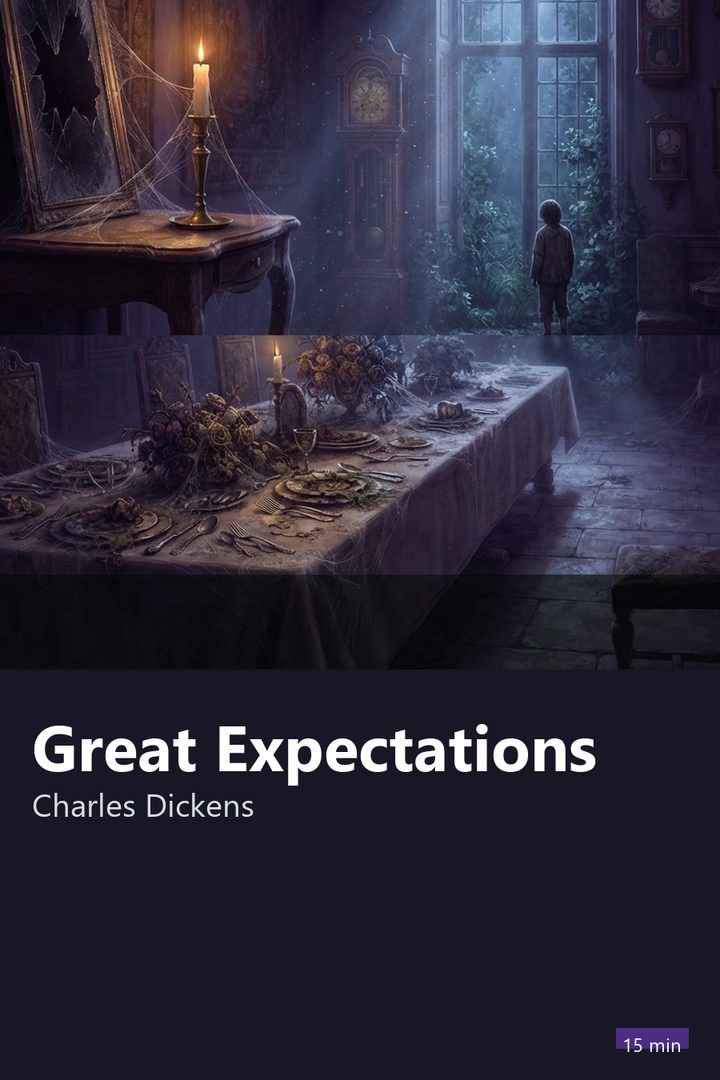
Cover of Great Expectations

Fiction · 16 min

Great Expectations

Charles Dickens · 1861

Who it's for

For readers who love a story full of twists, inheritance mysteries and an open ending, and who want to understand why a nineteenth-century English classic is still cited whenever the subject is social ambition and gratitude. It's also for anyone who has ever felt ashamed of a simple person who always stood by them, and wants to see that guilt laid bare without melodrama.

Read it in the app

⚡ Free to download • 🎁 One full book free every day

🎧 Audio coming soon in the app

Narration for the English summaries is on its way. Meanwhile you can read the full summary in the app.

3 ideas to take with you

1

In this novel, building your own identity on top of a secret you don't control leaves Pip waiting for the moment the explanation collapses.

2

Miss Havisham raises Estella to wound because her own pain needed a living instrument to keep circulating among men.

3

Joe's loyalty doesn't ask for an address or a new last name: it simply waits at the door, ready when Pip needs it again.

“
Miss Havisham stops the clocks in the house at twenty to nine, but her resentment keeps walking on its own, decades later.
An idea from Great Expectations, in the words of 15 Minutes

Preview

Start reading now

A boy, a graveyard and a starving man

Pip is an orphan who grows up in the marshes of Kent, England, raised by his much older sister and her husband, Joe, the village blacksmith. On a cold Christmas Eve, the boy visits the graveyard where his parents and little brothers lie, dead too young, and a ragged, starving man leaps out from behind a headstone and grabs him by the throat.

The man is Magwitch, a convict escaped from the prison ships anchored in the river, with an iron still clamped to his ankle. He demands food and a file to cut the chain, and threatens Pip with a terrible fate if he tells anyone. Terrified, the boy steals bread, pie and the file from his own kitchen and hands everything over the next morning, never imagining that this small gesture will come back, years later, in the most unexpected way possible.

Magwitch is recaptured right there and taken back to the prison ship. Pip believes the scare is over. But in this brief encounter Dickens has already planted the seed of everything the novel will unfold: gratitude, shame and the question of who truly deserves to be called a gentleman.
Raised by hand by his sister, truly raised by the blacksmith

Mrs. Joe keeps repeating that she raised Pip by hand, a phrase of the time meaning she brought him up all by herself, and she collects on that sacrifice with slaps and pinches. In her house, the cane nicknamed Tickler always hangs on the wall, ready for any disobedience.

Joe, her husband, is the opposite: a big blacksmith with simple speech and hands calloused from the forge, who treats Pip as an equal and not as a burden. On nights when Mrs. Joe is in a foul mood, the two exchange knowing glances by the fire, a silent alliance between those who get beaten and those who get beaten too.

It is Joe who teaches Pip, asking nothing in return, that affection doesn't need fancy speeches to be real. This is the moral standard the whole book uses as a yardstick: every time Pip drifts away from that simple way of loving, something inside him cracks.

The house where the clocks stopped

A distant relative arranges for Pip to visit Miss Havisham, a very wealthy woman who lives shut away in a decaying mansion called Satis House. She receives the boy wearing the same yellowed wedding dress, with only one shoe, sitting near a wedding cake covered in cobwebs and mice.

Decades earlier, on her wedding day, she was jilted at the altar by her groom, minutes before the ceremony, before even signing the dowry contract arranged between the families. Since then she has stopped every clock in the house at twenty minutes to nine, the exact hour of the news: curtains closed, candlelight all day long.

Miss Havisham doesn't try to get over her pain: she preserves it, decorated, like a private museum of her own resentment. It is to this house frozen in time that Pip will return again and again, always leaving more unhappy with his simple life than when he came in.

13 more sections and the quiz

Continue in the app

Read the whole summary, finish with the Great Expectations quiz and follow the guided Journeys. No ads in the app.

About Charles Dickens

Charles Dickens was born in Portsmouth, England, in 1812, and his childhood was marked by his father's imprisonment for debt and by work in a shoe-polish factory while he was still a child. He became the most popular novelist of the Victorian era, publishing most of his books in serial form, chapter by chapter, in weekly or monthly magazines. Besides Great Expectations, published between 1860 and 1861, he wrote Oliver Twist, David Copperfield and A Christmas Carol, and used much of his work to denounce the poverty and child exploitation of England at the time. He died in 1870, at fifty-eight, and is buried in Poets' Corner at Westminster Abbey.

Explore

Category:
Fiction
Part of the Journeys:
World Classics