15 Minutes
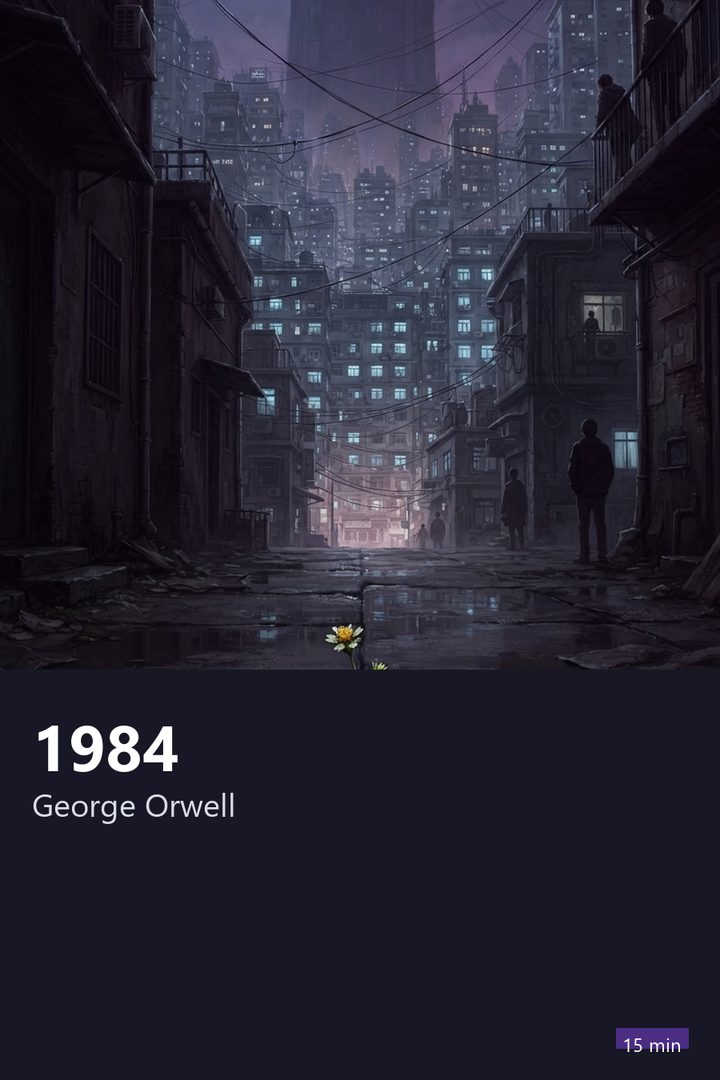
Cover of 1984

Fiction · 16 min

1984

George Orwell · 1949

Who it's for

For readers who like unsettling fiction and want to understand why 1984 became the go-to reference whenever people talk about surveillance, censorship, or control over the truth. It's also for anyone who has heard terms like Big Brother or Newspeak thrown around and wants to know where they come from.

Read it in the app

⚡ Free to download • 🎁 One full book free every day

🎧 Audio coming soon in the app

Narration for the English summaries is on its way. Meanwhile you can read the full summary in the app.

3 ideas to take with you

1

At the Ministry of Truth, Winston rewrites old newspapers so that the present can never be challenged by any record of the past.

2

The Two Minutes Hate shows how hating together, at the same time every day, binds a group more tightly than any speech could on its own.

3

In Room 101, the Party doesn't use generic pain: it uses each prisoner's most personal fear to break exactly that person.

“
In 1984, doublethink teaches Winston to hold two opposite certainties in his head at the same time, without feeling the clash between them.
An idea from 1984, in the words of 15 Minutes

Preview

Start reading now

A world watched all the time

In 1984, London is no longer the capital of England: it is Airstrip One, a province of the superpower Oceania, a country run by a single party that accepts no opposition and no public discussion of its decisions. Huge posters, plastered along hallways, stairwells, and streets, show the face of a man with a thick mustache, along with a warning that he is watching whoever walks by.

Winston Smith is an employee at the Ministry of Truth, the agency in charge of the country's information, history, and official culture. He lives alone in a small, run-down apartment, typical for members of the Outer Party, the lower middle class of this official hierarchy.

Inside his home, the telescreen works as a television and a camera at the same time: it broadcasts speeches and music all day long and, along with that, picks up sound and image and sends them back to the government, with no off switch. It's as if the living room of any apartment had a security camera running 24 hours a day, even in the middle of the night, with no warning of when someone on the other end is watching. That constant surveillance is the backdrop of the whole story.
The job of erasing the past

At the Ministry of Truth, Winston's job is rewriting old newspapers. Whenever a Party prediction doesn't come true, or a name falls out of favor, his task is to rewrite the old article as if it had never been said that way.

The original material, what was actually published once upon a time, becomes obsolete and goes down a chute called the memory hole, which leads straight to the incinerator. No trace is left of what existed before.

The practical effect is simple to grasp: if no one can prove what happened yesterday, whoever holds power today decides alone which version of history counts. Winston sees this clearly in his own work, but it would take him a while to turn that clarity into any kind of action.

Doublethink: believing two opposite things at once

The novel uses the word doublethink to describe a mental habit the Party cultivates in everyone: holding two contradictory beliefs in your head, accepting both as true at the same time, without feeling the clash between them.

The very names of the ministries show this trick at work: the Ministry of Truth handles official lies, the Ministry of Peace runs the permanent war, the Ministry of Love is where the torture happens, and the Ministry of Plenty manages rationing and scarcity.

You can spot a milder cousin of this habit in ordinary situations: that moment at work when you repeat a rule you know makes no sense, just because challenging it takes more effort than swallowing it. The book takes this mental engineering to the extreme, to the point where a person stops noticing they are contradicting themselves.

13 more sections and the quiz

Continue in the app

Read the whole summary, finish with the 1984 quiz and follow the guided Journeys. No ads in the app.

About George Orwell

George Orwell is the pen name of the British writer and journalist Eric Arthur Blair, born in 1903 in colonial India and raised in England. He fought as a militiaman in the Spanish Civil War, was shot in the neck, and came home disillusioned by the sectarianism he saw on both sides of the conflict. In the years that followed he wrote Animal Farm, in 1945, and 1984, in 1949, while his health worsened because of tuberculosis. Orwell died in January 1950, months after publishing 1984, without seeing the reach the book would have.

Explore

Category:
Fiction
Part of the Journeys:
Addictive Fiction