15 Minutes
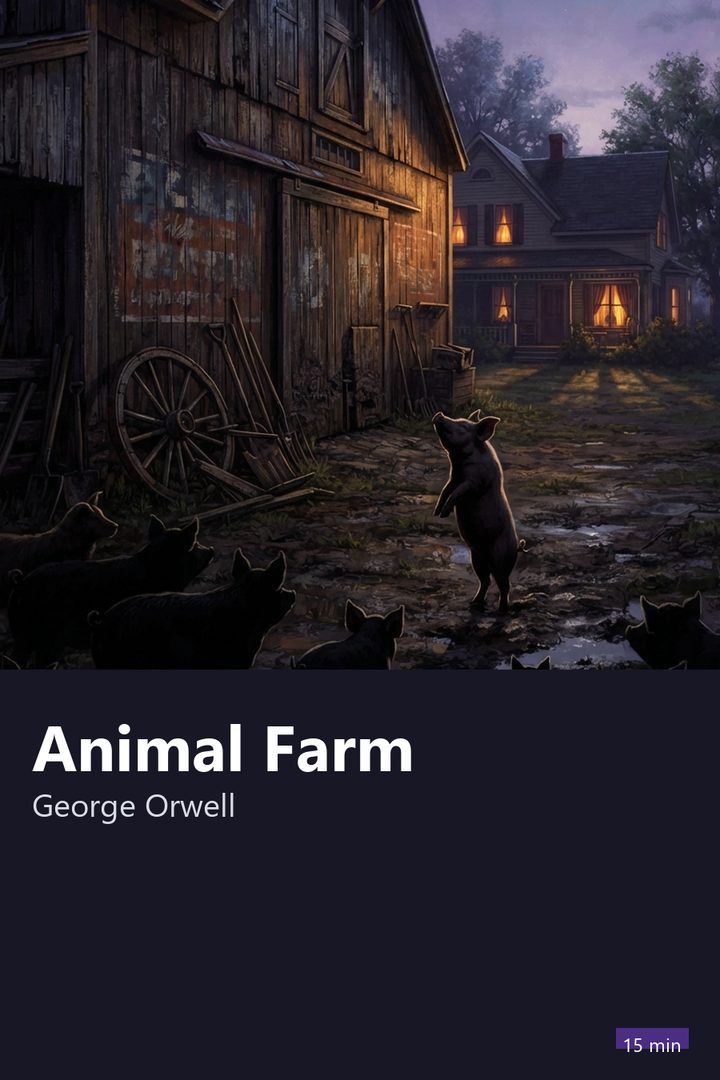
Cover of Animal Farm

Fiction · 17 min

Animal Farm

George Orwell · 1945

Who it's for

For anyone who has ever suspected that a promise of change that sounds too good to be true is hiding some fine print, and who wants to understand, through a fable about pigs and horses, how a group can lose sight of its own revolution without noticing the exact moment it happened.

Read it in the app

⚡ Free to download • 🎁 One full book free every day

🎧 Audio coming soon in the app

Narration for the English summaries is on its way. Meanwhile you can read the full summary in the app.

3 ideas to take with you

1

The Seven Commandments painted on the barn wall protect the animals only until the pigs have the power to rewrite the paint.

2

Napoleon doesn't beat Snowball in debate: he wins because he secretly raised the dogs that drive his rival off the farm.

3

Every time the windmill falls, the pigs blame Snowball, and Orwell shows how an enemy on the outside spares the ones who made the decisions on the inside.

“
Old Major's dream thrills the whole farm, but it says nothing about who will be in charge once the humans are gone.
An idea from Animal Farm, in the words of 15 Minutes

Preview

Start reading now

Old Major's dream

Major, an old prize-winning pig, gathers the animals of Manor Farm one night to tell them about a dream before he dies. He says the root of the animals' misery is man, who consumes without producing and lives off the labor of others, and he teaches them a song that promises a future without masters, called Beasts of England.

The speech sounds like that veteran coworker who sums up decades of exploitation in one sentence that everybody feels in their wallet: late paychecks, unpaid overtime, a boss who never delivers on what he promises. Major dies before saying who will run the farm afterward, and that gap is where everything else is going to unfold.

Three days later Major dies in his sleep. The other animals keep the dream as a life plan, but the plan never really existed: there was only the desire for change and the certainty that the pigs, the smartest of them, would take care of organizing everything from then on.
The night the animals threw out Mr. Jones

The rebellion isn't planned: it happens on a night when Mr. Jones, drunk, forgets to feed the animals. Starving, they break into the feed store, and when Jones shows up with a whip to stop the chaos, the animals react together and drive everyone off the farm, in a move nobody had rehearsed.

The next day, the animals walk through the farmhouse with amazement and suspicion, like someone entering for the first time a building they had always looked at from outside. They decide not to live there, keep the house as a memorial, and rename the place Animal Farm.

The pigs, being the cleverest, naturally take over organizing the work, without anyone voting on it. It's the kind of decision that seems obvious at the time, like letting the neighbor who's good with spreadsheets handle the building's finances all by himself, and which only shows its real price years later.

The Seven Commandments on the barn wall

To fix the principles of the revolution in place, the pigs boil everything down to Seven Commandments and paint each one on the barn wall in huge letters, so no animal will forget. The rules forbid sleeping in a bed, drinking alcohol, killing without reason, and wearing clothes, among others, and they end by stating that all animals are equal.

Having the rule written down, visible, the same for everyone, is the difference between a handshake deal and a signed contract. As long as it's up there in paint, it protects even those who can't read well, because there's always someone to point at the wall when something strays from the agreement.

The problem starts right there: whoever decides what is written on the wall also ends up deciding, later, whether something has moved. The wall was never neutral, it was only as trustworthy as whoever held the paint.

11 more sections and the quiz

Continue in the app

Read the whole summary, finish with the Animal Farm quiz and follow the guided Journeys. No ads in the app.

About George Orwell

George Orwell finished Animal Farm in 1944, in the middle of World War II, and spent almost a year trying to get it published: four British publishers turned the book down, afraid of offending the Soviet Union, then Britain's wartime ally against Nazi Germany. One of them even consulted a British government official before saying no. The book only came out in August 1945, months after the war ended in Europe. Orwell died in London in 1950, never imagining that the fable so many people rejected would become one of the most widely read books of the 20th century.

Explore

Category:
Fiction
Part of the Journeys:
Dystopias and Warnings