15 Minutes
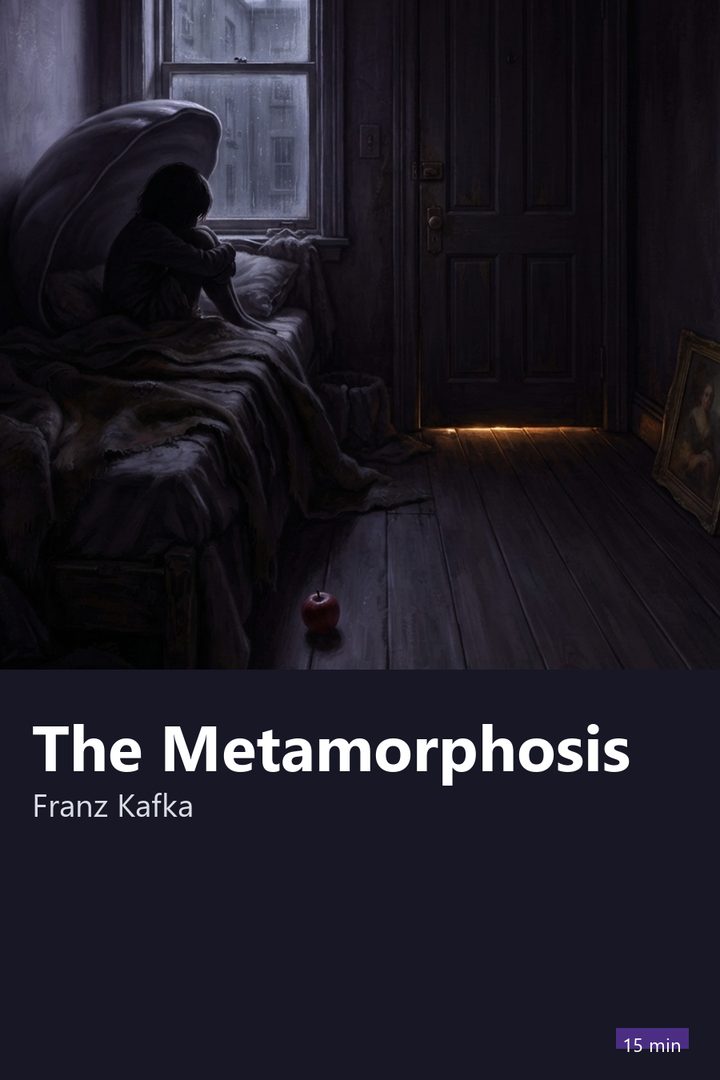
Cover of The Metamorphosis

Fiction · 15 min

The Metamorphosis

Franz Kafka · 1915

Who it's for

For anyone who has ever felt like a burden to their own family, or like a stranger in their own home without ever leaving the room. The Metamorphosis is also for readers who want to understand why such a strange classic is still being read more than a hundred years after it was written.

Read it in the app

⚡ Free to download • 🎁 One full book free every day

🎧 Audio coming soon in the app

Narration for the English summaries is on its way. Meanwhile you can read the full summary in the app.

3 ideas to take with you

1

In the Samsa household, which depended only on Gregor's paycheck, his body becomes a work tool before he is still seen as a member of the family.

2

In the novella, the apple the father hurls at Gregor out of fear shows that violence inside a home doesn't need any plan to truly hurt.

3

In the novella, a family's affection can have an expiration date when supporting someone weighs more on the budget than the memory of who that person used to be.

“
In the novella, Gregor's first thought after waking up transformed is not his own body, it's the train he is going to miss for work.
An idea from The Metamorphosis, in the words of 15 Minutes

Preview

Start reading now

An ordinary morning that turns into a nightmare

Gregor Samsa wakes up one ordinary morning and discovers, lying on his back in his own bed, that he has turned into a monstrous insect, with a hard shell and several thin legs flailing in the air. There is no explanation for the transformation: no doctor is called, no cause is investigated, the fact simply happened while he was asleep.

The strangest part is not the new body, it's Gregor's reaction to it. Instead of despair over his appearance, his first worry is a practical one: he is going to miss his work train. He has spent his whole life as a traveling salesman, selling fabric from town to town, and in that first moment the clock weighs more on him than his own transformed body.

That inversion drives the whole story. Kafka doesn't explain why the metamorphosis happens, he shows what happens when the body that supports an entire household suddenly stops being able to produce.


One paycheck holding up the whole house

Before the transformation, Gregor was the only one in the family with a steady job, supporting his father, his mother and his younger sister, Grete, on a traveling salesman's salary. His father had an old debt to the owner of the company, taken on after the family's own business collapsed, and it was to pay off that debt that Gregor worked himself to the bone.

The scene feels like any American household where one person carries the whole month's bills on their back, while the rest of the family lives off that paycheck without realizing the price of it. Gregor doesn't even complain: he even dreams of paying for his sister's studies at a music conservatory.

The problem appears when that working body stops functioning. The family discovers they had no other savings or source of income, and the affection they felt for Gregor starts to be measured by how much he can still provide.

The manager flees and the father reacts with fury

Since Gregor doesn't show up for the train, the company sends the chief clerk to the house to demand an explanation, still on that first morning. From outside the locked door, the manager threatens Gregor's job over a single delay, hinting at serious misconduct. When Gregor finally appears in the living room, the manager flees in terror down the stairs, without saying goodbye.

The father, frightened by his son's appearance, reacts with anger instead of care: he charges at the insect, beating the floor with a cane and hissing in fury, forcing Gregor to retreat to his own room, hurting a leg in the struggle over the narrow doorway.

Together, the two scenes make clear the kind of world Gregor lived in: a job that demands punctuality above any human explanation, and a home that, overnight, stops seeing him as the respected provider and starts treating him as a threat to be contained behind a closed door.

11 more sections and the quiz

Continue in the app

Read the whole summary, finish with the The Metamorphosis quiz and follow the guided Journeys. No ads in the app.

About Franz Kafka

Franz Kafka was born in Prague in 1883, then part of the Austro-Hungarian Empire, into a German-speaking Jewish family. He spent much of his life working for a workers' accident insurance company, writing at night after the workday ended. He published little during his lifetime, including the novella The Metamorphosis, released in 1915, and died in 1924, at forty, of tuberculosis. Before he died, he asked his friend Max Brod to burn the unpublished manuscripts he left behind, but Brod did not honor the request and published much of the work after Kafka's death.

Explore

Category:
Fiction
Part of the Journeys:
World Classics