15 Minutes
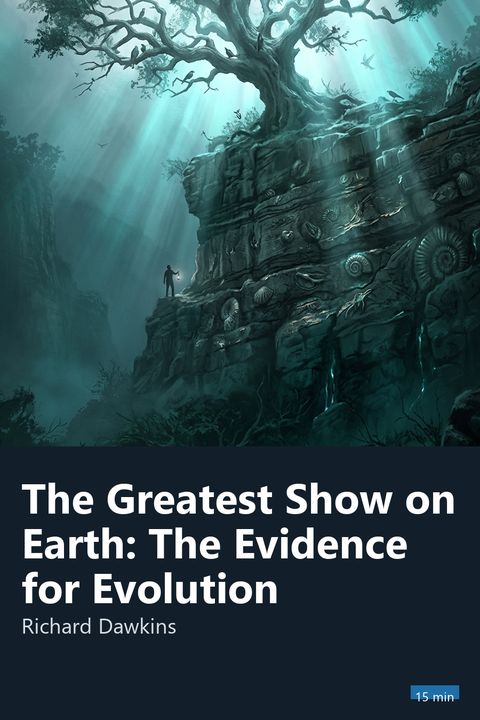
Cover of The Greatest Show on Earth: The Evidence for Evolution

Science · 15 min

The Greatest Show on Earth: The Evidence for Evolution

Richard Dawkins · 2009

Who it's for

For anyone who hears that evolution is just a theory and wants a clear, thoughtful look at the evidence behind it. The book brings together the strongest evidence in accessible language, with examples you can picture without a biology degree.

Read it in the app

⚡ Free to download • 🎁 One full book free every day

🎧 Listen to this summary in the app

Every summary has audio narration. Open the app to read it or listen to it.

3 ideas to take with you

1

In science, a theory brings together testable explanations and evidence to help us understand phenomena. It isn't just a guess.

2

A body develops through local rules, without an architect's blueprint. That's how complex forms emerge from simple processes.

3

Every species alive today is just the visible tip of a tree whose dead branches we discover by digging.

“
Broccoli, cauliflower, and cabbage come from the same wild plant: artificial selection shows us in a few thousand years what nature does over millions.
An idea from The Greatest Show on Earth: The Evidence for Evolution, in the words of 15 Minutes

Preview

Start reading now

Just a Theory? The Misunderstanding That Gets in the Way

Dawkins opens with a familiar complaint among scientists: in everyday conversation, theory means a guess, but in science it means something much stronger. A scientific theory is a set of ideas that explains many facts, has been tested in different ways, and still holds up. The theory of gravity and germ theory belong in this category, and nobody goes around saying medicine is just a theory.

To show what he means by evidence, he offers an analogy with a detective arriving at a crime scene. The detective didn't see the killer in action but reconstructs the case from footprints, fingerprints, and statements that fit together. Evolution works the same way: nobody watched dinosaurs turn into birds, but the combined evidence is overwhelming.

The book's central argument is that the evidence for evolution is already sufficient. We don't need to wait for a video of the past to accept what the evidence shows. The author calls people who reject this body of evidence history deniers, like someone rejecting the existence of Rome because they never met Caesar.

Evolution Before Your Eyes: Dogs, Kale, and Mutts

The first body of evidence comes from artificial selection, practiced by breeders for thousands of years. Wolves gave rise to Chihuahuas, Dobermans, dachshunds, and Labrador retrievers, all the same species but with very different shapes and temperaments. In just a few thousand years, human selection has reshaped an animal's body in remarkable ways.

The same goes for plants. Kale, broccoli, cauliflower, cabbage, and Brussels sprouts descend from a single wild mustard species. Generation after generation, farmers selected the leaves, flowers, or buds they wanted most. When you make cauliflower soup on the weekend, your pot contains the result of countless choices built up over time.

Dawkins's argument is simple: if humans can produce so much change so quickly by choosing which animals reproduce, nature can accomplish much more with millions of years and constant pressure. Natural selection follows the same logic, without a breeder in charge.

Real-Time Experiments: Foxes, Guppies, and Bacteria

The book presents cases in which evolution has been observed firsthand. In Siberia in 1959, geneticist Dmitri Belyaev began breeding foxes, selecting only the tamest animals. Within a few generations, they began wagging their tails, seeking affection, and developing patchy coats and floppy ears. These doglike features had never been directly selected for.

Another famous experiment is Richard Lenski's. Since 1988, he has tracked populations of E. coli bacteria in a laboratory through tens of thousands of generations. At one point, one lineage evolved the ability to use citrate, a substance the bacteria normally couldn't use. A new change had emerged right before the researchers' eyes.

The book also features guppies in Trinidad's streams that changed their color and behavior when researchers moved them to environments with fewer predators. The takeaway is that evolution isn't just something from the distant past. It's a process we can measure on a human timescale.

10 more sections and the quiz

Continue in the app

Read the whole summary, finish with the The Greatest Show on Earth: The Evidence for Evolution quiz and follow the guided Journeys. No ads in the app.

About Richard Dawkins

Richard Dawkins is a British evolutionary biologist born in Nairobi in 1941. He taught at the University of Oxford and became widely known for The Selfish Gene, published in 1976. He published The Greatest Show on Earth in 2009, three years after The God Delusion, and is a public advocate for atheism and science communication.

Explore

Category:
Science