15 Minutes
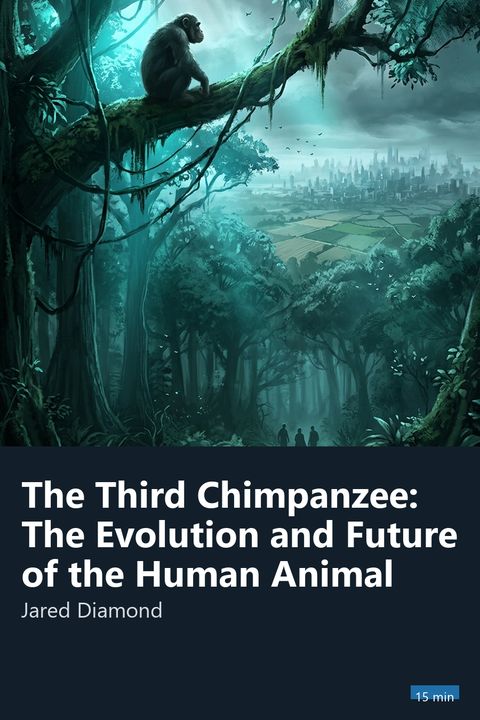
Cover of The Third Chimpanzee: The Evolution and Future of the Human Animal

Science · 15 min

The Third Chimpanzee: The Evolution and Future of the Human Animal

Jared Diamond · 1991

Who it's for

For anyone who has ever wondered, on a packed bus or while waiting in line at the bank, what exactly separates us from other animals. This tour of human evolution explains where language, adultery, agriculture, and the risk of wiping ourselves out came from.

Read it in the app

⚡ Free to download • 🎁 One full book free every day

🎧 Listen to this summary in the app

Every summary has audio narration. Open the app to read it or listen to it.

3 ideas to take with you

1

The difference between us and chimpanzees lies less in our genes than in what a few percentage points of difference let us build: cumulative language, culture, and technology.

2

Agriculture wasn't all progress: at several points in history, it traded dietary variety and health for larger populations and disease.

3

Our species' most distinctive trait is the ability to wipe out entire species, including our own. Reversing that starts with recognizing that we're one animal among many.

“
There's no anti-aging potion hidden in our genes: the body was optimized to function until reproduction, not to last.
An idea from The Third Chimpanzee: The Evolution and Future of the Human Animal, in the words of 15 Minutes

Preview

Start reading now

The Relative Who Shares 98.8% of Your Genes

The opening argument is simple: compare the DNA of humans, common chimpanzees, and bonobos, and the genetic divergence between us and each of them is approximately 1.6%. Based on that number, Diamond proposes putting all three species in the same genus, making humans the third chimpanzee. The title is deliberately provocative: it forces readers to confront just how much of an animal they still carry within themselves.

For perspective, the genetic differences between humans of different ethnic backgrounds are tiny, around a small fraction of 1%. Any two people, one from Japan and one from the American South, share more genes with each other than either shares with a chimpanzee. From a biological standpoint, race is a classification with very limited scientific value.

The conclusion that guides the rest of the book: if we're so genetically similar, the explanation for our dominance can't lie in DNA alone. It must lie in a small difference that a cultural event amplified.


The Great Leap: When Culture Hit the Gas

Between 50,000 and 100,000 years ago, something changed in anatomically modern humans. Before then, tools changed little over tens of thousands of years, with almost no innovation. Afterward came composite tools, art, ornaments, burials with objects, and long-distance trade routes. Diamond calls this moment the Great Leap Forward.

The hypothesis he finds most likely is that the leap came not from a redesigned brain but from a refinement in the capacity for language. Not a new language, but the ability to produce more varied sounds that could be linked together and passed on, allowing people to connect ideas, plan, and teach. Once cumulative speech became possible, culture began evolving faster than genes.

It's the same kind of shift in scale you know from everyday life: a group chat with 200 people shares information in hours that once would have taken weeks to spread by word of mouth. Efficient communication doesn't change people's hardware. It changes how quickly they can coordinate their efforts.

Why We Choose Partners Who Resemble Our Parents

An entire chapter explores how animals choose mates and what that reveals about us. Diamond argues that human sexual behavior bears strong evolutionary traces. One central concept is imprinting, the process by which an animal learns early on, usually in childhood, which traits are normal in a mate of its own species. Chicks that see a person during their first few days start following that person as though they were their mother.

In humans, imprinting affects mate preferences. The book cites a classic finding, the Westermarck effect: two people raised together from early childhood rarely feel attracted to each other as adults, even without biological kinship. Diamond uses this to explain why, as we grow up, we tend to look for something familiar in partners, partly because the people who raised us served as models.

The chapter also discusses adultery's role in our species' evolution, showing that, genetically speaking, strict monogamy is rarer than public morality suggests. This chapter is best read as a description of the animal origins of human patterns, not as moral permission for anything.

10 more sections and the quiz

Continue in the app

Read the whole summary, finish with the The Third Chimpanzee: The Evolution and Future of the Human Animal quiz and follow the guided Journeys. No ads in the app.

About Jared Diamond

Jared Diamond is a biologist, geographer, and professor emeritus at the University of California, Los Angeles. He studied physiology and spent decades researching birds in New Guinea. He is best known for Guns, Germs, and Steel, which won the Pulitzer Prize in 1998, and Collapse, about the downfall of societies. The Third Chimpanzee was published in 1991, before those two bestsellers.

Explore

Category:
Science