15 Minutes
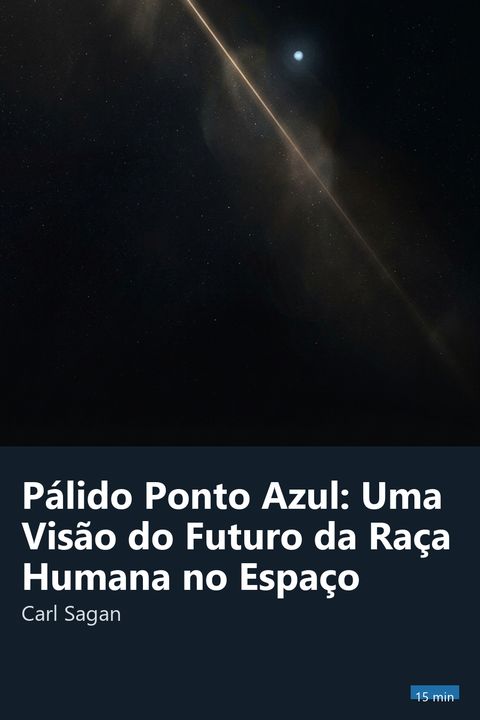
Cover of Pale Blue Dot: A Vision of the Human Future in Space

Science · 15 min

Pale Blue Dot: A Vision of the Human Future in Space

Carl Sagan · 1994

Who it's for

For anyone who has looked up at the sky during a blackout and felt both wonder and a dizzying sense of scale. Starting with a photograph of Earth taken from billions of kilometers away, the book explores our place in the universe and why humanity needs to look beyond our world.

Read it in the app

⚡ Free to download • 🎁 One full book free every day

3 ideas to take with you

1

A simple image of Earth as a pixel can change more minds than a stack of speeches about borders and rivalries.

2

Every generation that discovers it is less central than it imagined also gets a chance to become less arrogant.

3

If the technology that deflects an asteroid can also aim it at a city, who decides and who provides oversight become questions just as important as the engineering.

“
Anyone who doesn't keep all their savings in one account understands the book's argument: spreading our species across more than one world would spread the risk.
An idea from Pale Blue Dot: A Vision of the Human Future in Space, in the words of 15 Minutes

Preview

Start reading now

The Photograph the Probe Took Looking Back

The book begins with an image. In February 1990, Voyager 1, already beyond the region of the planets, turned its camera backward at Sagan's suggestion and photographed the Solar System from about six billion kilometers away. In one frame, Earth appears as a tiny speck smaller than a pixel, suspended in a beam of scattered light produced by the camera itself.

Sagan turned that image into the starting point for a reflection on scale. Everyone you know, every war, every soap opera, every emperor, and every soccer fan is on that pixel. The book asks you to pause for a few minutes and let your mind try to take that in.

The image gets its power from the feeling that there is no backup plan within reach. There is no other place, at least for now, where our species can live, and that fact changes how we weigh disputes over borders and wounded pride.


The Great Demotions: From the Center of the Cosmos to a Speck of Dust

Sagan traces the history of humanity's loss of its central status. Copernicus removed Earth from the center of the system. Then came the discovery that the Sun is an ordinary star in one galaxy among billions, followed by Darwin's idea that we are related to other animals. Each step was painful and met with resistance, sometimes violent.

The author argues that these demotions expanded humanity's horizons rather than diminishing our species. Knowing that the universe is immense and Earth is a small part of it strips away our self-importance and offers something more valuable: the ability to marvel at what is real, rather than what feels comfortable.

It's like discovering as a teenager that your street isn't the center of town and your town isn't the center of the country: it feels unsettling at first, but it opens up the entire map.

The Search for Life Out There and the Conversation About UFOs

Sagan enthusiastically supported the search for extraterrestrial intelligence, but he insisted on separating that serious research from stories about flying saucers. He examines accounts of abductions and sightings, showing how memory fails, how suggestion alters recollections, and how the desire to see something unusual produces testimony that is both sincere and mistaken.

His standard is what became famous as rigorous skepticism: extraordinary claims call for extraordinary evidence. Telling a fascinating story isn't enough; you need evidence someone else can check. He wasn't saying that extraterrestrials were impossible, only that the evidence wasn't yet on the table.

In practice, that lesson applies to rumors in the family group chat: before forwarding anything, ask what the evidence is, who checked it, and what else might explain it. It's a pocket-sized antidote to news that seems too good, or too frightening, to be true.

11 more sections and the quiz

Continue in the app

Read the whole summary, finish with the Pale Blue Dot: A Vision of the Human Future in Space quiz and follow the guided Journeys. No ads in the app.

About Carl Sagan

Carl Sagan was an American astronomer and science communicator, born in Brooklyn in 1934. He taught at Cornell University, worked on NASA space missions, including the Voyager probes, and won the 1978 Pulitzer Prize for The Dragons of Eden. His 1980 television series Cosmos made him famous around the world. He died in 1996.

Explore

Category:
Science