15 Minutes
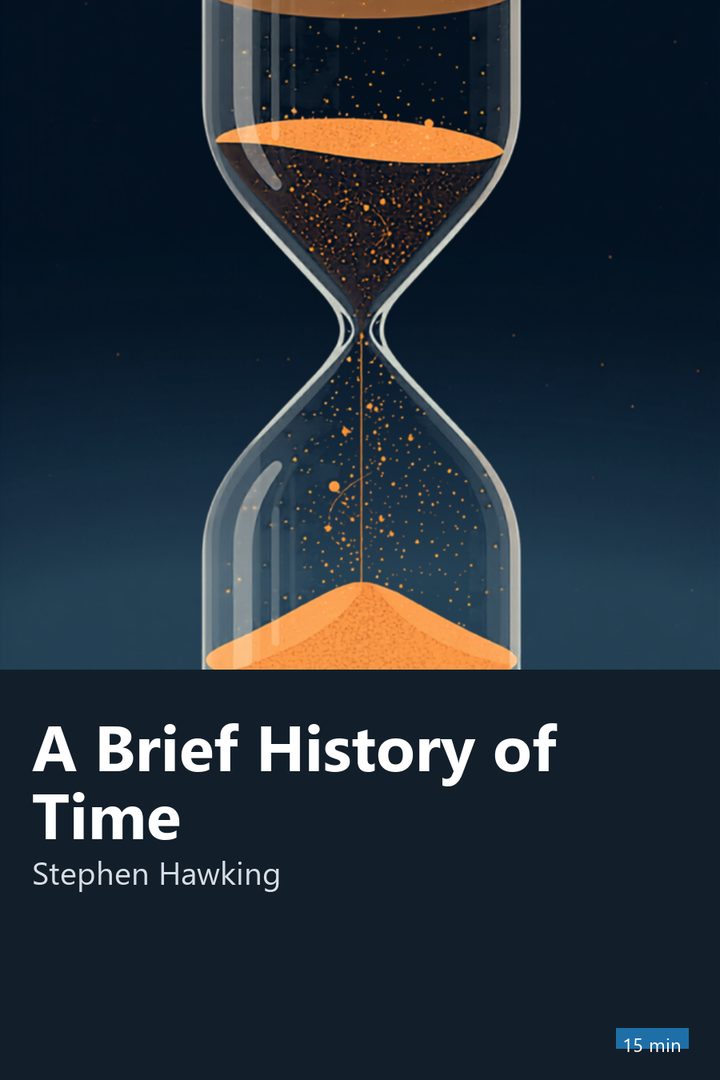
Cover of A Brief History of Time

Science · 15 min

A Brief History of Time

Stephen Hawking · 1988

Who it's for

For anyone who has ever looked up at the night sky and wondered how it all began, or who wants to understand what black hole and Big Bang really mean without memorizing a single formula. It also works for people who tried to read the original and got stuck halfway, and want a lighter path through the same ideas.

Read it in the app

⚡ Free to download • 🎁 One full book free every day

🎧 Audio coming soon in the app

Narration for the English summaries is on its way. Meanwhile you can read the full summary in the app.

3 ideas to take with you

1

Gravity is not a rope pulling two objects together. It is the space around a large mass becoming curved, guiding other bodies along.

2

Galaxies are not flying through empty space. The space between them is what keeps growing, like a ball of dough swelling with raisins in it.

3

We remember the past and not the future because disorder only grows in one direction, never undoing the road already traveled on its own.

“
A stopped clock in space does not exist. Every place in the universe runs at its own pace, depending on the speed and gravity there.
An idea from A Brief History of Time, in the words of 15 Minutes

Preview

Start reading now

A book more bought than read

A Brief History of Time spent years on the bestseller lists and became the classic example of the book everybody has on the shelf and few finish. If you got stuck halfway, that's nothing to be ashamed of, because the book mixes easy pages with others that call for a physics background most of us don't have.

Hawking wrote the book after decades as a respected physicist, at a time when he already spoke through a synthesizer attached to his wheelchair. He wanted to explain to the general public questions that used to circulate only among specialists.

This summary doesn't follow the order of the chapters. The idea here is to take the central questions, what space is, what time is, how the universe began, what exists inside a black hole, and explain each one with an image from your everyday life.


Space and time are not two separate things

We grow up thinking space is one thing, like the distance between your home and your job, and time is something quite different, like a clock ticking. Twentieth-century physics joined the two into a single structure called spacetime, and that merger changes the results of real calculations.

Think of a running app that shows your route on a map with the stopwatch running beside it. Separately, the map shows only where you've been, and the stopwatch only shows how much time has passed. Together, they tell a single story, the exact point where you were at each instant, which is more or less how physics treats spacetime.

This fusion explains why an event that looks simultaneous to one person may not look simultaneous to another, depending on how fast each one is moving. It's not an optical illusion. It's a real consequence of how spacetime behaves, confirmed in repeated experiments over more than a century.

Why there is no universal clock

Einstein's relativity, which Hawking uses as the foundation of the entire book, overturns the idea that a single clock ticks the same for the whole universe. Time passes at slightly different rates depending on the speed of whoever is measuring it and the strength of gravity where that person is.

One way to feel this firsthand, with no formulas at all, is to think of the GPS satellites your phone uses to find your location. Up there, far from Earth's strong gravity, their time runs a tiny bit faster than yours down here, a small difference, but big enough to throw off the map's location if nobody corrected the calculation every single day.

This isn't science fiction or a loose theory on paper. It's engineering that works in your pocket right now. If relativity were wrong, GPS would miss your position by miles after just a few hours, and that's not what happens.

12 more sections and the quiz

Continue in the app

Read the whole summary, finish with the A Brief History of Time quiz and follow the guided Journeys. No ads in the app.

About Stephen Hawking

Stephen Hawking was born in Oxford, England, in 1942, and was diagnosed with a degenerative motor neuron disease at 21, when he was still a physics student. Even as he gradually lost movement in his body and later his own voice, he pursued a career as a theoretical physicist at the University of Cambridge for decades, with important work on black holes and cosmology. A Brief History of Time was published in 1988 and sold millions of copies in dozens of languages, becoming one of the most famous science books ever written. Hawking died in 2018, at the age of 76.

Explore

Category:
Science
Part of the Journeys:
Science Curiosity