15 Minutes
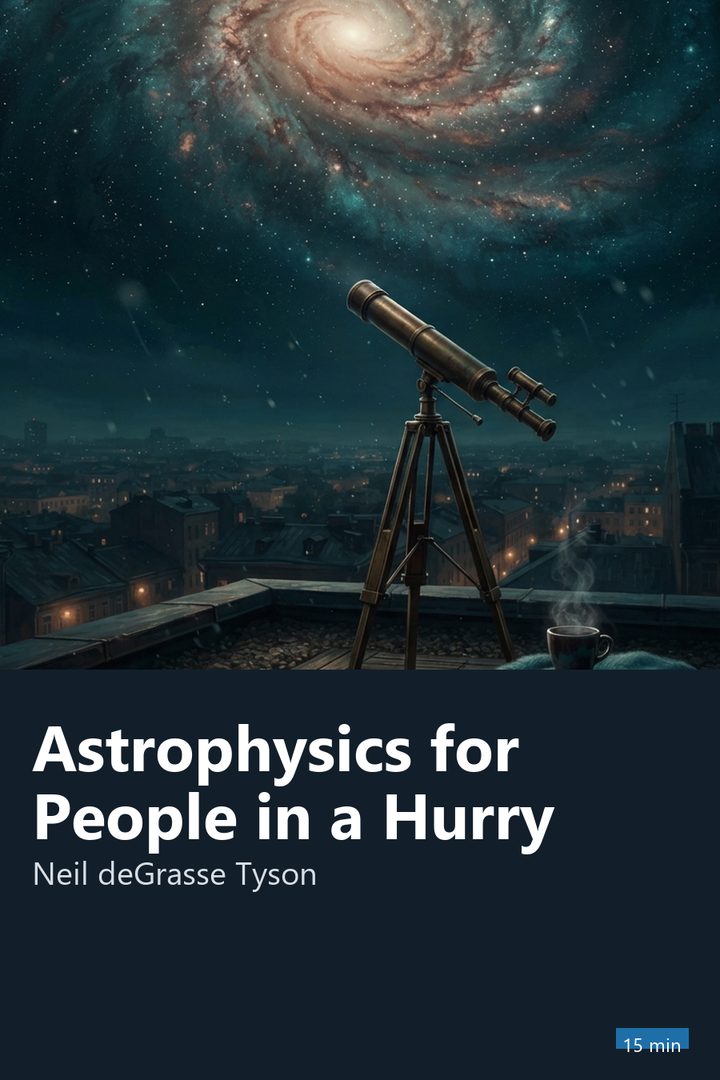
Cover of Astrophysics for People in a Hurry

Science · 16 min

Astrophysics for People in a Hurry

Neil deGrasse Tyson · 2017

Who it's for

For anyone curious about the universe who never had time to tackle a thick astronomy book. It works as a first doorway for readers who want to separate what science already knows from what is still a mystery, with no technical background needed.

Read it in the app

⚡ Free to download • 🎁 One full book free every day

🎧 Audio coming soon in the app

Narration for the English summaries is on its way. Meanwhile you can read the full summary in the app.

3 ideas to take with you

1

The same physical laws that hold in your neighborhood hold in any distant galaxy, and that consistency is what lets astronomers study stars far beyond the reach of any human trip.

2

Gravity treats all mass the same, pulling inward from every direction, and that even tug is what turns big planets and stars into spheres.

3

For the author, facing the real size of the universe should shrink the weight that everyday arguments and local disputes take on.

“
The oldest radiation in existence is still passing all around you right now, like a photograph of the universe taken when it was a small fraction of its current age.
An idea from Astrophysics for People in a Hurry, in the words of 15 Minutes

Preview

Start reading now

The biggest story ever told, in a few pages

Imagine summing up the origin of everything, from nothing until now, during a bus ride to work. That is the book's proposal: tell the story of the entire universe in short chapters, without pretending the subject is easy, but without dragging the reader along. According to scientific consensus, the universe is about 13.8 billion years old and began from an extremely hot, dense state that started expanding and cooling, a process called the Big Bang.

It was not an explosion in the middle of empty space, like a firework on the Fourth of July. It was space itself that began to stretch, carrying matter, energy and the count of time along with it. There is no center to point a finger at, because all of space was already contained in that initial state, too dense for atoms or any stars we would recognize today to exist.

The first instants: from a hot point to a whole universe

In the first instants after the Big Bang, the universe went through a phase of extremely fast expansion called cosmic inflation: in a fraction of a second much shorter than the blink of an eye, space stretched to many times its own size. This stretch is the most theoretical part of the book, reconstructed from models and indirect clues, not from a camera pointed at moment zero.

After inflation, the universe kept expanding at a slower pace and gradually cooled. In that cooling, protons, neutrons and the first light nuclei were born, hydrogen and helium, in a nucleosynthesis that lasted only a few minutes. It helps to separate what is consensus, the expansion and the gradual cooling, from what is still a research frontier, like the exact details of inflation.

The same laws hold here and in every corner of the cosmos

A simple and beautiful argument in the book: the same laws of physics that cool a beer at the neighborhood bar hold in a galaxy billions of light-years away. Gravity, electromagnetism and the behavior of light seem to work the same at any point in the observable universe.

This is not a philosophical detail, it is a working tool: by analyzing the light of a distant star you can tell what it is made of and how fast it is moving away, because each chemical element leaves a light signature that is always the same, whether it is in the Sun or in a star on the other side of the galaxy. It is like an electrician who rewires houses in any neighborhood without relearning the trade at every address: the rules don't change from street to street.

12 more sections and the quiz

Continue in the app

Read the whole summary, finish with the Astrophysics for People in a Hurry quiz and follow the guided Journeys. No ads in the app.

About Neil deGrasse Tyson

Neil deGrasse Tyson is an American astrophysicist with a PhD in astrophysics from Columbia University. Since 1996 he has directed the Hayden Planetarium, part of the American Museum of Natural History in New York. In 2014 he hosted the new version of the series Cosmos, picking up the work Carl Sagan began decades earlier. Astrophysics for People in a Hurry was published in 2017.

Explore

Category:
Science
Part of the Journeys:
The Universe Made Simple