15 Minutes
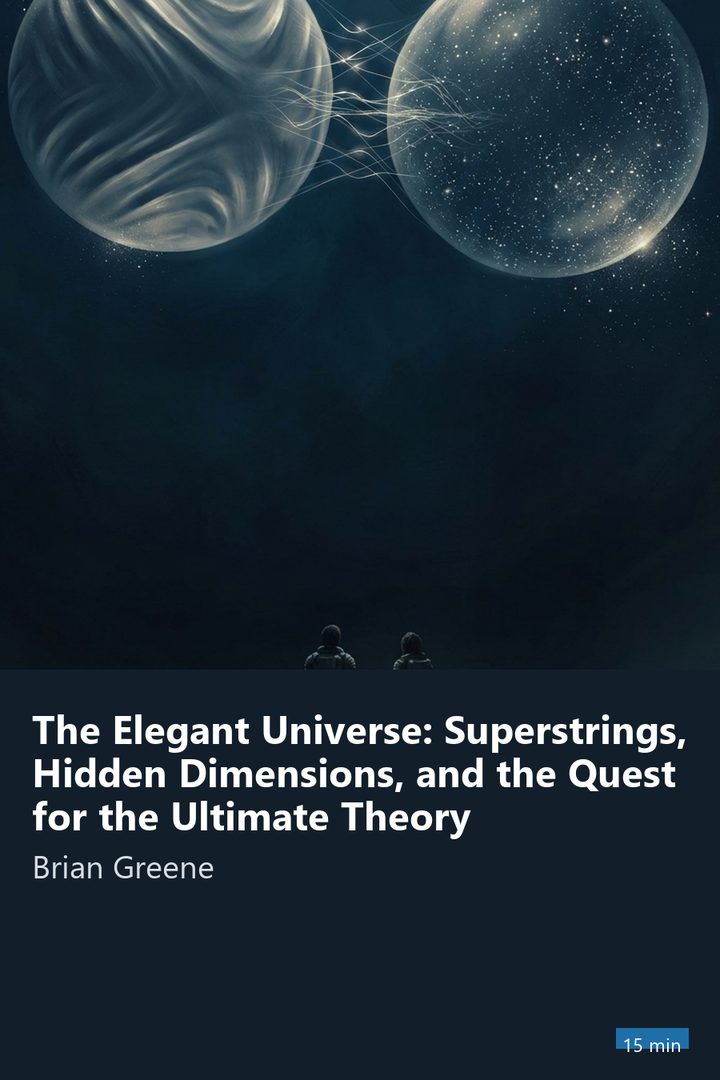
Cover of The Elegant Universe: Superstrings, Hidden Dimensions, and the Quest for the Ultimate Theory

Science · 16 min

The Elegant Universe: Superstrings, Hidden Dimensions, and the Quest for the Ultimate Theory

Brian Greene · 1999

Who it's for

For anyone who wants to understand what the universe is made of without needing a single formula, just the curiosity to take on big ideas calmly. It's also for readers who have already read about black holes or the Big Bang and want to know why physicists are still searching for a theory that joins the two halves of physics.

Read it in the app

⚡ Free to download • 🎁 One full book free every day

🎧 Audio coming soon in the app

Narration for the English summaries is on its way. Meanwhile you can read the full summary in the app.

3 ideas to take with you

1

The two best-tested theories in physics, the one about gravity and the one about the quantum world, agree on almost everything, except what happens inside a black hole or at the instant the universe was born.

2

For string theory, an electron and a photon wouldn't be fundamentally different things: they would be the same tiny string of energy vibrating in different notes.

3

In Greene's telling, two string theories that seemed to be rivals turned out, thanks to the discovery of dualities, to be the same physics told by two different narrators of the same game.

“
When two correct calculations, done together, return an infinite number, physics doesn't celebrate: it knows some piece of the puzzle is still missing.
An idea from The Elegant Universe: Superstrings, Hidden Dimensions, and the Quest for the Ultimate Theory, in the words of 15 Minutes

Preview

Start reading now

Two perfect theories that don't talk to each other

The 20th century left physics with two extraordinary theories: general relativity, from Einstein, which describes gravity on a gigantic scale, and quantum mechanics, which describes the world of atoms and of particles smaller than an atom. Each one, on its own, is the best-tested theory science has ever produced, and in more than a hundred years no experiment has been able to contradict either of them.

The problem shows up when someone tries to combine the two calculations in a situation where gravity gets strong and space gets tiny at the same time, like inside a black hole or at the instant the universe began: the math of the two theories refuses to work together, and the calculation spits out infinity. It's like having two perfect apps on your phone that crash the device when you open them together. Brian Greene's book tells the story of a candidate to resolve this standoff.
Einstein and elastic space-time

Before getting to strings, the book reconstructs what relativity has already solved. Einstein showed, in special relativity, that space and time aren't fixed: they depend on how fast you're moving. Ten years later, in general relativity, he took the bigger step: gravity is not a force pulling from a distance, as people had thought since Newton, but the effect of mass curving space-time around it.

A simple way to picture it: a stretched trampoline with a bowling ball sinking into the fabric; a marble rolling nearby isn't pulled by any invisible rope, it just follows the curve of the fabric. That's how the Sun holds the Earth in orbit. This idea has been confirmed many times over, including by the GPS in your phone, which has to correct the satellites' clocks because of this curvature of space-time. The problem is what happens when this same physics has to deal with the scale of an atom.

The strange world down below

While relativity takes care of the very large, quantum mechanics takes care of the very small and behaves in a way that makes no sense to an intuition trained in the visible world. An electron has no definite position before it's measured: it exists as a cloud of probabilities until the moment someone observes it. Another hallmark of this theory is the uncertainty principle: the more precisely you know a particle's position, the less you know about its speed, and vice versa, a feature of nature itself, not of the measuring instrument.

It's like photographing someone running through a packed neighborhood party: focusing on the face blurs the motion, and no better camera fixes that, because the mess is in the reality of that scale itself. This randomness bothered Einstein himself, but the experimental record, repeated in labs around the world, confirms this probabilistic behavior with no known exception to this day. It's established consensus, not an open hypothesis.

11 more sections and the quiz

Continue in the app

Read the whole summary, finish with the The Elegant Universe: Superstrings, Hidden Dimensions, and the Quest for the Ultimate Theory quiz and follow the guided Journeys. No ads in the app.

About Brian Greene

Brian Greene is an American theoretical physicist and a professor of physics and mathematics at Columbia University in New York. He earned his doctorate at the University of Oxford as a Rhodes Scholar and is one of the best-known voices in popularizing string theory. In 2008 he cofounded, with Tracy Day, the World Science Festival, an annual event that brings science to the public in New York. The Elegant Universe, originally published in 1999, was his first major popular science book and was also turned into a documentary series.

Explore

Category:
Science
Part of the Journeys:
The Universe Made Simple