15 Minutes
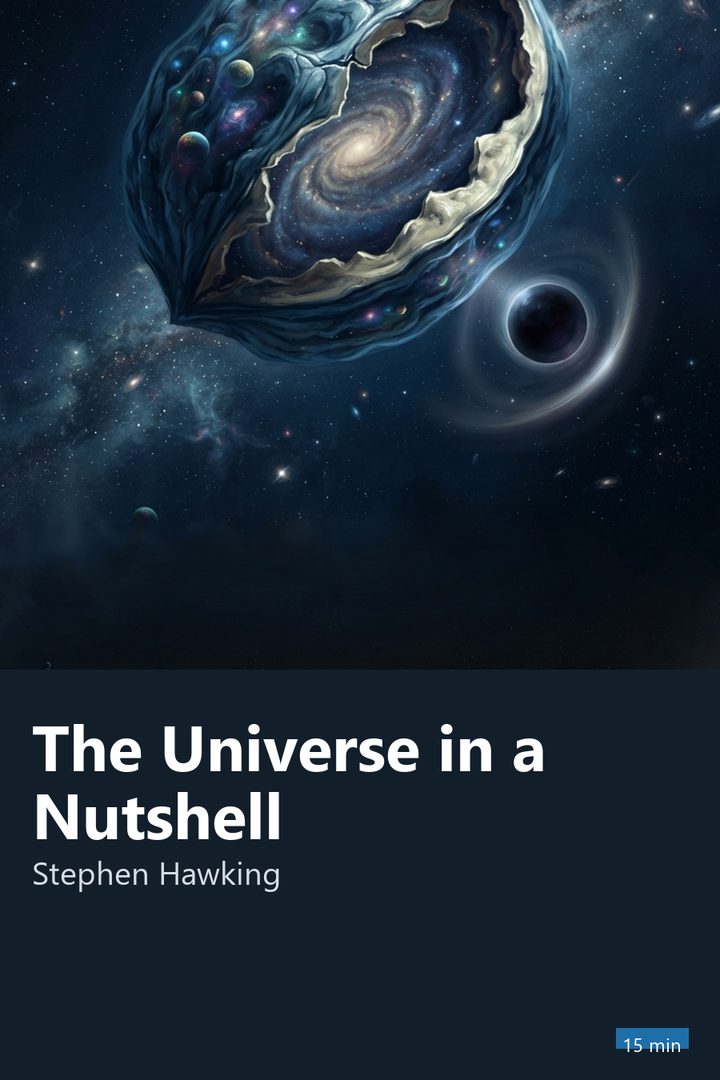
Cover of The Universe in a Nutshell

Science · 15 min

The Universe in a Nutshell

Stephen Hawking · 2001

Who it's for

For anyone who has heard about black holes, the Big Bang, or time travel in a video or a conversation and wants to understand the idea behind those terms without a single formula. It's also for people who started A Brief History of Time, got stuck halfway, and want a second shot with the same curiosity.

Read it in the app

⚡ Free to download • 🎁 One full book free every day

🎧 Audio coming soon in the app

Narration for the English summaries is on its way. Meanwhile you can read the full summary in the app.

3 ideas to take with you

1

According to Hawking's theoretical prediction, not yet directly observed, quantum effects make a black hole slowly give off radiation: even the darkest object in the universe wouldn't be completely black.

2

In 2001, Hawking saw a dead end in predicting the future, because information that fell into a black hole seemed to vanish; in 2004 he changed his mind.

3

According to M-theory, still without experimental confirmation, our entire universe could be one membrane among many others, almost touching its neighbors without us ever noticing.

“
In Hawking's proposal, treating time as just another direction of space turns the beginning of the universe into a smooth edge, without the point where all the math breaks down.
An idea from The Universe in a Nutshell, in the words of 15 Minutes

Preview

Start reading now

A book written for people who got stuck on the last one

In 1988 Hawking published A Brief History of Time and sold millions of copies, becoming a worldwide phenomenon even among people who had never opened a physics book. The problem is that plenty of people bought it, started reading, and got stuck somewhere in the middle, and the bookmark is probably still there today.

The Universe in a Nutshell, from 2001, was born from that realization. Hawking tries again, this time with far more illustrations and less running text per page, to tell what has changed in theoretical physics since the first book, and to face head-on topics he had only scratched before: time travel, black holes that give off radiation, and the possibility of more universes beyond our own.

It's like that thick book you bought to decorate the shelf and impress guests: the desire to understand was real, it just needed a format that helped you actually turn to the next page.
Einstein removed time from its post as universal judge

Before Einstein, common sense imagined a single time, the same for everybody, like a giant clock marking the official hour for the whole universe. General relativity, which the book revisits right in the first chapter, knocks that idea down: space and time form one fabric, spacetime, which bends near large masses and runs at a different pace depending on the speed and gravity of each place.

One tool the book uses to visualize this is the light cone: a drawing that shows, for each point in spacetime, everything it can influence in the future and everything that could have influenced it in the past. Nothing travels faster than light, so nothing escapes that cone, not even a radio signal.

It's similar to your cell signal dropping when the bus enters a tunnel: there's an exact moment when contact is lost, because you've left the range. In spacetime that range also has a limit, and it reorganizes the idea of "now" that old physics took for granted.

Time has a shape, and it can be imaginary

One of the most debated points in the book is the proposal of imaginary time, developed by Hawking with physicist Jim Hartle: a mathematical trick that treats time, inside the calculation, as if it were just another direction of space, rather than a straight line with a marked starting point.

The reason is to solve an annoying problem: if you wind the clock back to the beginning of the universe using ordinary math, the equations of general relativity break down at a point of infinite density, called a singularity, where physics stops making sense. By treating time as space, that beginning becomes a smooth edge, like the South Pole on a globe: you can walk right up to it and keep walking, without falling off the edge of a map that doesn't actually exist.

It's a mathematical tool tested more for internal consistency than by experiment, and the book itself treats the subject as a proposal, not a settled fact.

11 more sections and the quiz

Continue in the app

Read the whole summary, finish with the The Universe in a Nutshell quiz and follow the guided Journeys. No ads in the app.

About Stephen Hawking

Stephen Hawking (1942-2018) was a British theoretical physicist who held the Lucasian Professorship of Mathematics at Cambridge for thirty years, the same post Isaac Newton had held centuries earlier. Diagnosed young with amyotrophic lateral sclerosis, a degenerative disease that gradually took his movement and later his voice, he kept researching and teaching with the help of a speech synthesizer controlled by a sensor on his cheek. Already the author of A Brief History of Time, a worldwide hit in 1988, he published The Universe in a Nutshell in 2001, trying to explain, with more pictures and less running text, what had changed in theoretical physics since then.

Explore

Category:
Science
Part of the Journeys:
The Universe Made Simple