15 Minutes
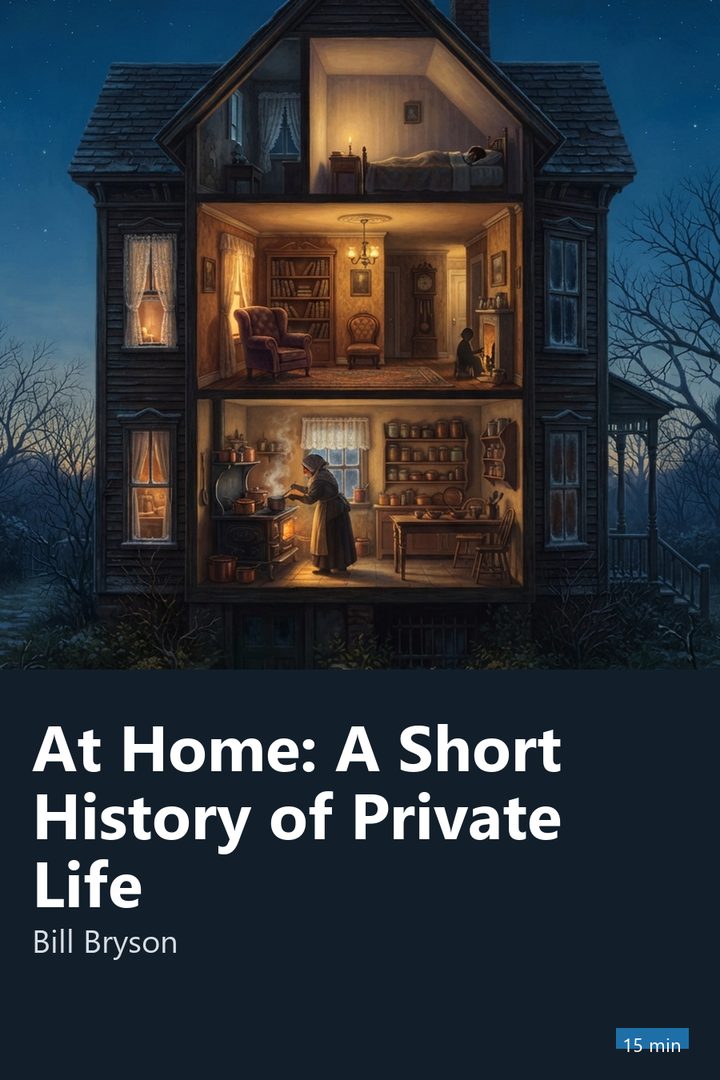
Cover of At Home: A Short History of Private Life

Science · 15 min

At Home: A Short History of Private Life

Bill Bryson · 2010

Who it's for

For people who like history told from behind the scenes, through everyday objects, and who enjoy picking up fun facts without having to memorize dates or complicated names.

Read it in the app

⚡ Free to download • 🎁 One full book free every day

🎧 Audio coming soon in the app

Narration for the English summaries is on its way. Meanwhile you can read the full summary in the app.

3 ideas to take with you

1

When the English government taxed windows, whole families bricked up openings in their walls, trading light and air for savings, a reminder that every tax changes behavior, not just budgets.

2

Bryson reports, drawing on historians, that in many eras sleeping in two blocks, with a stretch awake in the middle of the night, seemed to be common, a reading that still sparks debate.

3

The discovery that cholera came from contaminated water, and not from the air as people believed, only happened when someone had the patience to map cases one by one on a single street, proof that organized data solves more than loose guesswork.

“
For much of history, a pinch of salt decided whether a family ate fresh meat or rotten meat, and that explains why it was once worth more than gold on certain trade routes.
An idea from At Home: A Short History of Private Life, in the words of 15 Minutes

Preview

Start reading now

1851: the year a house became a pretext for everything

Bryson picks 1851 as his starting point because it was the year the old rectory where he lives, in Norfolk, England, was built to house a parson of the Church of England. It is also the year of the Great Exhibition, held in London inside the Crystal Palace, a gigantic building of iron and glass designed by Joseph Paxton to show the world the inventions and products of the time.

The exhibition drew millions of visitors in a single summer, and became a symbol of a moment when ordinary domestic life was about to change fast: better light, food that kept longer, bigger houses, and more objects inside the home than any earlier generation could have imagined piling up.

That contrast drives the whole book: the author uses his own house, room by room, as an excuse to tell the story of ordinary things like salt, soap, mattresses and electrical outlets, things we use every day without ever asking where they came from, or how much work, and sometimes how much suffering by others, it took to get them here.


The hall: how the house stopped being a single room

Originally, the ordinary English house had no separate rooms: an entire family, along with the servants, lived, ate and slept in a single great room called the hall, around a central fire. Privacy was not an idea that made sense to most people until centuries later.

Little by little, those with money began dividing the house into rooms with defined purposes: one place just for eating, another just for sleeping, another for receiving guests. The hall, once the whole house, shrank until it became just the entryway we know today, a passageway instead of the center of family life.

This division into rooms seems obvious to people who have lived that way for generations, but it is a recent invention on the scale of human history, and along with it changed the very idea of what private life inside a home means.

The kitchen: from slow fire to imported ice

Before the refrigerator, preserving food was a daily and risky job: meat spoiled fast, milk soured in hours, and much of the kitchen routine revolved around stretching the shelf life of what was already in the house, with salt, smoking or pickling in vinegar.

Ice became a luxury item and then big business: in the 19th century, an American entrepreneur began cutting blocks of ice from frozen lakes in Massachusetts and shipping that ice, wrapped in sawdust, to places as far away as the Caribbean and India. It became one of the most profitable export businesses in the United States of that century, decades before the electric refrigerator existed.

Spices like pepper, cinnamon and cloves also arrived from far away, carried along entire trade routes built just to bring seasoning to the European table, in an era when keeping food from spoiling was worth as much work as producing it.

11 more sections and the quiz

Continue in the app

Read the whole summary, finish with the At Home: A Short History of Private Life quiz and follow the guided Journeys. No ads in the app.

About Bill Bryson

Bill Bryson was born in Des Moines, Iowa, in 1951, and moved to England as a young man, where he spent most of his adult life. At Home grew out of his curiosity about his own residence, a former Victorian rectory built in 1851 in a village in Norfolk. Between 2005 and 2011, Bryson served as chancellor of Durham University in England, a symbolic post given to prominent public figures. At Home was originally published in 2010 and became one of the biggest bestsellers of the author's career.

Explore

Category:
Science
Part of the Journeys:
Science Curiosity